
Note: The original version of this article, published on 1 December 2021, was based on fuel price adjustments announced by the Department of Mineral Resources and Energy (DMRE) on 29 November. On 1 December, the DMRE made changes to these adjustments. This article was revised on 2 December 2021 to reflect these changes. Fuel prices read more »
According to the Quarterly Labour Force Survey (QLFS) for the 3rd quarter of 2021, the number of employed persons declined by 660 000 to 14,3 million compared to the 2nd quarter of 2021. The decline in employment is coupled with a decline in the number of unemployed persons to 7,6 million from 7,8 million, resulting in read more »

The annual change in the consumer price index (CPI) in October 2021 was 5,0%, unchanged from the 5,0% recorded in September. The monthly rate also held steady, remaining at 0,2%. Food and non-alcoholic beverages (NAB) and transport were the most significant contributors to both the annual and monthly rates. Annual food inflation slows for a read more »
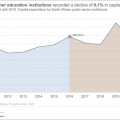
A simple picture can tell a striking story. The bell-shaped chart below shows the rise and subsequent decline of South African public-sector infrastructure investment. Capital expenditure represents the money that is spent on construction, machinery, equipment, land, buildings and other fixed assets. This form of investment has an impact on communication, travel, logistics and the read more »
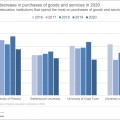
The COVID-19 pandemic and subsequent lockdown restrictions in 2020 impacted the finances of higher education institutions. There was a subdued increase in revenue, stifled by a decline in the collection of tuition fees. Higher education institutions spent less money, largely on the back of lower operational costs. Total revenue increased, but only marginally The amount read more »
Data Story 25 October 2021 100 Day Countdown to the total count of the population in South Africa, Census 2022 The 100 Day Countdown to Census Night of the next population count, Census 2022, starts on 25 October 2021. The night of 2 February 2022 will be the reference point on which everyone read more »

Introduction In September 2021, Statistics South Africa (Stats SA) implemented new samples for the following monthly surveys: P3041.2 – Manufacturing: Production and sales; P6141.2 – Wholesale trade sales; P6242.1 – Retail trade sales; P6343.2 – Motor trade sales; P6410 – Tourist accommodation; P6420 – Food and beverages; and P7162 – Land transport. New samples for read more »
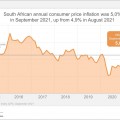
Annual consumer price inflation edged slightly higher to 5,0% in September from 4,9% in August and 4,6% in July. This represents the fifth consecutive month with annual inflation above the 4,5% midpoint of the South African Reserve Bank’s monetary policy target range. The monthly change in the consumer price index (CPI) was 0,2%. Transport, food read more »
As stipulated in Treasury Instruction No 11. of 2021, and in the interests of transparency, Statistics South Africa (Stats SA) has published information related to PPE procurement by the department for the period March 2020 and ongoing, on its website. The information can be accessed here . This information will be updated on a monthly read more »

Provincial government plays a vital role in the administration of the country’s health and education systems, responsible for providing basic education to learners and healthcare to those in need. These two mammoth tasks take up the bulk of provincial government spending. In the 2019/20 fiscal year, total provincial government expenditure was R628,8 billion. Education was the read more »