
After six consecutive quarters of growth, the South African economy stalled in the second quarter (April–June) of 2026, weakening by 0,2%.1 Mining, trade and manufacturing drove down economic activity on the production (supply) side of the economy, while a sharp rise in imports and subdued investment constrained growth on the expenditure (demand) side.
Three industries record losses
Figure 1 below shows how industries on the production side of the economy performed in the second quarter. Mining activity contracted by 3,0%, led by declines in the production of platinum group metals, manganese ore, gold and iron ore.
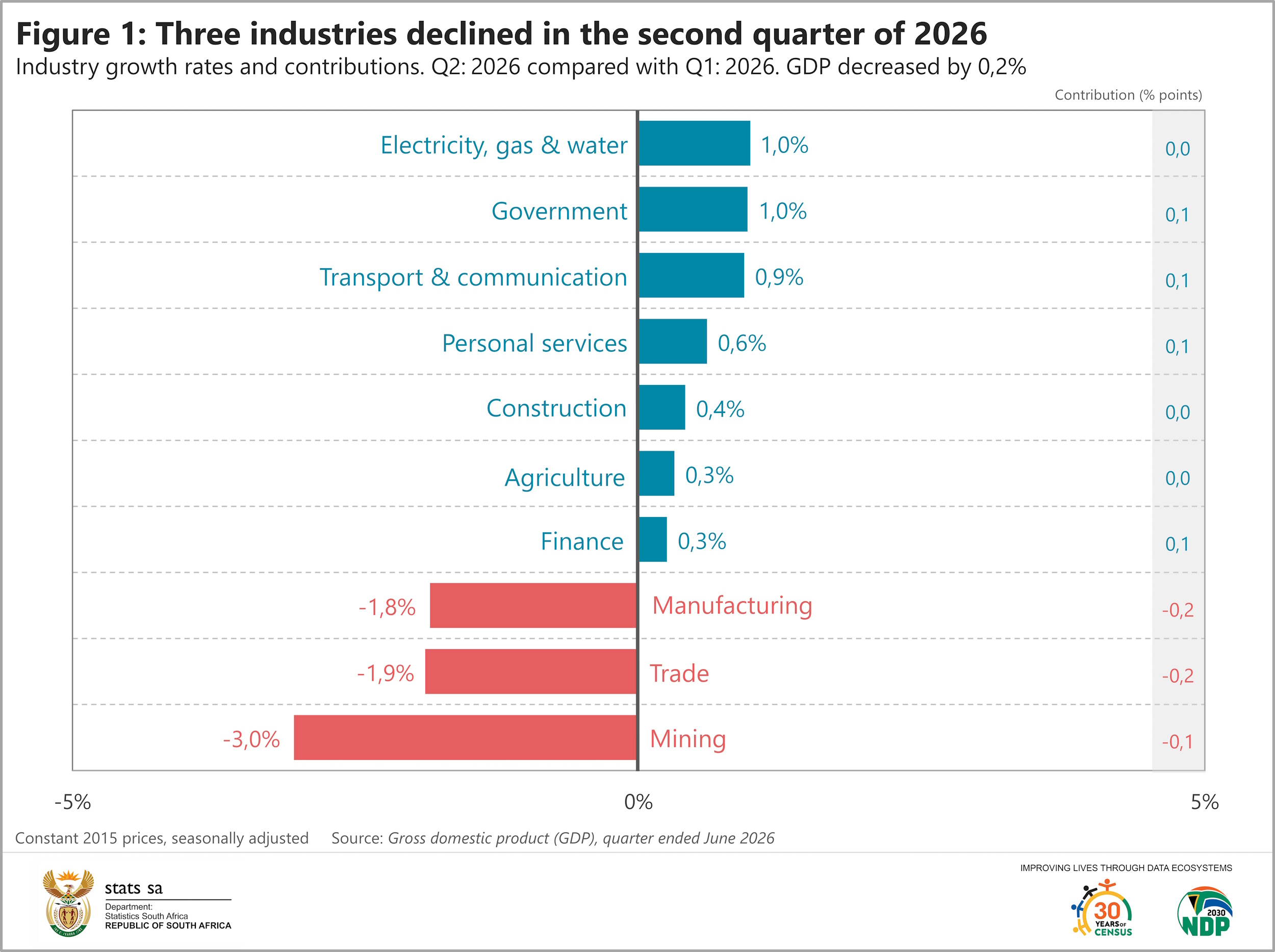
Following six straight quarters of growth, the trade industry wobbled in the second quarter, shrinking by 1,9%. This was due to a decline in wholesale trade, motor trade and the food & beverages industry. Consumer activity remained relatively upbeat, reflected in stronger retail trade and accommodation. Motor trade was dragged lower by softer fuel sales, but new vehicle sales continued to strengthen.
The manufacturing industry recorded its third consecutive decline. Seven of the ten manufacturing divisions recorded negative growth rates, with food & beverages; furniture & ‘other’ manufacturing; and basic iron and steel, non-ferrous metal products, metal products and machinery the largest negative contributors.
Seven industries were stronger in the second quarter, but their upward momentum was not enough to lift overall growth into positive territory. Transport & communication expanded by 0,9%, driven higher by a rise in land transport. Construction grew for a second straight quarter, registering increases in residential and non-residential buildings. Agriculture recorded its seventh consecutive increase, with the production of horticultural products and field crops rising.
Stronger imports constrain growth
Imports rose sharply by 4,9% in the second quarter, largely influenced by increased trade in machinery & electrical equipment and mineral products. Exports expanded by 0,9%, led by higher exports of pearls, precious & semi-precious stones and precious metals (see Figure 2 below).
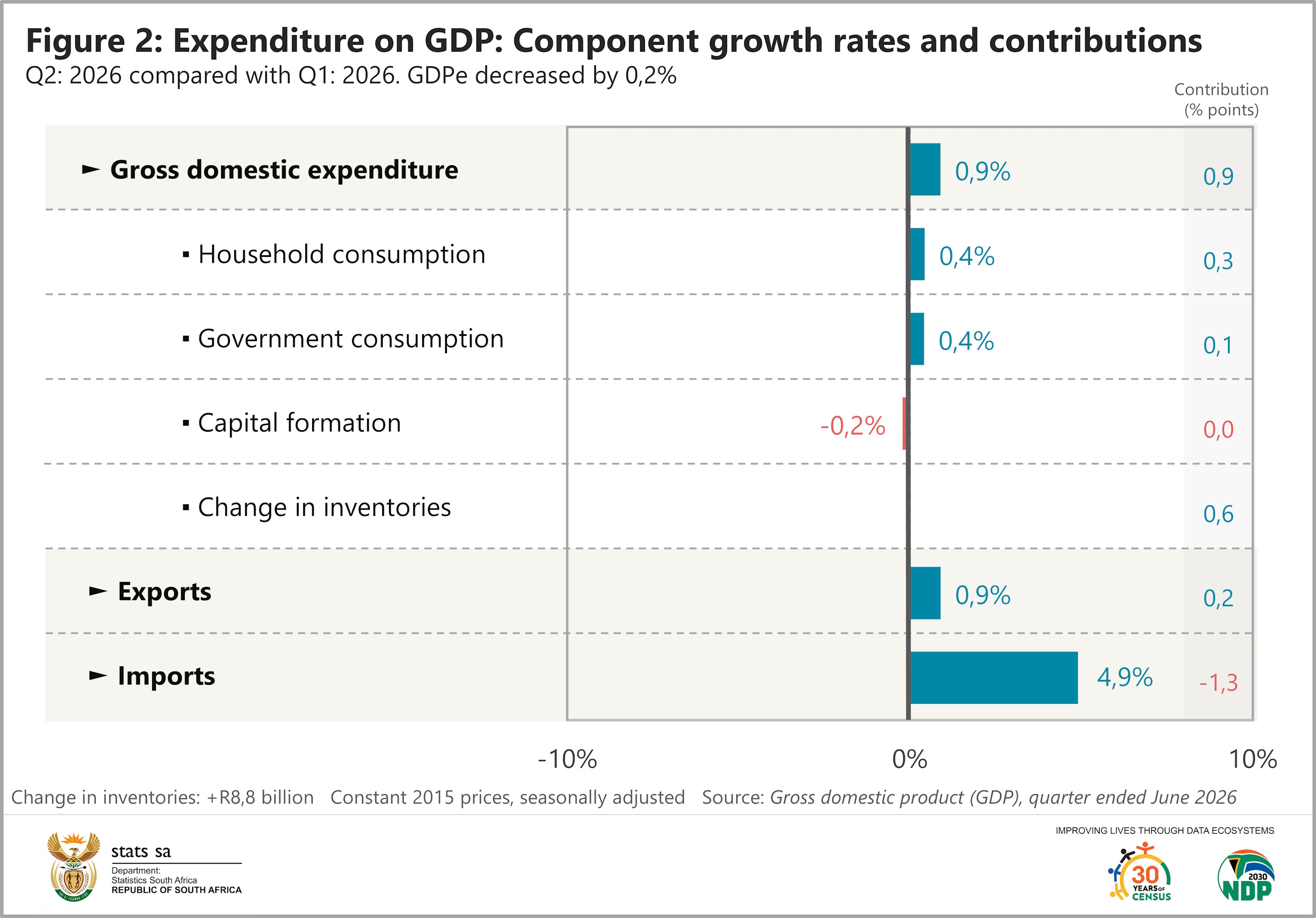
Capital formation (i.e. investments in infrastructure and other fixed assets) declined for a second consecutive quarter, with construction works and transport equipment the largest negative contributors. Public corporations and private business enterprises pulled back on capital formation in the second quarter. General government, on the other hand, recorded an increase.
Household consumption expenditure grew by 0,4%. Consumers spent more on a range of items, with the highest increases recorded for food & non-alcoholic beverages; alcoholic beverages, tobacco & narcotics; and restaurants and hotels. This is in line with the rise in retail trade and accommodation on the production side of the economy.
The second quarter recorded a net build-up in inventories of R8,8 billion. Although trade and manufacturing produced less in the second quarter, essentially reducing supply, the two industries added to their stockpiles in response to lower demand. The personal services industry also contributed positively. Six industries, however, drew from their stockpiles. Mining was the most notable, withdrawing inventories valued at R10,9 billion.
For more information, download the gross domestic product (GDP) for the quarter ended June 2026 release, media presentation and Excel files here.
1 The quarter-on-quarter rates are seasonally adjusted and in real (volume) terms (constant 2015 prices).
Similar articles are available on the Stats SA website and can be accessed here.
For a monthly overview of economic indicators and infographics, catch the latest edition of the Stats Biz newsletter here.