
South Africa’s latest labour market results show that the unemployment rate fell to 31,9% in the third quarter of 2025, down by 1,3 percentage points from the previous quarter. While the decline in the official rate is encouraging, Statistics South Africa (Stats SA) says there’s more to understanding the world of work than this single figure.
From the third quarter of 2025, the Quarterly Labour Force Survey (QLFS) introduces several methodological updates to align South Africa’s labour statistics with the latest international standards. These updates are based on new recommendations from the International Conference of Labour Statisticians (ICLS) — the global body that sets standards and guidelines for how countries collect and report labour statistics.
Among the most significant changes is the introduction of a new framework for labour underutilisation, which provides a more complete picture of people’s connection to the labour market.
What Has Changed — and Why It Matters
The QLFS publication has now been revised to include additional measures of labour underutilisation based on the 19th ICLS resolutions on statistics on work, employment and labour underutilisation. While these updates do not change the definition of employment or unemployment, they enhance how other forms of work and labour market participation are measured and are able to respond to different user needs. This means the headline unemployment rate remains comparable to previous quarters, and new measures offer a deeper understanding of the working age population that is underutilised.
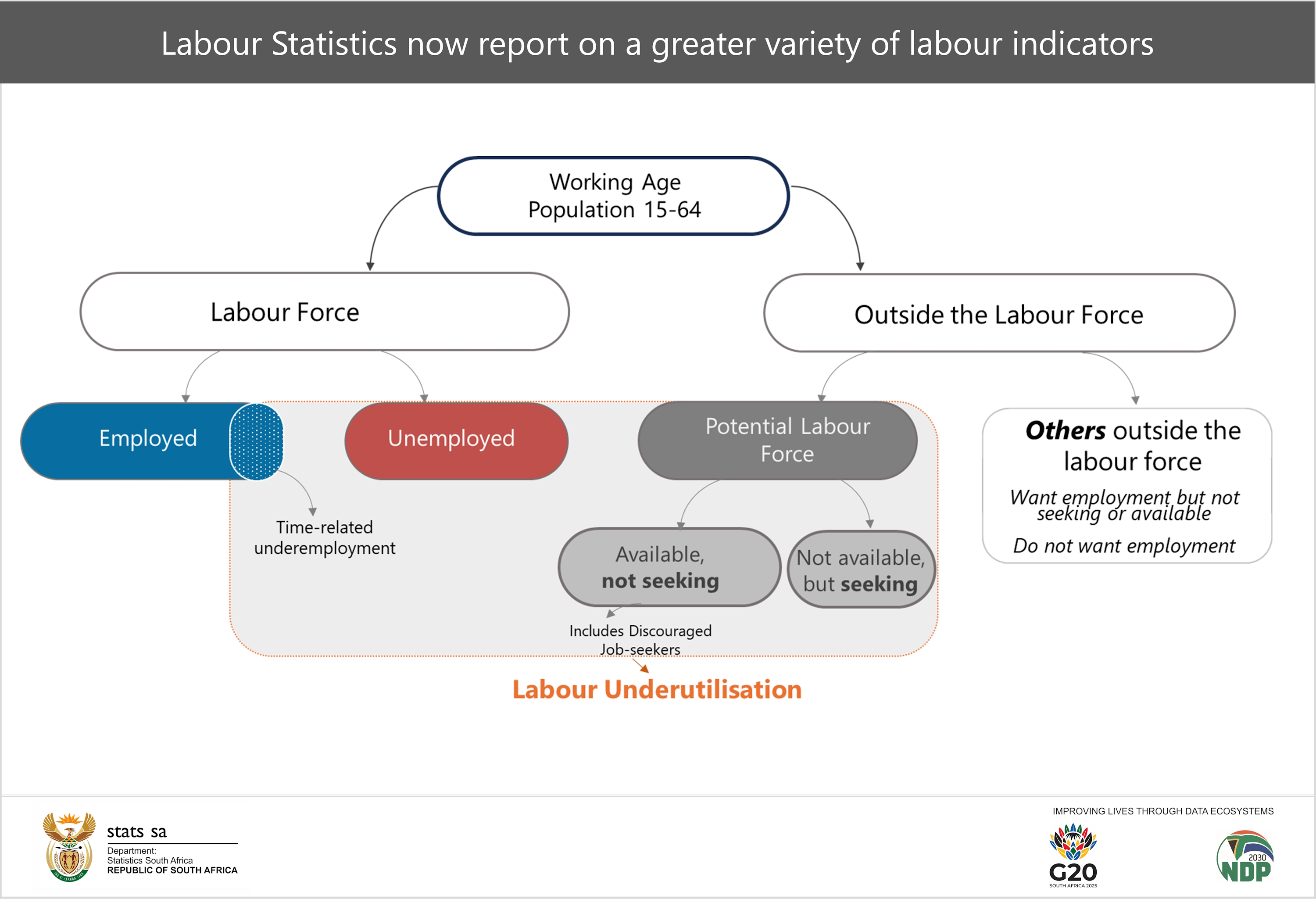
One important terminology change is that the category previously known as “Not Economically Active” has been replaced with the more internationally recognised term “Outside of the Labour Force.” Within this group, a new classification — the “Potential Labour Force” — has been introduced. This includes people who want to work but are either not actively looking for a job or not currently available to start work as well as the discouraged jobseekers.
Similarly, the definitions of the informal sector and informal employment have been updated to align with international recommendations (i.e. 21st ICLS on statistics on informal economy). Stats SA cautions that figures for these categories in Q3:2025 should not be compared with earlier estimates, since they are now measured differently.
These changes form part of Stats SA’s ongoing effort to ensure that South Africa’s labour data remain credible, relevant and internationally comparable, providing policymakers and the public with a clearer and more internationally comparable view of the labour market.
Introducing the Labour Underutilisation Measures (LU1–LU4)
To better reflect the complexity of the labour market, Stats SA now reports on a set of indicators known as Labour Underutilisation (LU) measures. These go beyond the traditional unemployment rate to capture other ways people can be underused in the economy.
LU1 is the official unemployment rate — those without work but actively looking and available to start work.
LU2, combines unemployment with time-related underemployment, referring to people who are working fewer hours and are available for more work.
LU3 combines unemployment with the potential labour force — people who want to work but are not actively seeking or not available to start and those that are not seeking but are available.
LU4 is the composite measure of labour underutilisation, combining all three groups: unemployed, underemployed and potential labour force.
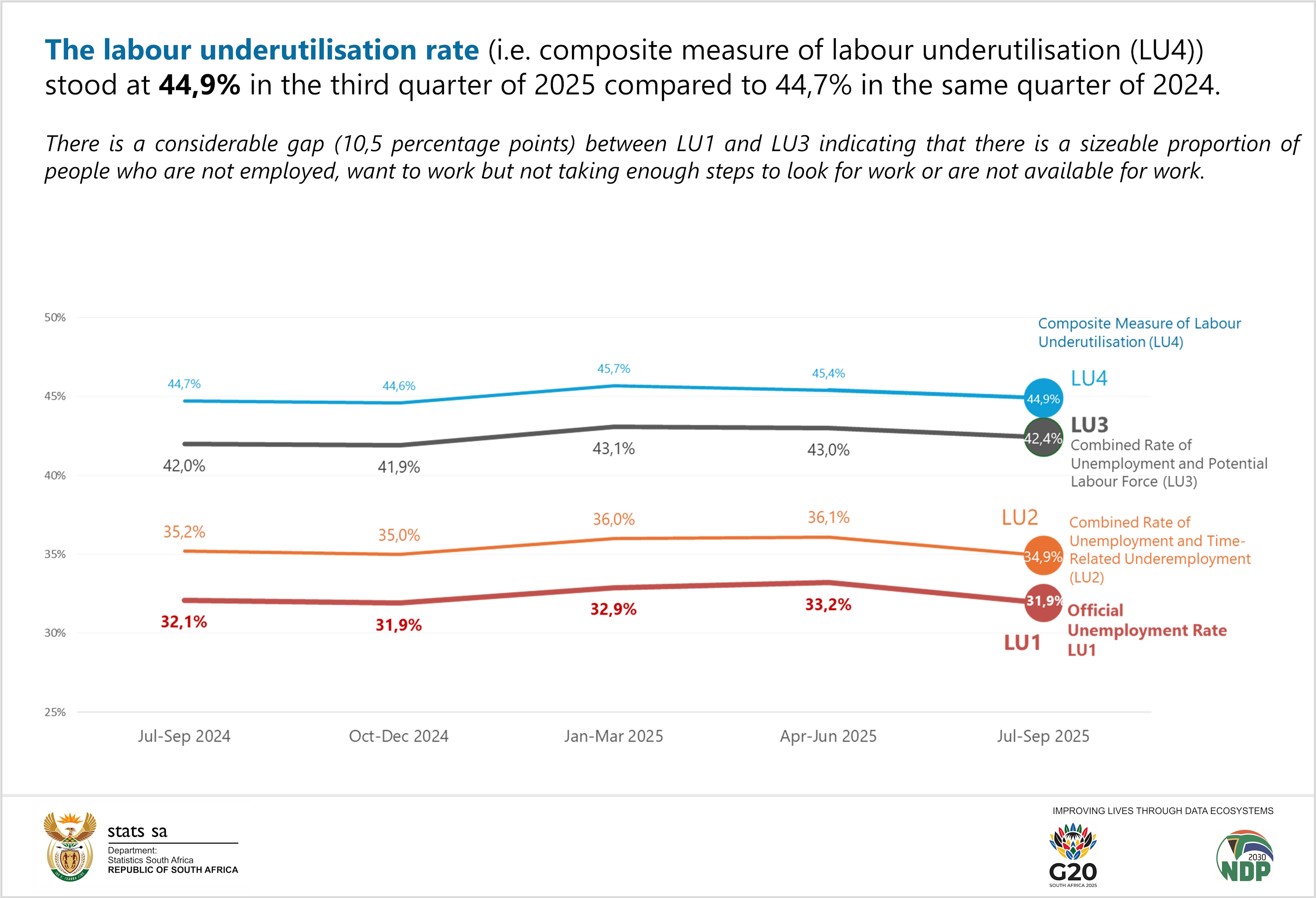
In the third quarter of 2025, the LU2 rate was 34,9%, down by 1,2 percentage points from the previous quarter.
The LU3 rate declined by 0,6 of a percentage point to 42,4%, and the LU4 rate stood at 44,9%.
There were 13,3 million underutilised persons in South Africa during Q3:2025. Of these, 8,0 million were unemployed, 4,5 million were in the potential labour force, and 747 000 were in time-related underemployment.
Understanding the New Potential Labour Force (LU3) Rate
Until Q2:2025, Stats SA reported an expanded unemployment rate, which included discouraged jobseekers. From Q3:2025, a new indicator LU3 has been reported, which is conceptually similar to the expanded unemployment rate but slightly broader — it includes both discouraged jobseekers and non-job seekers who were available for other reasons and job seekers who were not available during the reference period.
The expanded unemployment rate in Q2:2025 was 42,9%, while the LU3 rate for Q3:2025 is 42,4%. The close alignment between these figures shows continuity, but the LU3 measure allows for a more complete view of those marginally attached to the labour market.
The difference between the official unemployment rate (LU1) and LU3 — a gap of 10,5 percentage points — highlights that a significant share of South Africans want to work but are not actively looking for work or are not unavailable.
Who Is Most Affected? Women and Youth
The challenge of labour underutilisation is not experienced equally across all socio-economic groups. The data show that women and young people are the most affected.
For men, the LU3 rate was 38,3%, compared to an official unemployment rate (LU1) of 29,3% — a gap of 9 percentage points. For women, the gap was even wider at 11,8 percentage points, with a LU3 rate of 46,9% compared to an official rate of 35,1%.
Among youth aged 15–24 years, the situation is particularly severe. The official unemployment rate stood at 58,5%, while their LU3 rate reached 69,3% — showing that many young people are either discouraged or not actively seeking work or not available despite wanting to work.
A More Complete Picture of South Africa’s Labour Market
These new measures offer a broader and more realistic understanding of South Africa’s labour market — one that recognises not only those officially unemployed, but also those underemployed or on the fringes of the labour force.
Stats SA says the introduction of these internationally aligned concepts marks a major step forward in improving the quality and policy relevance of labour market statistics. They help ensure that South Africa’s data remains comparable and a reliable foundation for analysis, planning and informed public debate, and that the experiences of all workers — visible and invisible — are better reflected in the numbers.
For more information, download the full report here.