Households and individuals in South Africa are reporting slightly greater financial adequacy than a decade ago — but many still say their income falls short of meeting their everyday needs. This is one of the key insights emerging from Statistics South Africa’s new report titled: Subjective Poverty in South Africa: Findings from the Income & Expenditure Survey, 2022/2023.
Subjective poverty isn’t only about income — it’s about how individuals experience their everyday lives. It reflects whether individuals perceive that their resources allow them to live with dignity and meet what they regard as basic, acceptable living standards. This can include the stress of rising cost of living, the pressure of supporting extended family, or the constant fear that tomorrow’s costs will outpace today’s income. As a result, even households that do not percieve themselves as “poor” may still feel financially strained and uncertain. And those perceptions matter — they influence how households make decisions, plan for the future, and navigate the challenges of everyday life.
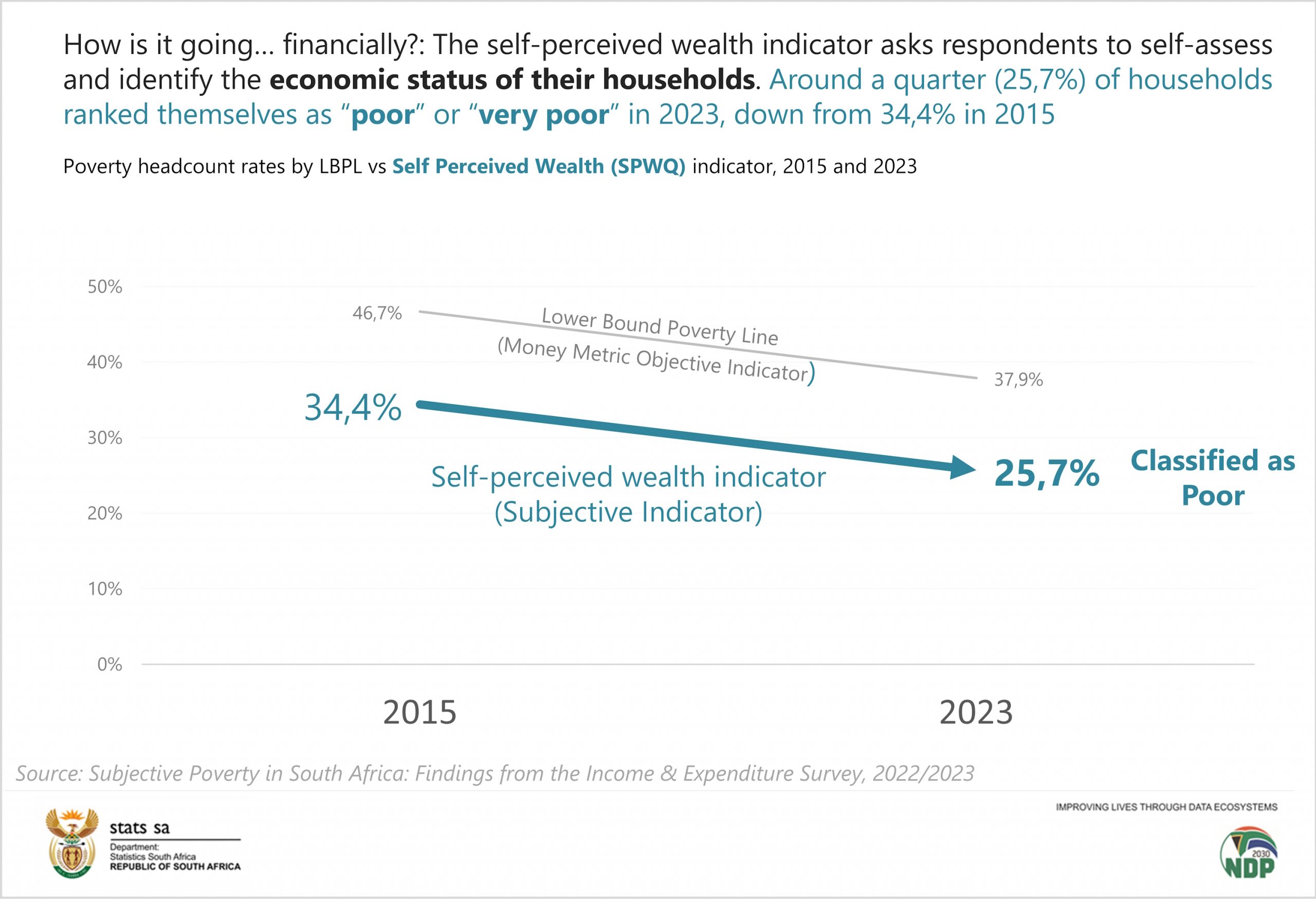
The latest findings show that fewer households and individuals in South Africa perceive themselves as poor than they did eight years ago. Two of the three measures used to capture how individuals perceive their financial status have improved. Using the self‑perceived wealth indicator — which reflects how individuals rate their own financial wellbeing — individuals who perceived themselves as poor dropped from 34,4% in 2015 to 25,7% in 2023.
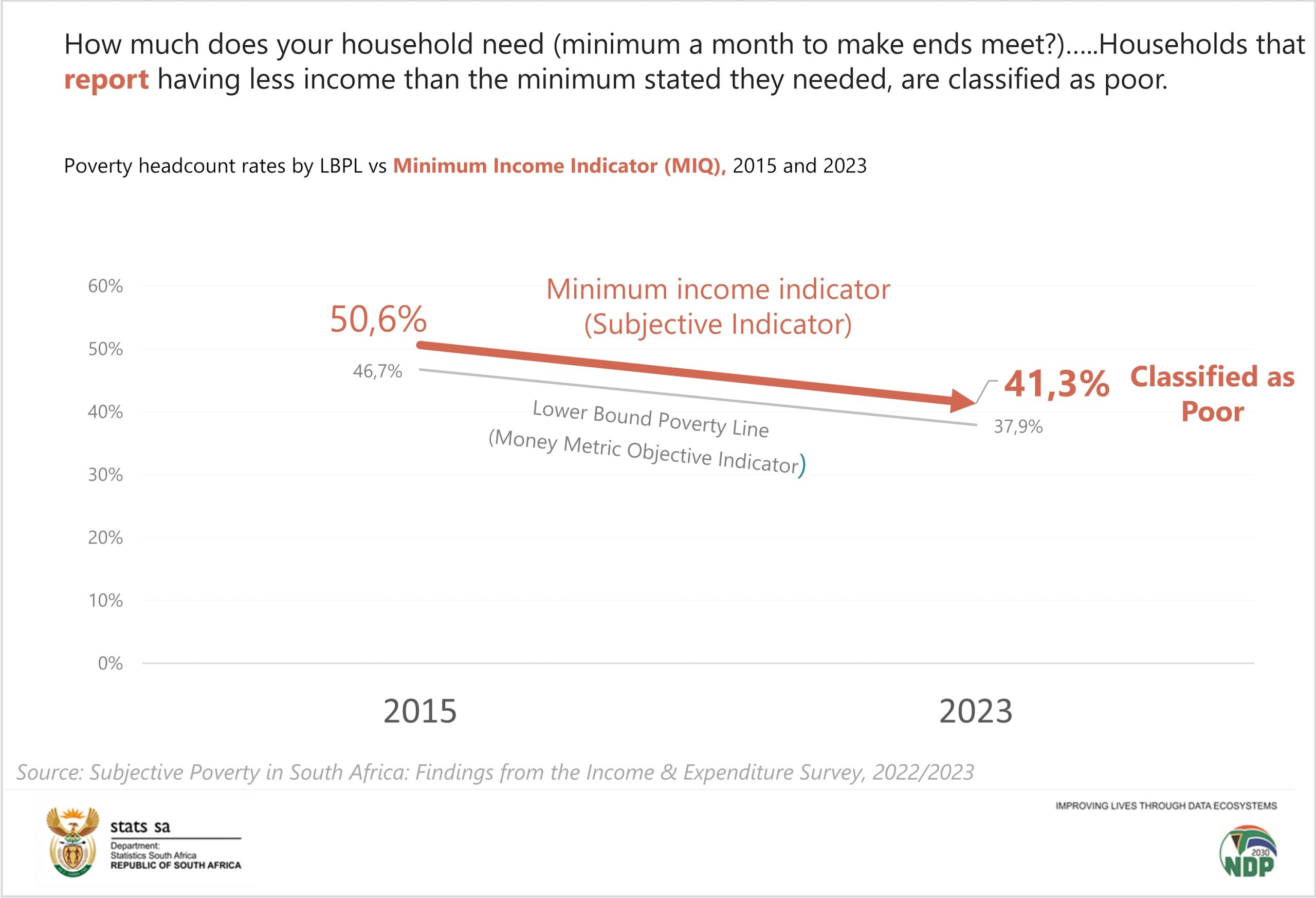
The minimum income indicator which compares what individuals say they need to make ends meet with what they actually earn also declined, from 50,6% to 41,3%. This 9,3‑percentage‑point drop is the largest improvement of the three measures.
However, not all indicators showed the same trend. The income evaluation indicator — which measures whether individuals regard their income is enough to cover what they believe they need, increased from 49,7% in 2015 to 51,4% in 2023. This means that a slightly larger share of individuals now regard their income falls short, even though fewer individuals classified themselves as poor overall.
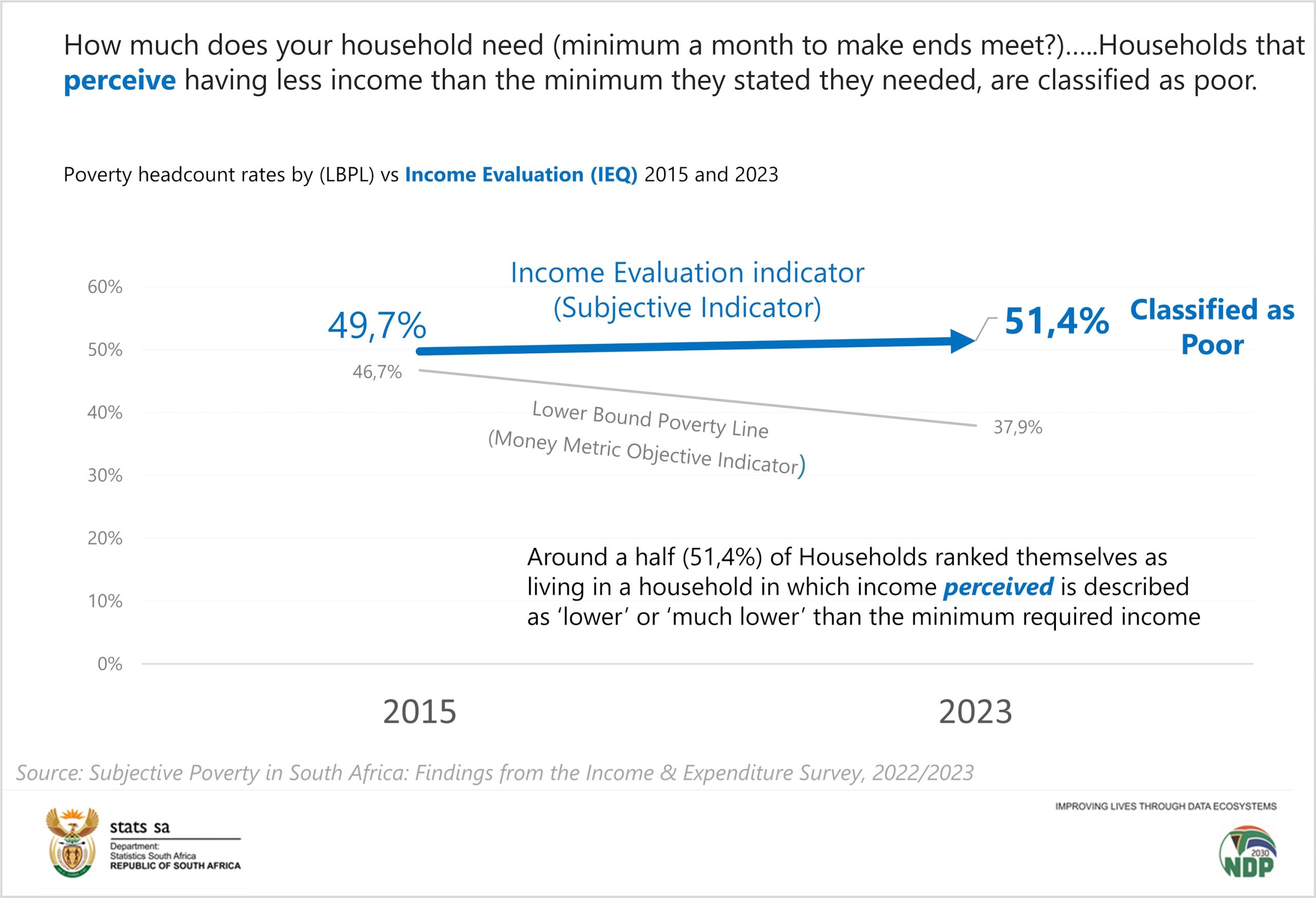
Looking at the trends collectively, we see that residents in South Africa are increasingly less likely to label themselves as poor, yet many still perceive themselves to be financially stretched and unable to meet the rising cost of living.
At household level, the pattern is similar: most measures of how households feel about their financial situation have improved since 2015.
The income evaluation indicator, increased slightly from 48,8% in 2015 to 51,0% in 2023. This means more households now feel that their income isn’t covering their needs.
In contrast, the self‑perceived wealth indicator fell from 33,8% to 25,3%, while the minimum income indicator dropped from 53,0% to 44,5%. Together, these results suggest that fewer households perceived and also classified themselves as poor, even though many still regard themselves as financially stretched.
The results also reveal gender differences that challenge traditional assumptions about poverty. When relying on subjective measures, males, appear as facing the highest risk to
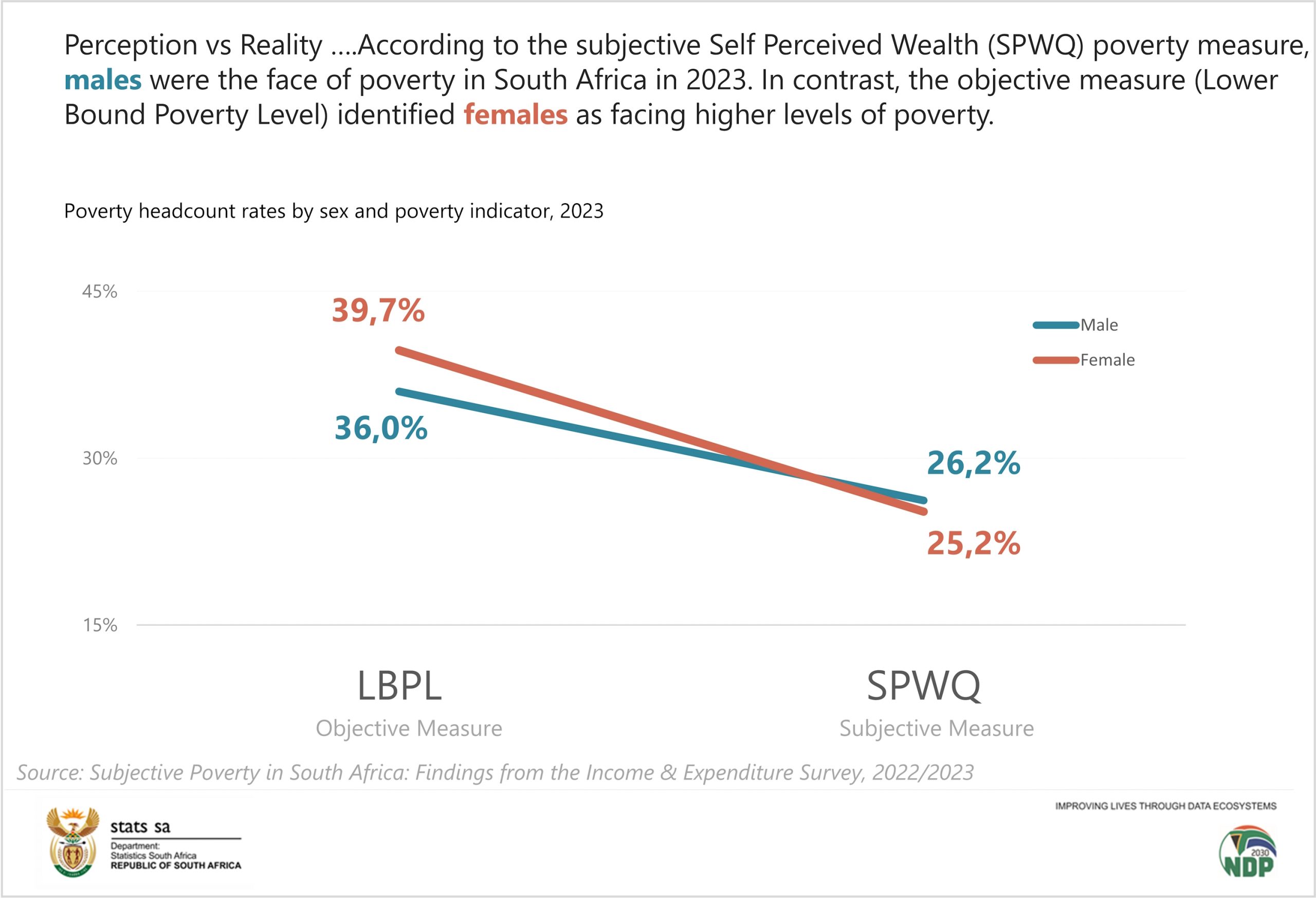
poverty between 2015 and 2023, the opposite of what objective measures typically show. For example, using the self‑perceived wealth indicator, 25,2% of females considered themselves poor in 2023, compared with 26,2% of males. The minimum income indicator shows a similar pattern, with poverty affecting 40,6% of females versus 41,9% of males. Only the income evaluation indicator shows near‑identical results, with males at 51,2% and females at 51,6% suggesting that both genders felt equally constrained by rising living costs in 2023.
The findings also show an association between happiness and poverty. Individuals who describe themselves as “less happy” show a significantly higher likelihood of experiencing poverty, regardless of whether poverty is measured subjectively or objectively.
Using the Lower‑Bound Poverty Line, the income level needed to cover basic food and essential non‑food items is 40,6% of “less happy” individuals were poor in 2023, compared with 16,8% of those who were “happier.”
The gap between “less happy” and “happier” individuals becomes even more striking when looking at subjective measures of poverty.
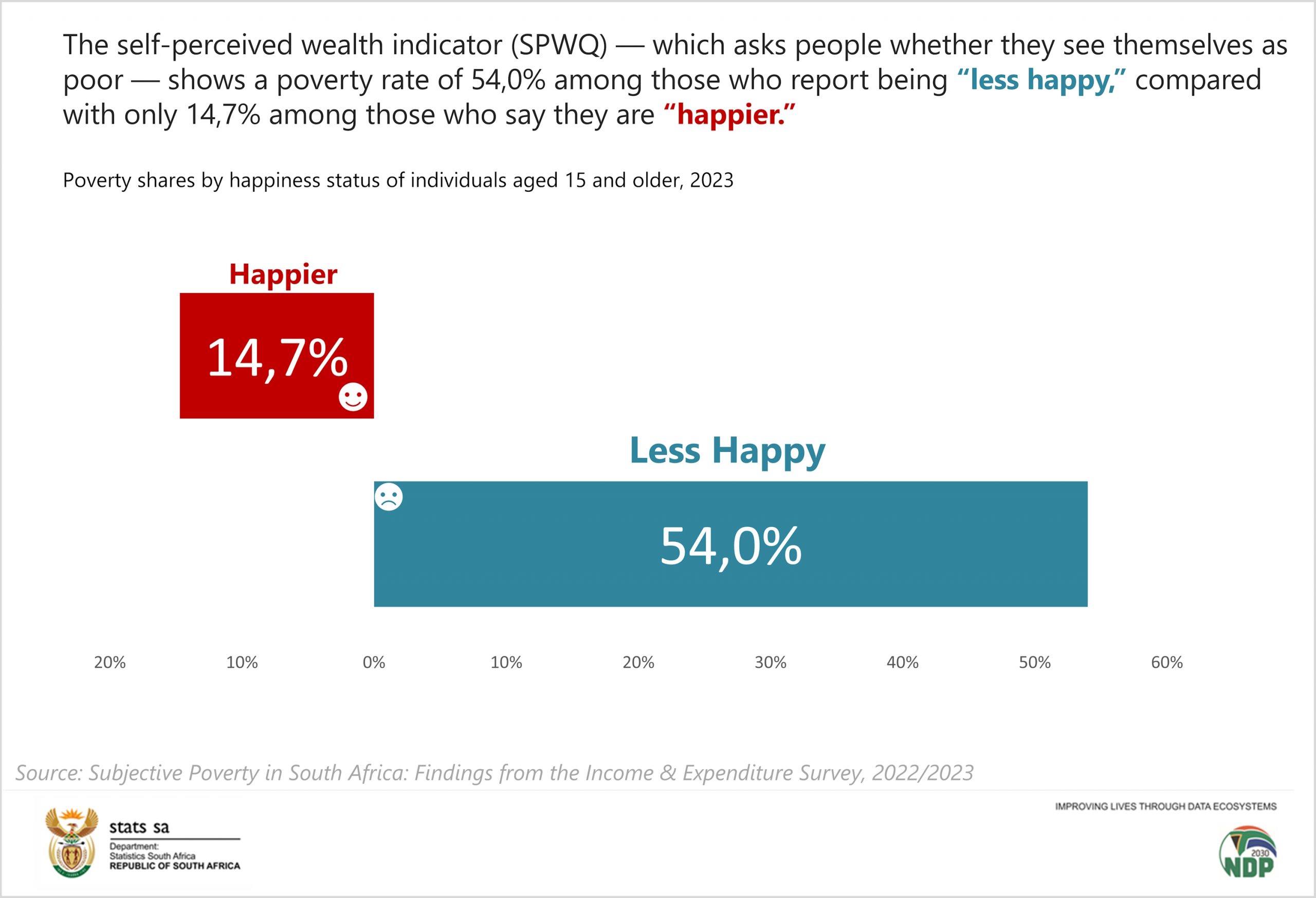
The self‑perceived wealth indicator shows a poverty rate of 54,0% among those who report being “less happy,” compared with only 14,7% among those who say they are “happier.”
A similar pattern emerges in the minimum income indicator. Here, 43,1% of “less happy” individuals say they fall below their perceived minimum income, compared with 40,8% among “happier” individuals.
The income evaluation indicator, shows an even larger divide: 58,4% of “less happy” individuals feel their income is insufficient, versus 43,3% of those who are “happier.”
Overall, these findings show that while subjective poverty has declined over time, perceived financial strain remain, particularly among men and among individuals who describe themselves as less happy. These findings indicate that individuals’ reported levels of happiness are consistently associated with how they evaluate their financial circumstances.
The report uses three of the most widely utilised subjective poverty measures in order to update the subjective poverty profile in South Africa. Adapted from the Living Conditions Survey (LCS), these include the self-perceived wealth indicator which asks respondents to self-assess and identify the economic status of their households, the minimum income indicator which asks respondents to select the smallest level of income with which their household could make ends meet and the income evaluation indicator which asks respondents to directly evaluate whether or not their household’s actual level of income is above or below the minimum income required for the household to make ends meet.
For more information, download the report here.