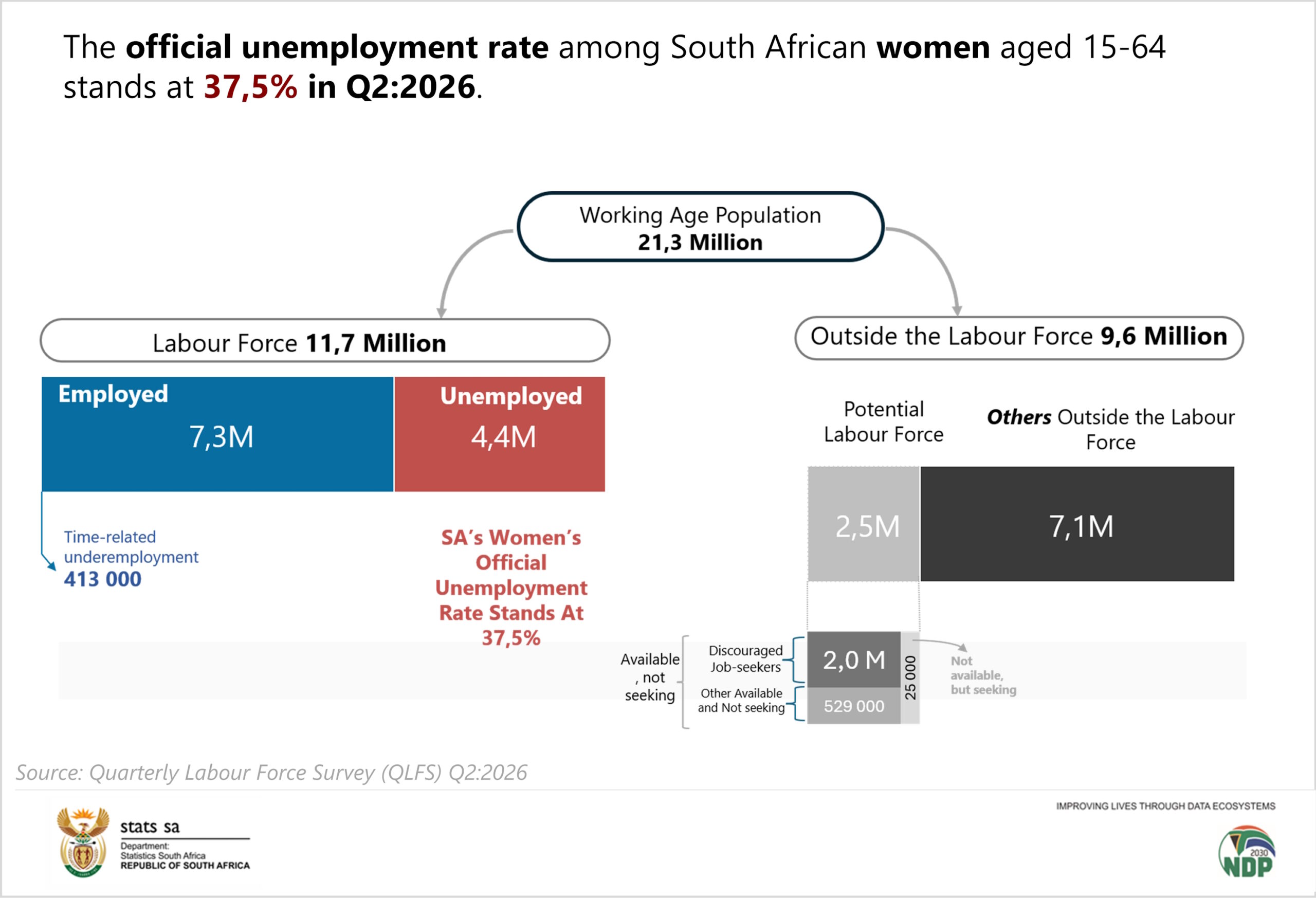
The South African labour market continues to reflect unequal employment outcomes between men and women. According to the Quarterly Labour Force Survey (QLFS) released by Statistics South Africa (Stats SA) in Q2:2026, women accounted for 50,3% of the 42,3 million working-age population (15-64 years). However, their labour market outcomes differ, with women bearing a disproportionate burden of unemployment and remaining outside the labour force. Of the 21,3 million women of working age, 11,7 million were in the labour force, of whom 7,3 million were employed and 4,4 million were officially unemployed. Consequently, the official unemployment rate for women stood at 37,5% in the second quarter of 2026, exceeding the unemployment rate for men (30,3%) by 7,2 percentage points.
A key indicator of economic inclusion, the labour force participation rate (which measures the proportion of the working-age population that is either employed or actively seeking work), reflects a persistent gender gap. Although women’s labour force participation rate has increased over time, it remains consistently lower than that of men. The labour force participation rate, which measures the share of the working-age population that is either employed or actively seeking work, stood at 54,9% for women and 64,4% for men, a gap of 9,5 percentage points in Q2:2026. A similar disparity is evident in the absorption rate (the proportion of the working-age population that is employed). The absorption rate for women was 34,3%, compared to 44,9% for men, a 10,6 percentage points difference. For women, the gap between their labour force participation and their absorption into employment stood at 20,6 percentage points in Q2:2026, up from 14,9 percentage points in Q2:2016. These disparities indicate that women remain less likely than men to participate in the labour market and, when they do participate, are less likely to be employed.
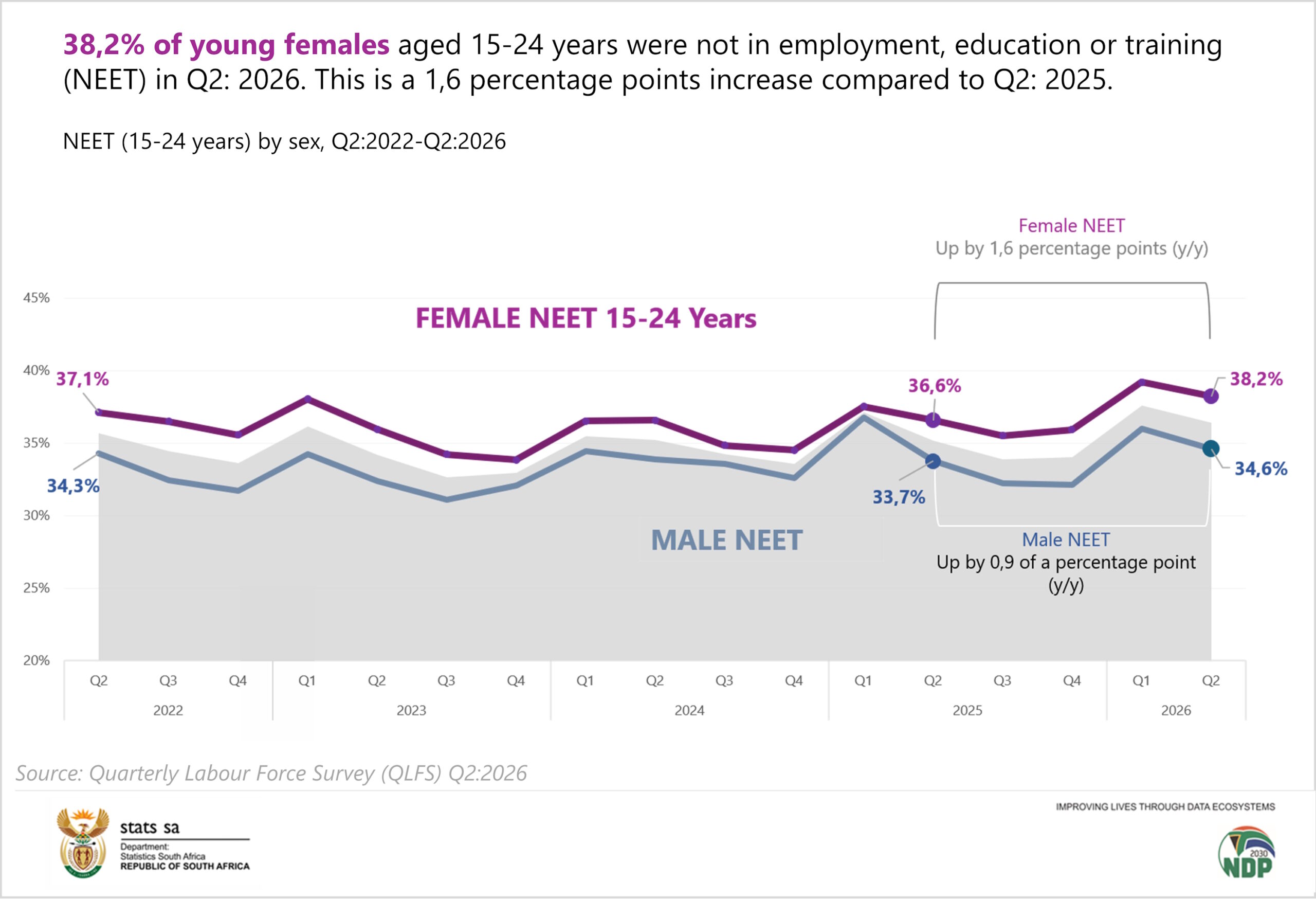
In addition to lower labour force participation, women are more likely than men to remain outside the labour force. In Q2:2026, 9,6 million women were outside the labour force. Of these, 2,5 million formed part of the potential labour force, comprising individuals who were either available for work but not actively seeking employment or actively seeking employment but unavailable to start work. Discouraged work-seekers comprised 78,1% (2,0 million) of the potential labour force. Similar challenges are evident among young women, with 38,2% of females aged 15-24 years classified as not in employment, education or training (NEET), compared with 34,6% of young men. The female NEET rate increased by 1,6 percentage points from Q2:2025, highlighting the continuing difficulties young women face in accessing employment, education and training opportunities.
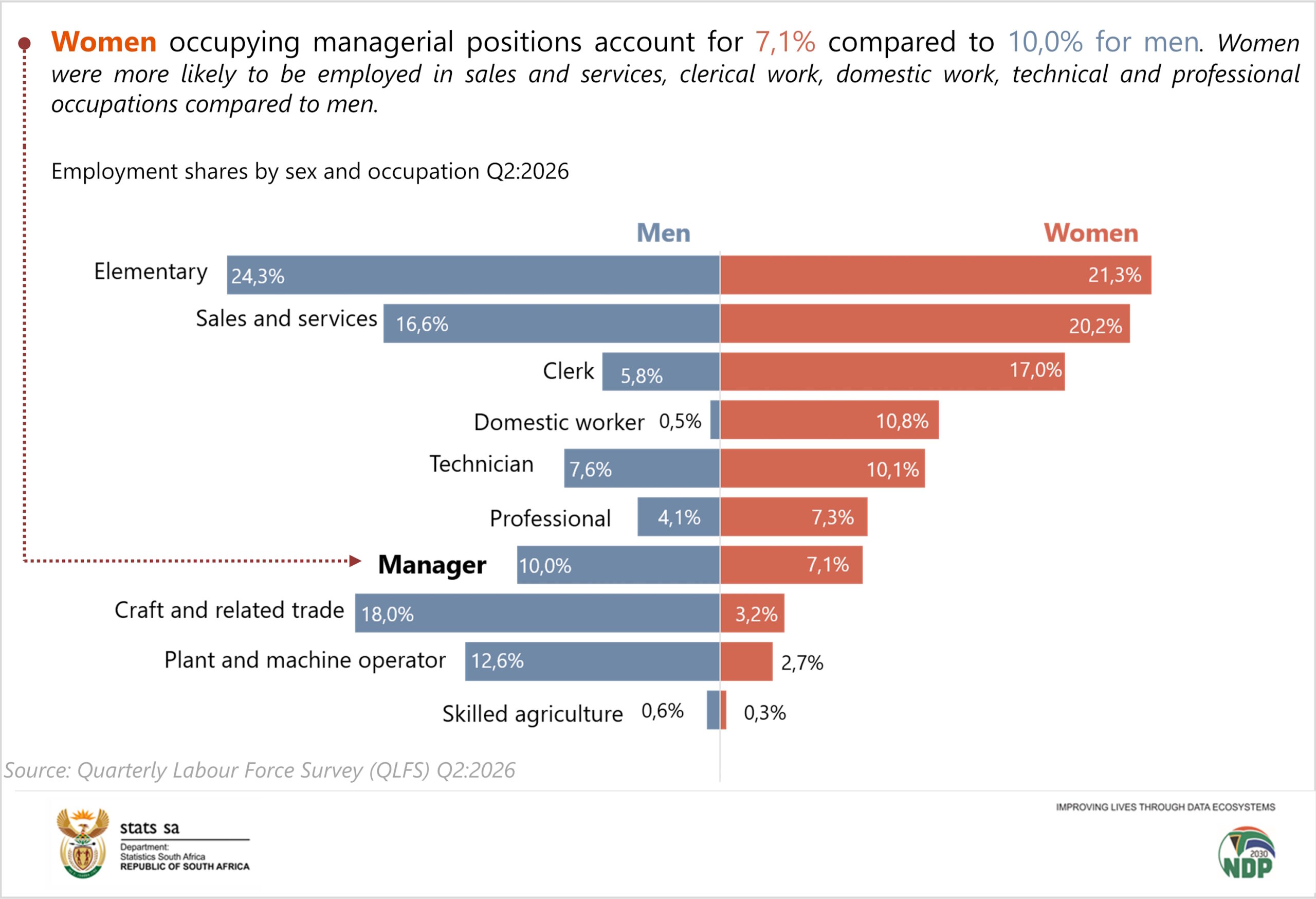
Even when women secure employment, they are more likely than men to be concentrated in certain occupations. Among employed women, 7,1% were employed in managerial occupations, compared with 10,0% of employed men in Q2:2026. Conversely, women were more likely than men to be employed in sales and services, clerical occupations and domestic work. Clerical occupations accounted for 17,0% of employed women, compared with 5,8% of employed men, while domestic work accounted for 10,8% of women’s employment, compared with 0,5% of men’s employment. These patterns indicate that gender disparities extend beyond access to the labour market to the types of occupations in which women and men are employed.
Behind every labour market statistic is the story of women’s participation in South Africa’s economy. The QLFS, Q2:2026 results show that while millions of women are active in the labour market, they remain more likely than men to be unemployed, outside the labour force, or concentrated in a narrower range of occupations. These differences are already evident among young women entering adulthood, suggesting that gender gaps continue across generations. As South Africa observes Women’s Month, the latest labour market data offer an opportunity to reflect on the progress made and the realities that continue to shape women’s experiences in the world of work.
For more information, download the latest report here.