
June was a busy month for Stats SA. The agency published 28 publications, with many providing fresh data on the performance of the economy.
The latest business indicators
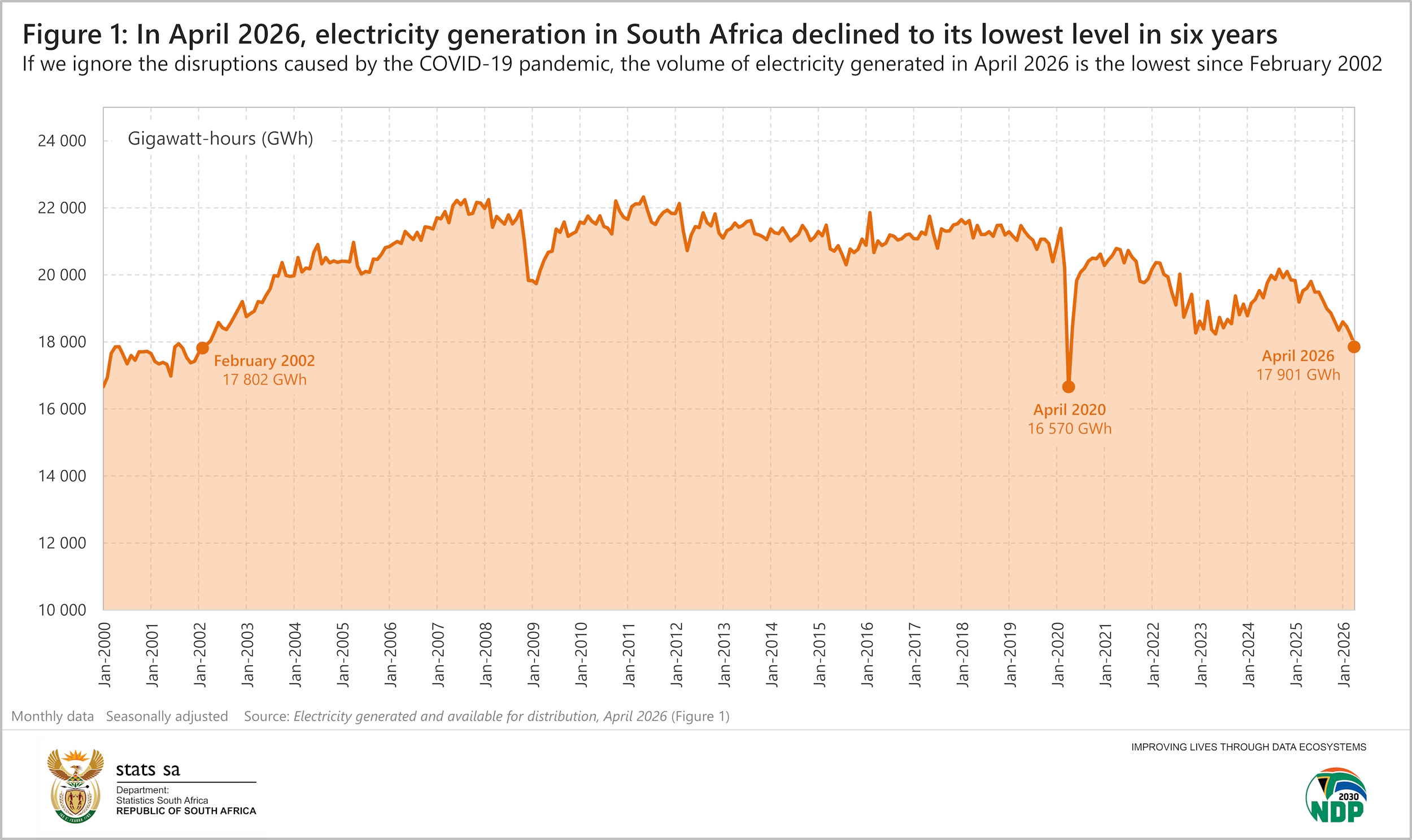
Electricity generation continued to wane, declining by 9,0% year-on-year in April. Seasonally adjusted electricity production dipped to 17 901 gigawatt-hours (GWh), the lowest level since the COVID-19 Level 5 lockdown in April 2020 (16 570 GWh). Excluding the disruptions caused by the pandemic, the volume of electricity generated in April 2026 is the lowest since February 2002, when 17 802 GWh was produced.
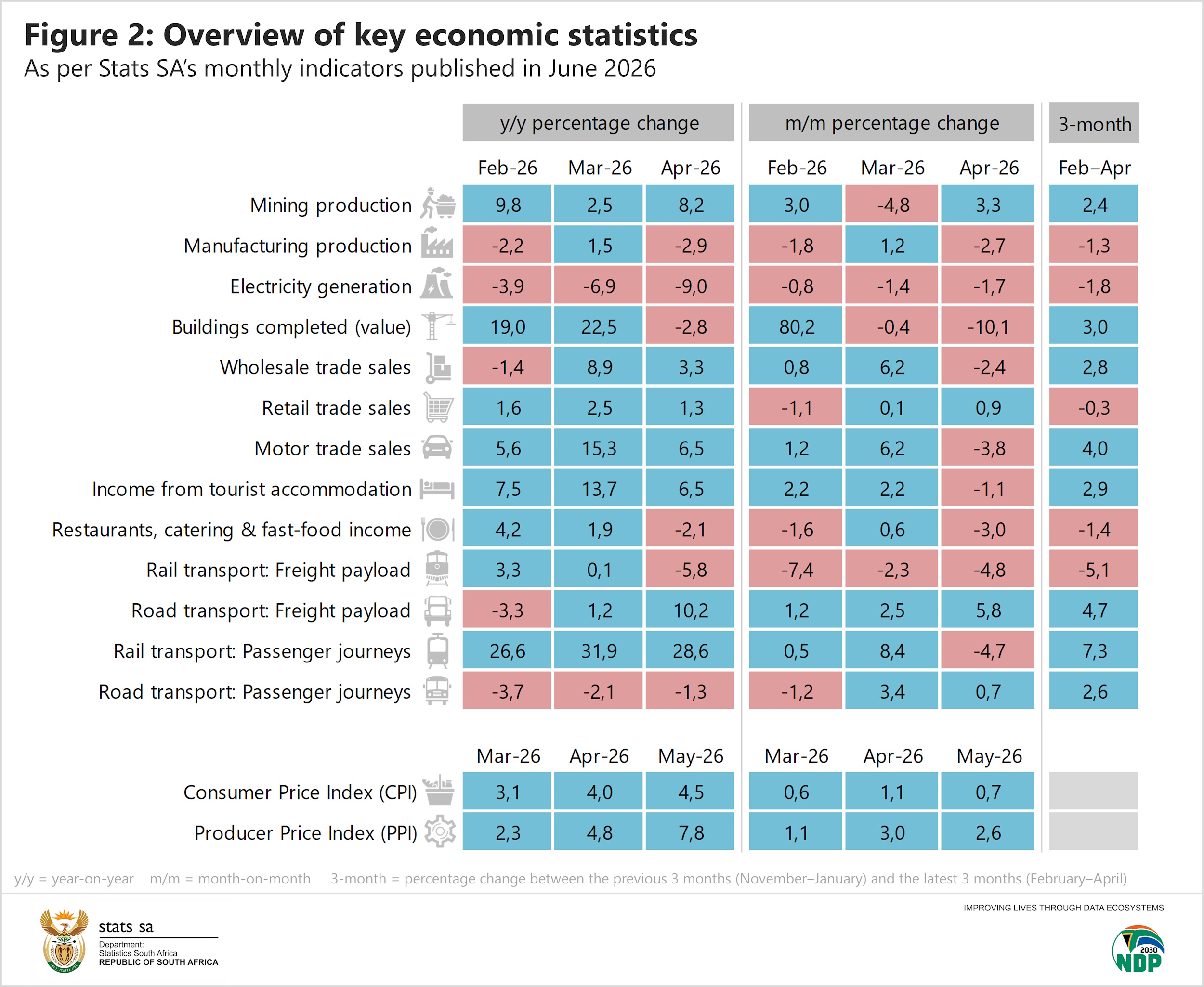
Manufacturing; construction (buildings completed as reported by large municipalities); restaurants, catering & fast-food; rail freight transport; and road passenger transport were also down year-on-year in April 2026 (see Figure 2 below).
Manufacturing production decreased by 2,9%. Six of the ten manufacturing divisions recorded a lacklustre month, with the basic iron and steel, non-ferrous metal products & machinery division the key drag on overall growth. The petroleum, chemicals, rubber & plastic products division recorded no change. Three manufacturing divisions were positive, with textiles & clothing recording the highest growth rate (+7,7%).
On the upside, Figure 2 shows that mining, wholesale trade, retail trade, motor trade, tourist accommodation, road freight transport and rail passenger transport were all stronger year-on-year.
National mining activity expanded by 8,2%. The platinum group metals category was the most significant positive contributor, rising by 36,5% and contributing a notable 8,8 percentage points to overall growth. Nickel, manganese ore and chromium ore were also positive, with chromium ore recording its eighth consecutive year-on-year increase. On the downside, production declined for diamonds, copper, coal, iron ore and gold.
Retail trade sales continued to shine, rising by 1,3%. Five of the seven retail groups recorded gains, with the miscellaneous category, all ‘other’ retailers, the largest driver of growth. Household furniture & appliance retailers and general dealers also made notable positive contributions. Hardware, paint & glass recorded zero growth, while textiles & clothing was the only category to decline, dipping by 0,7% year-on-year.
Dealerships enjoyed a 14,0% increase in new vehicle purchases, which was the main factor behind the 6,5% rise in motor trade sales. The used vehicle market also expanded, growing by 13,4% year-on-year. Workshop income and fuel sales bucked the trend, recording decreases.
Income from tourist accommodation rose by 6,5%, driven by a rise in income generated by the ‘other’ accommodation category, as well as by hotels and guest-houses & guest-farms. Caravan parks & camping sites, however, registered a decline; this is the 8th consecutive decline since September 2025.
Inflation continues to accelerate
Consumer inflation jumped further to 4,5% in May from 4,0% in April and 3,1% in March. May’s print is the highest since July 2024, when the rate was 4,6%. The fuel index rose by 14,3% between April and May, taking the annual rate to 28,7%. Petrol is 24,8% and diesel 53,8% more expensive than a year ago.
Factory gate inflation, as measured by the producer price index (PPI), also rose sharply in May, rising to 7,8% from 4,8% in April. This is the highest rate since April 2023 (8,6%).
Quarterly and annual statistical releases
Stats SA published the latest gross domestic product (GDP) estimates in June. Real GDP expanded by 0,5% in the first quarter of 2026, representing the economy’s sixth consecutive increase. The finance, agriculture, trade and transport industries were the most significant positive contributors to growth on the production (supply) side of the economy. Manufacturing disappointed, however, shrinking for a second consecutive quarter. The expenditure (demand) side of the economy was driven higher by a decline in imports and a rise in household spending, government spending and exports.
Other notable outputs in June include national government finances; municipal finances (quarterly and annual); data for the formal business sector (financial, capital expenditure and employment); and building statistics for 2025.
What to look forward to in July
Together with the scheduled set of monthly economic indicators, Stats SA will finalise two detailed industry reports in July with data from 2024. The first will cover the construction industry and the second the real estate, activities auxiliary to financial intermediation & business services industry. Stats SA will also reintroduce the statistics of insolvencies on 21 July 2026. The data will report the total number of individuals and partnerships placed under final sequestration.
Interested to know more? Keep up to date with our publication schedule. For a comprehensive list of products and releases, download our catalogue. For a regular update of indicators and infographics, visit our data story feed and download the latest edition of the Stats Biz newsletter.