


Violence against children remains one of the most pervasive yet often hidden challenges affecting societies today. Despite global policy commitments, abuse, neglect, and exploitation of children continues across homes, schools, and communities. In South Africa Child Protection Week, observed from 29 May to 5 June 2026, raises awareness about children’s rights and safety while encouraging reporting and shared responsibility. It also promotes education on creating safer environments. Guided by the theme, “Working Together in Ending Violence Against Children,” General Household Survey (GHS) data from 2009 to 2024 shows the scale and patterns of violence affecting children.
According to the data, the proportion of learners aged five years and older who experienced corporal punishment declined by 10 percentage points over the 14-year period. While the decrease was gradual in the earlier years, the sharpest decline occurred between 2015 and 2024.
This downward trend is consistent with South Africa’s legislative stance against corporal punishment. The practice was outlawed in schools under Section 10 of the South African Schools Act (No. 84 of 1996), which criminalises its use by educators. The ban is rooted in constitutional protections that safeguard children’s dignity and their right to be free from violence.
Data for 2024 shows notable differences in the sources of physical violence experienced by learners aged five years and older. Incidents involving teachers (156 229) are far higher than those involving fellow learners (87 059), pointing to authority figures as a leading source of reported violence in schools.
In total, 1 156 009 learners said they experienced some form of violence at school, showing that the problem is widespread. About 14% reported physical violence from teachers, compared with roughly 8% from other learners.
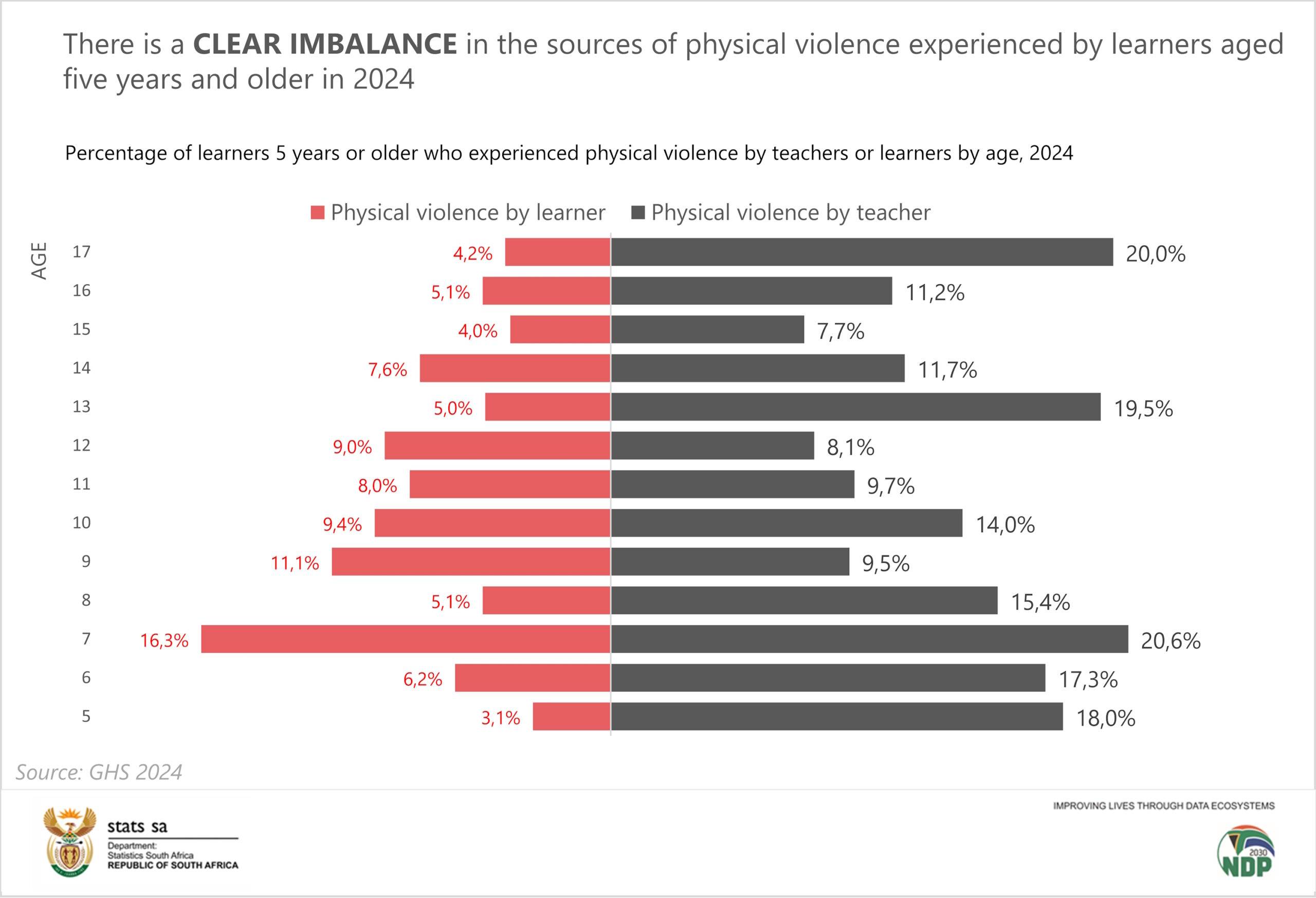
Younger children appear most at risk. Learners aged 5 to 8 report higher levels of violence, with peaks at age 7 (20,6%) and again at age 13 (19,5%), highlighting particularly vulnerable stages in early schooling and early adolescence.
In contrast, peer‑perpetrated violence is most prominent among 7‑year‑olds (16,3%), suggesting that aggressive peer interactions tend to emerge early and are concentrated in the first years of formal education. This divergence in age‑specific peaks indicates that different dynamics may be at play depending on the source of the violence: while peer‑related aggression surfaces earlier, teacher‑related or other forms of violence appear to persist into later developmental stages.
A clear distinction emerges between teacher‑ and peer‑perpetrated incidents. Verbal abuse is more frequently reported from fellow learners, with 21% identifying peers as the source, compared to 12% who report similar experiences involving teachers.
Age patterns reinforce this trend. The highest incidence of verbal abuse occurs among 7‑year‑olds, where nearly one‑third (30,1%) report exposure, pointing to the early primary school years as a key period of vulnerability to peer aggression. Elevated levels are also evident among pre‑teens, suggesting that verbal abuse not only begins early but can persist, and potentially intensify into later developmental stages.
Among learners aged five and older who experienced violence in schools in 2024, reports of verbal violence were almost evenly split by gender, with a slight majority of females affected (51,2%).
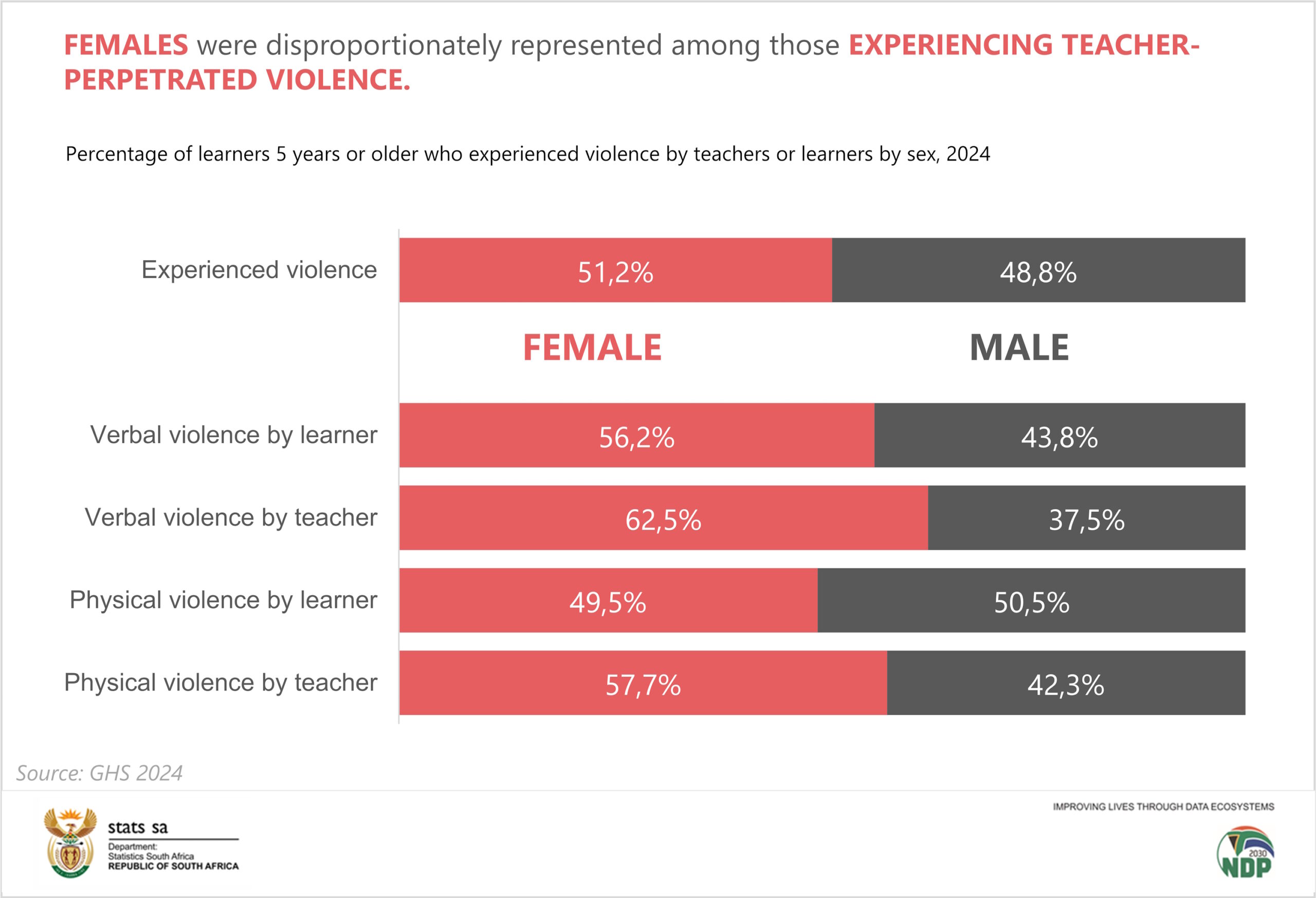
A closer look, however, reveals clear gender differences across types of violence. Females make up a significant share of those subjected to teacher‑perpetrated abuse, accounting for roughly 63% of reported verbal incidents and about 58% of physical violence cases involving teachers.
The pattern extends, though less sharply, to peer interactions. In cases of peer‑related verbal violence, females represent 56,2% of affected learners, indicating that girls are consistently more likely to report experiences of abuse across both teacher‑ and peer‑driven contexts.
These figures sit within a broader pattern of school‑based violence that is both widespread and uneven. Younger learners, particularly around age seven, face heightened vulnerability, while females are disproportionately affected, especially in cases involving teacher‑related and verbal abuse.
Guided by the call for “Working Together in Ending Violence Against Children,” the evidence points to a continuum of harm that continues to undermine the safety and purpose of learning spaces. It is a reminder that addressing this persistent reality requires a shared societal commitment, as the experiences of children reflect deeper social tensions unfolding within environments meant to nurture their growth.