

The South African economy is predominantly service-oriented. The tertiary sector accounted for 70% of economic activity or value added in 2024, far larger than the secondary (20%) and primary (10%) sectors combined.1 Within the tertiary sector, the finance, real estate & business services industry was responsible for 23% of value added, making it the largest industry in the economy.
The recently published Real estate, activities auxiliary to financial intermediation and business services industry 2024 statistical report covers portions of this important industry. Showcasing information sourced from approximately 7 500 sampled enterprises registered for value-added tax (VAT), the report provides detailed insight into finances, employment, details of services rendered and ICT usage.
The industry is a melting pot of businesses. Examples of important players include real estate agents, property developers, security companies, financial advisors, financial auditors, business consultants, law firms, advertising agencies and ICT service providers.
Several interesting results emerge from the data.
Investigation & security activities lead job creation
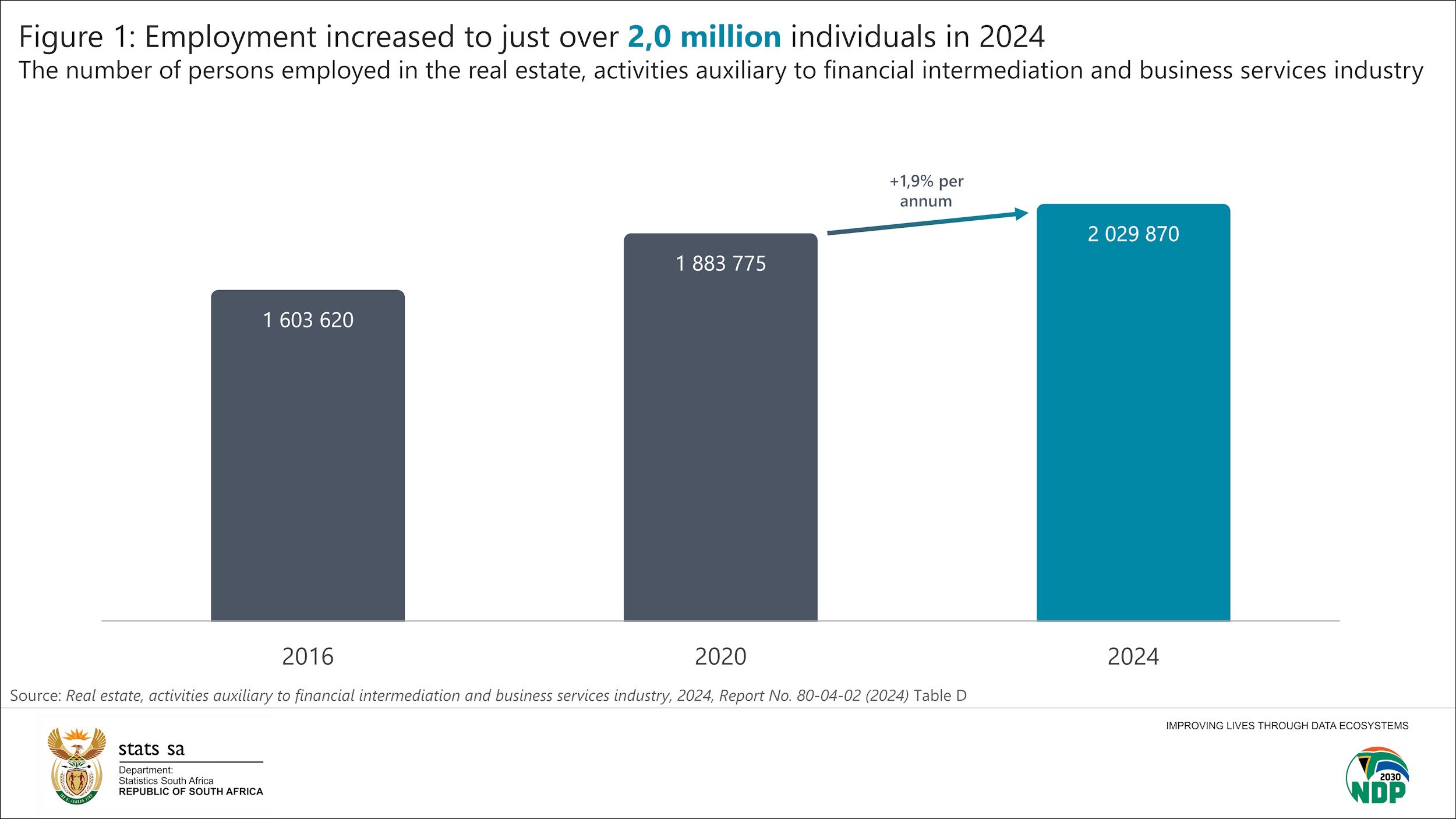
The economic size of the industry is reflected in its employment numbers. The industry employed just over 2,0 million individuals in 2024, up from 1,9 million in 2020. This represents an increase of 146 095 jobs, or a rise of 1,9% per annum (see Figure 1 below).
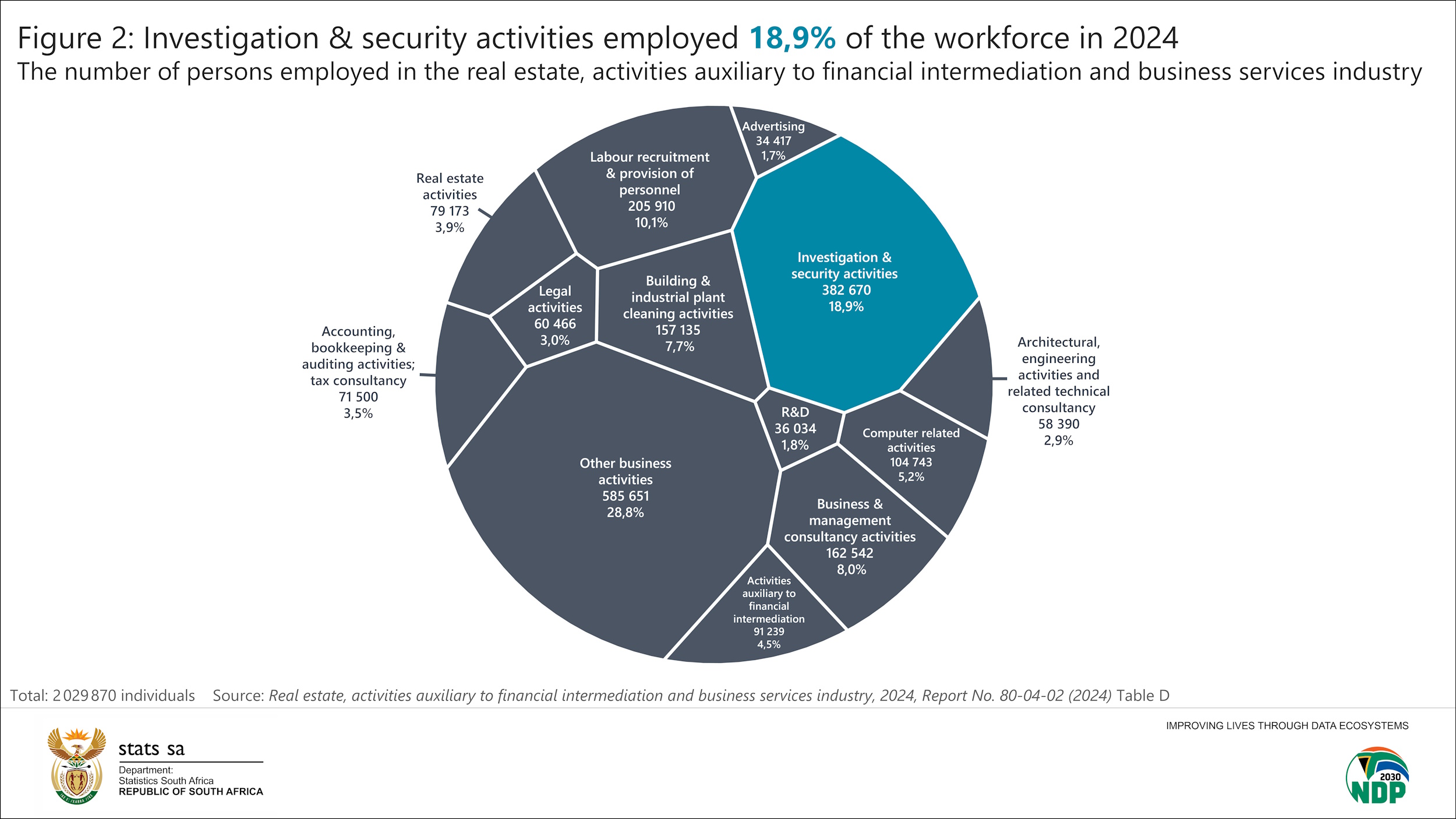
Digging a little deeper into the data reveals the structure of the workforce (see Figure 2 below). Investigation & security activities accounted for a notable slice, employing 382 670 individuals, or 18,9% of the total.
Key functions in investigation & security include guard services; armed response; monitoring and surveillance; cash-in-transit services; and detective work. Between 2020 and 2024, investigation & security activities created 71 570 jobs, making it the leading driver of employment growth (see Figure 3 below).
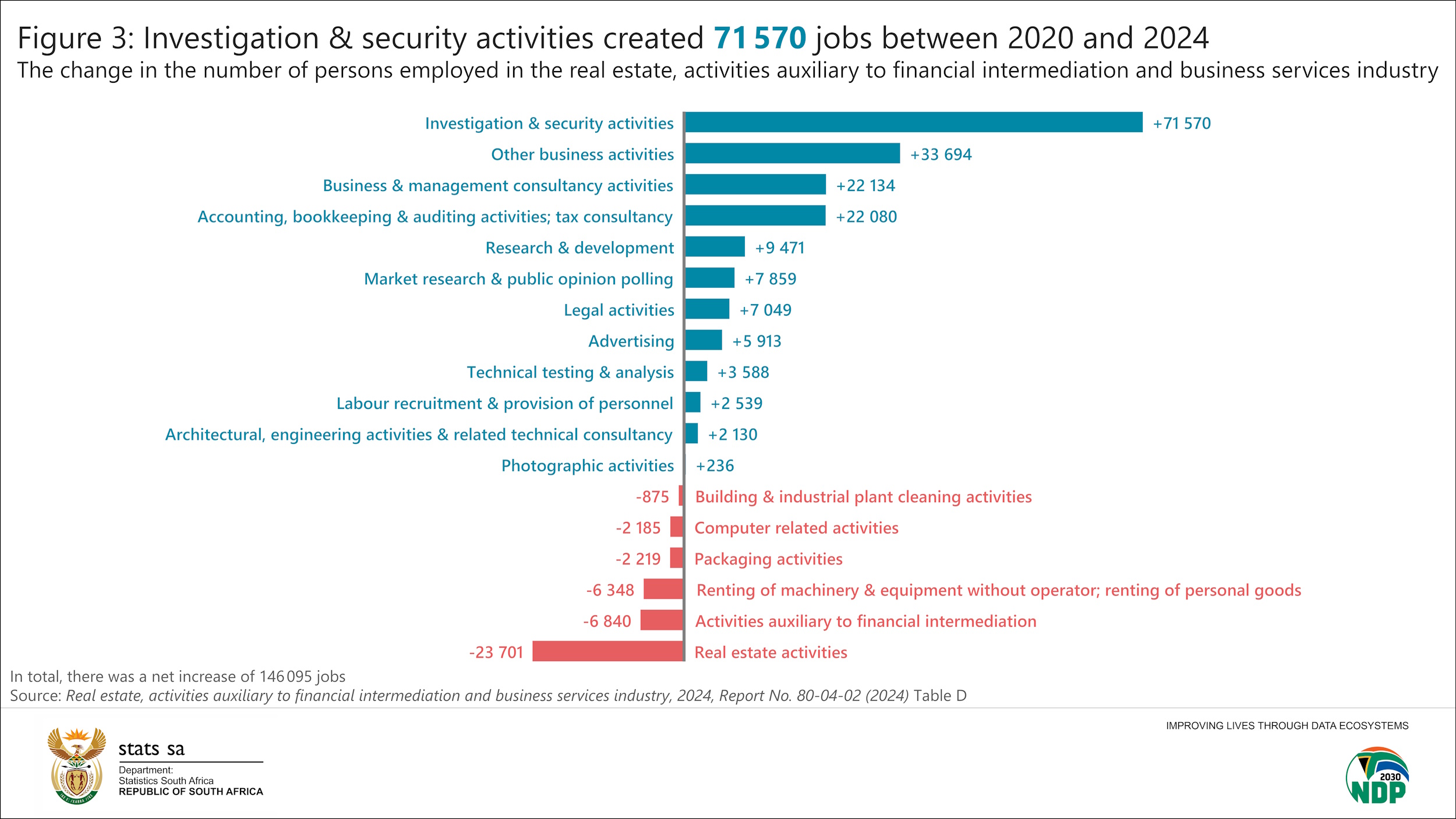
Twelve of the 18 activities covered in the report recorded a rise in employment. Six activities, however, registered a decline, with real estate shedding the most jobs. What is striking about real estate is that its workforce declined notably over the last eight years. In 2016, real estate employed 114 103 individuals, which shrank to 102 874 in 2020 and to 79 173 in 2024.
Profit margin trends vary across the industry
The loss of jobs in real estate contrasts to the rise in its profit margin. In 2020, the profit margin for real estate was notably lower at 6,9% compared with the 33,9% recorded in 2016. However, it recovered to 31,0% in 2024 (see Figure 4 below). The profit margin is calculated by dividing net profit after tax by turnover, expressed as a percentage.
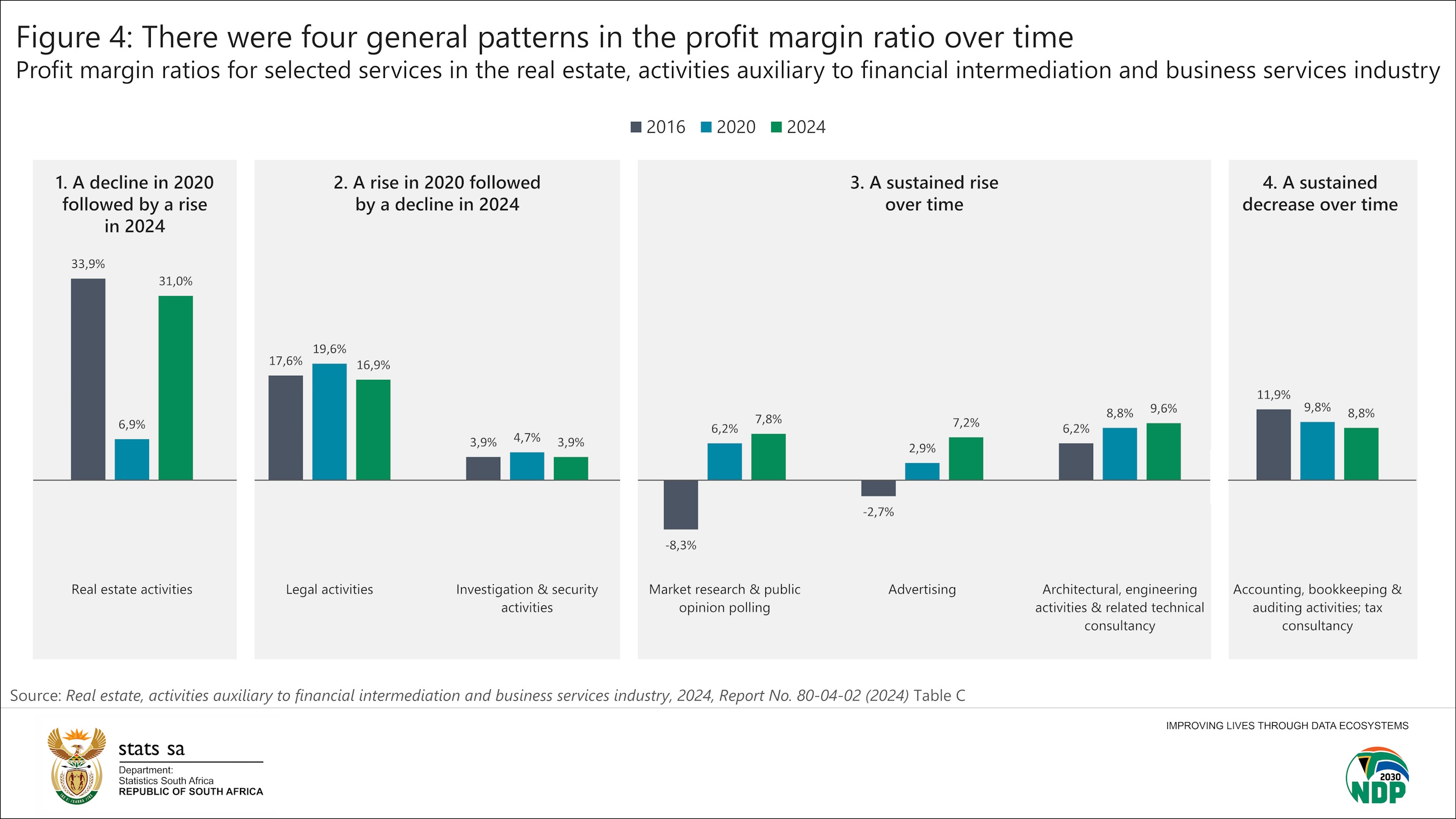
The data reveal four general patterns of how the profit margin shifted across the industry. Real estate joins 10 other activities that recorded decreases in 2020, followed by increases in 2024.
Three activities registered a rise in their profit margins in 2020, but a decline in 2024. These included legal activities, investigation & security activities (as shown in Figure 4), and technical testing & analysis. Market research & public opinion polling, and advertising recovered from losses in 2016 to record positive profit margins in 2020, increasing even higher in 2024. Architectural, engineering activities & related technical consultancy activities also exhibited a consistent rise over the three survey periods. Accounting, bookkeeping & auditing activities registered a consistent decline.
Computer related activities are the main driver of capital expenditure growth
Capital expenditure includes investments in new fixed assets, such as land and buildings; plant and machinery; furniture and office equipment; transport equipment (e.g. motor vehicles); and ICT equipment. Capital expenditure in the real estate, activities auxiliary to financial intermediation and business services industry rose by R12 646 million between 2020 and 2024, from R96 335 million to R108 981 million.
Computer related activities led this increase, recording a rise of R13 709 million. Real estate activities registered the largest decline, followed by investigation & security activities (see Figure 5 below).
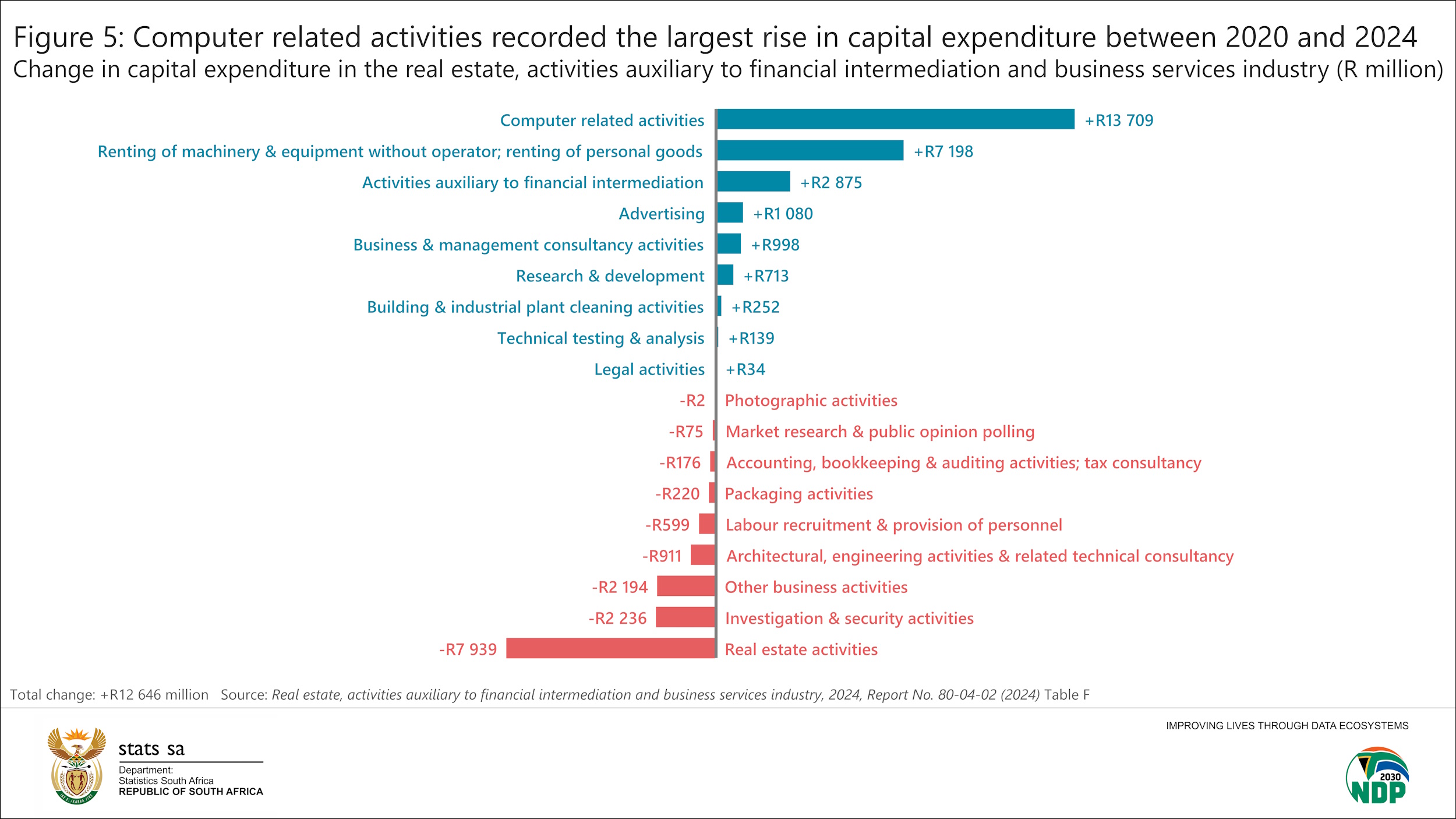
To summarise the results above, firstly, the real estate, activities auxiliary to financial intermediation and business services industry employed just over 2,0 million individuals in 2024. There was a net increase of 146 095 jobs between 2020 and 2024, with investigation & security activities leading the rise. Secondly, real estate recorded a notable decline in the number of jobs over the period, but a corresponding rise in its profit margin ratio. Thirdly, both investigation & security activities and real estate registered a decline in capital expenditure in 2024 compared with 2020. However, computer related activities registered the largest increase in capital expenditure over the same period.
For more information, download the Real estate, activities auxiliary to financial intermediation and business services industry 2024 statistical report, associated Excel files and media presentation here.
1 Stats SA. Gross domestic product (GDP), quarter ended March 2026. ‘GDP P0441- Q1 2026’ Excel file (available for download here).
Similar articles are available on the Stats SA website and can be accessed here.
For a monthly overview of economic indicators and infographics, catch the latest edition of the Stats Biz newsletter here.