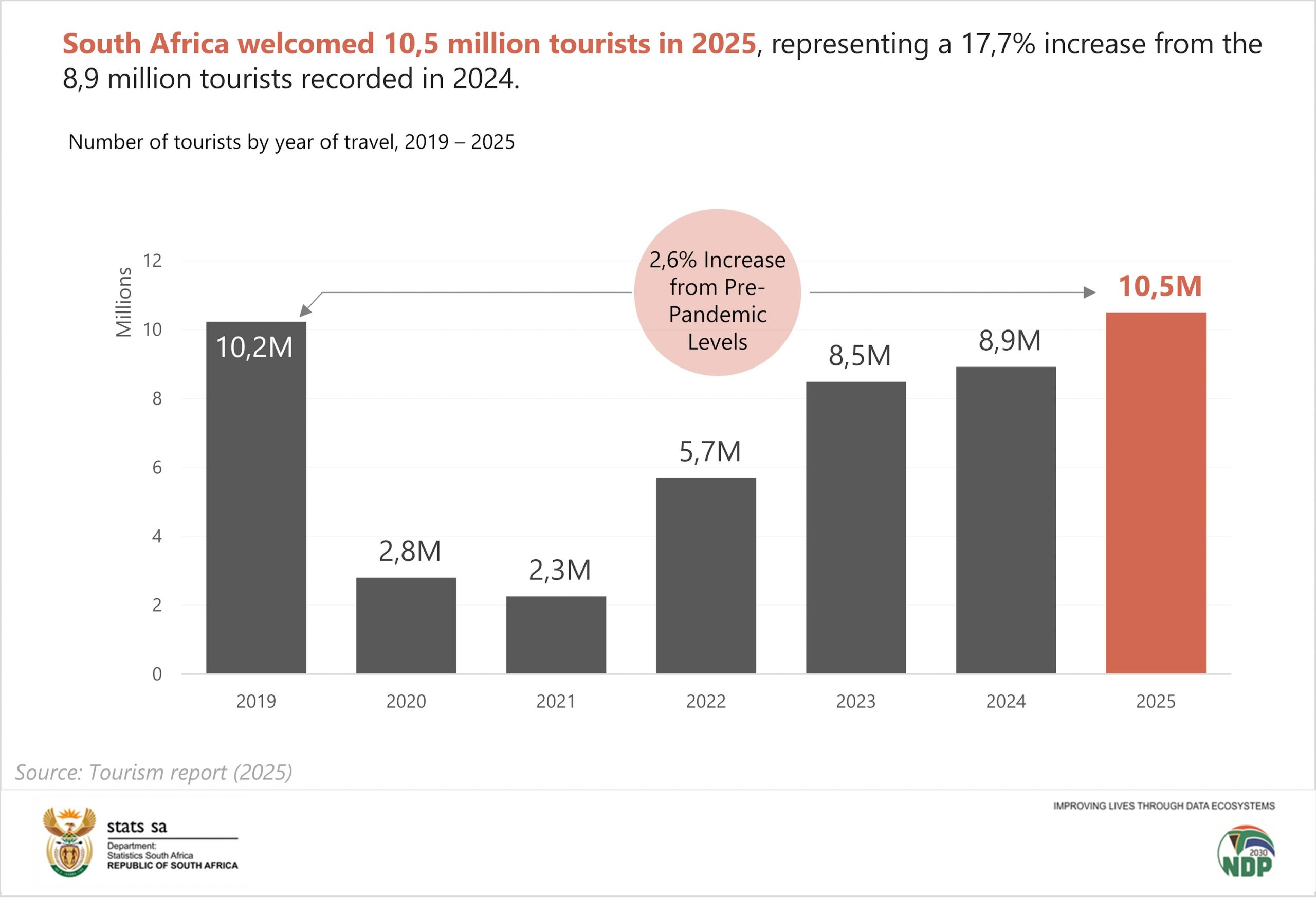
South Africa’s international tourism sector recorded a strong recovery in 2025, surpassing pre-pandemic levels for the first time since global travel disruptions. According to the Tourism report (2025) released by Statistics South Africa (Stats SA), the country welcomed 10,5 million tourists in 2025, representing a 17,7% increase from the 8,9 million tourists recorded in 2024. Tourist arrivals were also 2,6% higher than the 2019 pre-pandemic level, highlighting the continued recovery and growing resilience of the tourism sector.
As tourism numbers rise, understanding who is travelling becomes increasingly important. A traveller is anyone who moves from one place to another, whether for work, leisure, family visits, or other reasons. A tourist, however, is a traveller who stays at least one night at their destination in a hotel or other accommodation, usually for leisure purposes rather than employment. While all tourists are travellers, not all travellers are tourists — a distinction that helps clarify broader travel patterns and trends.
In 2025, South Africa recorded 36,5 million travellers in total. Of these, 18,9 million were arrivals, 17,0 million were departures, and 527 116 were transit travellers. These movements reflect the continued growth in cross-border travel as international mobility strengthens.
Same‑day visitors are people who travel to a destination but do not stay overnight. In 2025, South Africa saw a near‑even split between women and men in this group, with women making up just over half (about 1,69 million) and men slightly behind (around 1,66 million). This contrasts with overnight visitors/ tourists, where men formed the majority.
Age patterns also differed. Among women, the largest proportion of same‑day visitors was aged 25–34, making up 54%. For men, the largest share came from those aged 65 and older, accounting for 56%.
Regional Travel Continues to Drive Tourist Arrivals
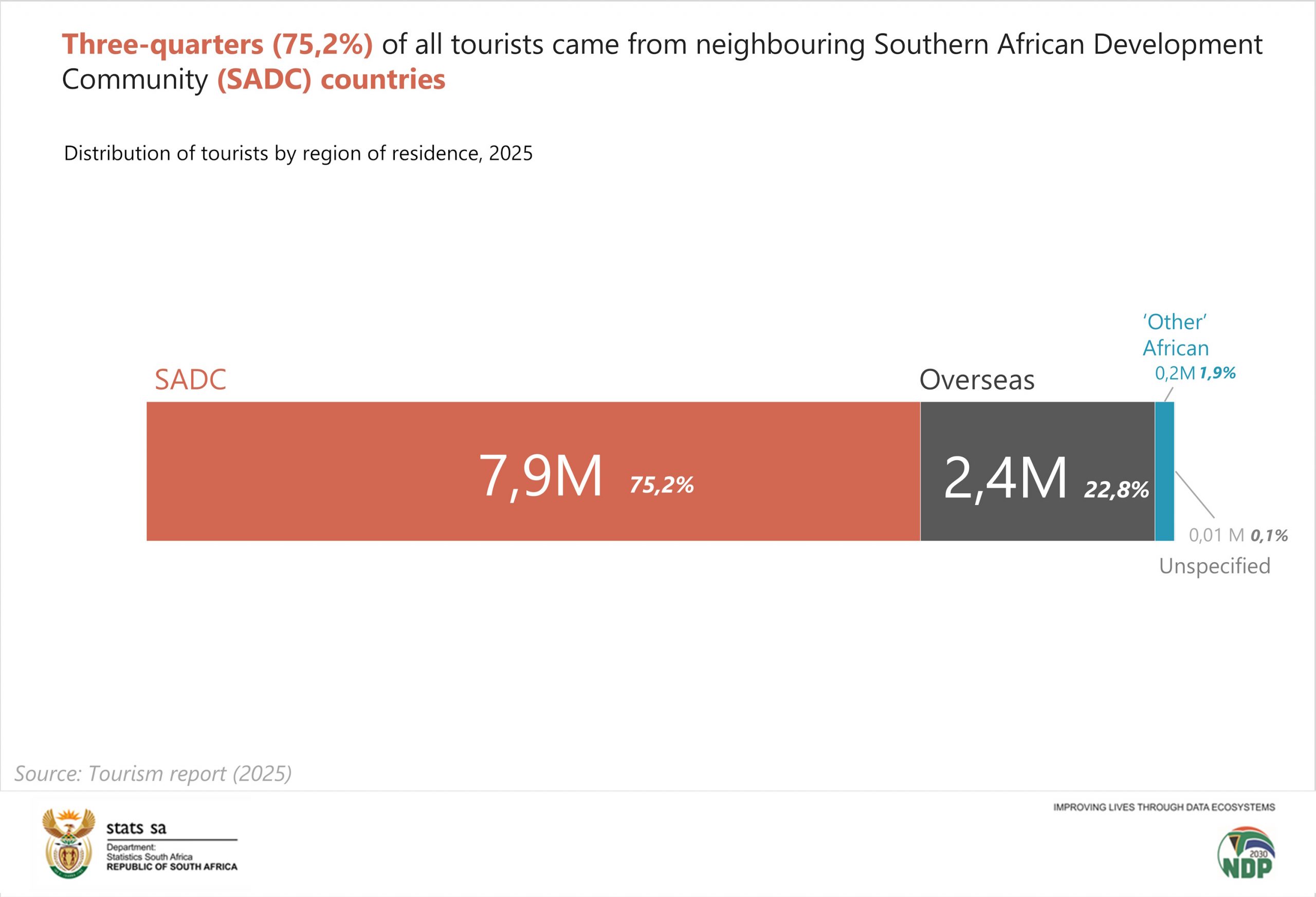
South Africa’s tourism industry continued to be driven largely by regional travel in 2025. Three‑quarters (75,2%) of all tourists came from neighbouring Southern African Development Community (SADC) countries, while tourists from other African countries contributed 1,9%. This means more than 77% of all tourist arrivals were from the African continent. Overseas tourists made up 22,8% of total arrivals, reflecting South Africa’s continued appeal to long‑haul markets.
Overseas Travel Patterns Show Steady Growth
Tourism from overseas countries followed clear seasonal trends. Tourist numbers were highest in the first and final quarters of the year — periods associated with warmer weather and more holiday travel. The post‑pandemic recovery also continued to strengthen. Overseas arrivals grew by 42% between 2022 and 2023, by 3,7% between 2023 and 2024, and by 11,9% from 2024 to 2025.
How Long Tourists Stayed
Length of stay varied significantly by region. SADC tourists typically made short trips, most commonly two to three days. Tourists from other African countries tended to stay for four to seven days. Overseas tourists stayed the longest, with most remaining in the country for eight to fourteen days.
Despite these differences, the combined average stay across all tourists in 2025 amounted to 26 days when adding up multiple visits throughout the year. SADC tourists recorded the highest average stay at 33 days, followed by tourists from other African countries at 20 days and those from overseas at 14 days.
Who Was Visiting?
Men made up the majority of tourists in 2025, accounting for 57,4% of arrivals, while women represented 42,6%. Most tourists fell within the working‑age population. The largest age group was 35–44 years (28,8%), followed by those aged 25–34 (23,6%). Children aged 0–14 years accounted for 5,3% of arrivals, while older travellers aged 65 and above made up 5,8%.
Why Tourists Came to South Africa
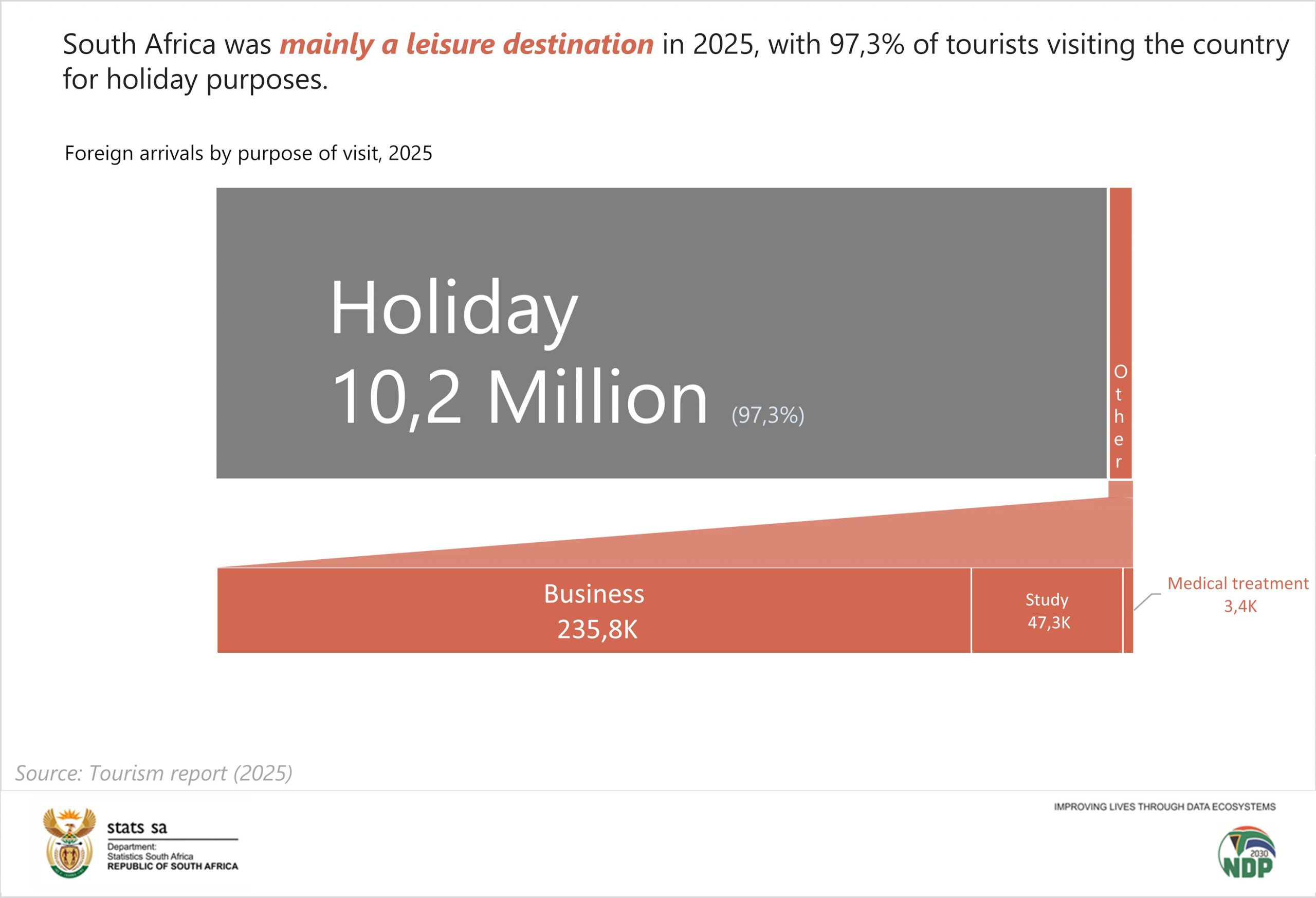
South Africa was mainly a leisure destination in 2025, with 97,3% of tourists visiting the country for holiday purposes. Business travel made up 2,2% of arrivals, while 0,5% of tourists travelled for study. Medical tourism was very limited, accounting for less than 0,1% of all tourists.
Founding BRIC Nations Countries Strengthen Tourism Ties
Tourism links with the original founding BRIC nations (Brazil, the Russian Federation, India and China) continued to play an important role. A total of 213 138 tourists from these countries visited South Africa in 2025, making up 8,9% of all overseas arrivals.
India led the group with 69 680 tourists, followed by Brazil (63 848), the Russian Federation (41 708) and China (37 902). Year‑on‑year comparisons showed mixed trends: arrivals from Russia and Brazil surged by 35,7% and 28,1% respectively, while China and India recorded declines of 8,5% and 7,8%.
A longer-term comparison shows clear growth from both Russia and Brazil. Tourist arrivals from Russia increased from 8 307 in 2016 to far higher levels by 2025, including a 74,7% increase between 2022 and 2023. Brazil followed a similar pattern, with arrivals rising by 74,3% over the same period. In contrast, arrivals from China and India decreased compared with their 2016 levels — by 67,6% and 26,9% respectively.
The Bigger Picture
Overall, South Africa’s tourism sector showed impressive resilience in 2025, welcoming more than 10,5 million tourists and surpassing pre‑pandemic levels. The strength of regional travel, combined with a steady rebound in long‑haul markets and deepening ties with major economies like the BRICS nations, illustrates the country’s enduring global appeal. As international travel continues to stabilise, these trends offer valuable insight into the opportunities that lie ahead for sustaining South Africa’s tourism growth.
For more information, download the full report here.