
The latest set of monthly economic indicators sheds some light on how the economy performed in the second quarter (April–June). There were several other notable releases in the month, including the most recent inflation and unemployment figures.
Business performance largely upbeat
Mining and manufacturing rebounded after two consecutive quarters of decline. Mining production expanded by 3,9% in the second quarter (Figure 1), largely driven by platinum group metals. The industry also produced more gold, chromium ore, iron ore, coal, nickel and diamonds in the second quarter. On the downside, manganese ore declined. Copper production slumped for a third straight quarter.
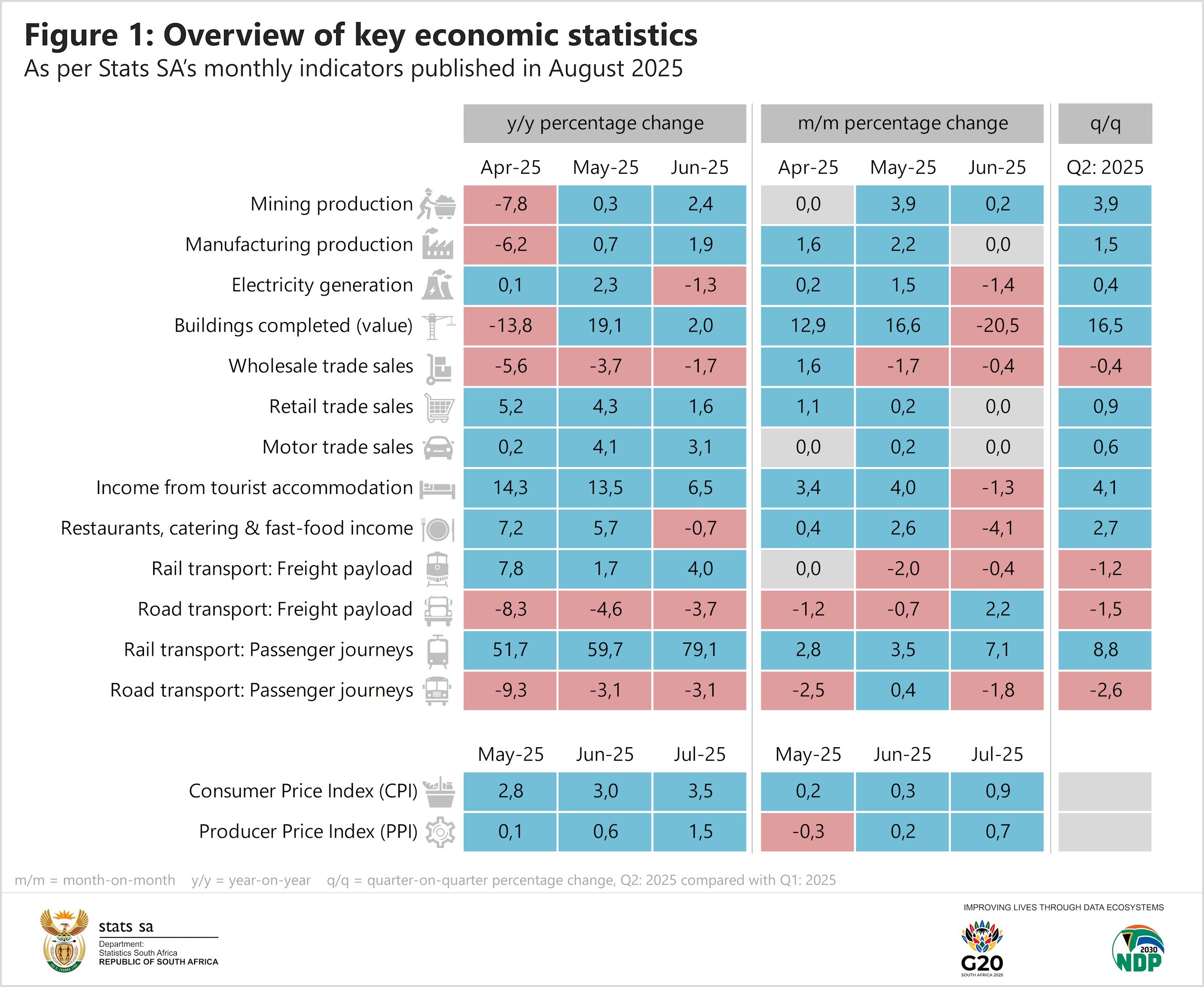
Manufacturing grew by 1,5%. The automotive and petroleum, chemicals, rubber & plastics divisions were the most significant positive contributors. Three divisions were weaker, including food & beverages; iron, steel & machinery; and furniture & other manufacturing.
Retail trade increased by 0,9% in the second quarter, mainly lifted by textiles & clothing. Most other retail types also recorded gains. Food & beverages and general dealers were the exceptions, registering a decline in sales.
Electricity generation; construction (buildings completed as reported by large municipalities); motor trade; tourist accommodation; restaurants, catering & fast food; and rail passenger transport also demonstrated resilience in the second quarter.
Inflation accelerates for a second straight month
Consumer and producer price inflation were both up for a second consecutive month in July. Headline consumer inflation rose to 3,5%, the highest print in 10 months. Rising food prices continue to place pressure on household budgets. Beef prices in particular have risen sharply over the last year.
Producer price inflation (for final manufacturing) was 1,5%, the highest rate in 11 months. The ‘food products, beverages & tobacco products’ category was the leading contributor to the rate in July, with sharp increases recorded for meat and fish.
Unemployment rate increases in the second quarter
The country’s official unemployment rate recorded a second consecutive increase, rising to 33,2%. Job losses were recorded in six of the ten industries, including community & social services, finance, agriculture, transport, utilities and manufacturing.
August was Women’s Month in South Africa, providing an opportunity to explore gender gaps in the labour market. Women remain economically vulnerable. The unemployment rate for women was 35,9% in the second quarter, lower than the unemployment rate recorded for men (31,0%). Female graduates faced a higher unemployment rate than their male counterparts.
Other notable economic releases published in August
What to look forward to in September
The next gross domestic product (GDP) estimates will provide a comprehensive overview of economic performance in the second quarter of the year. The GDP data will be published here at 11h30 on 9 September.
Following on the heels of the extra-budgetary accounts and funds report, financial data for the provincial government will be published here on 25 September. On the same day, quarterly financial data for municipalities will also be released. The spotlight will then shift to the formal business sector with the release of quarterly financial data and quarterly capital expenditure data on 30 September.
Interested to know more? Keep up to date with our publication schedule here. For a comprehensive list of products and releases, download our catalogue here. For a regular update of indicators and infographics, visit our data story feed and download the latest edition of the Stats Biz newsletter.