

The South African economy recorded its fifth consecutive quarter of growth, expanding by 0,4% in the fourth quarter (October–December) of 2025.1 Finance, trade and personal services drove much of the upward momentum on the production (supply) side of the economy. A rise in household spending, gross fixed capital formation and government consumption lifted the expenditure (demand) side.
The positive showing in the fourth quarter helped push annual gross domestic product (GDP) up by 1,1% in 2025. This is the highest annual growth rate since 2022, when GDP increased by 2,1%.
Five of the ten industries grew in the fourth quarter
Finance, real estate & business services had the most significant positive impact on the supply side of the economy. The industry grew by 1,4%, adding 0,3 of a percentage point to GDP growth (see Figure 1 below). This was mainly due to a rise in financial intermediation, insurance & pension funding; auxiliary activities; real estate activities; and other business services.
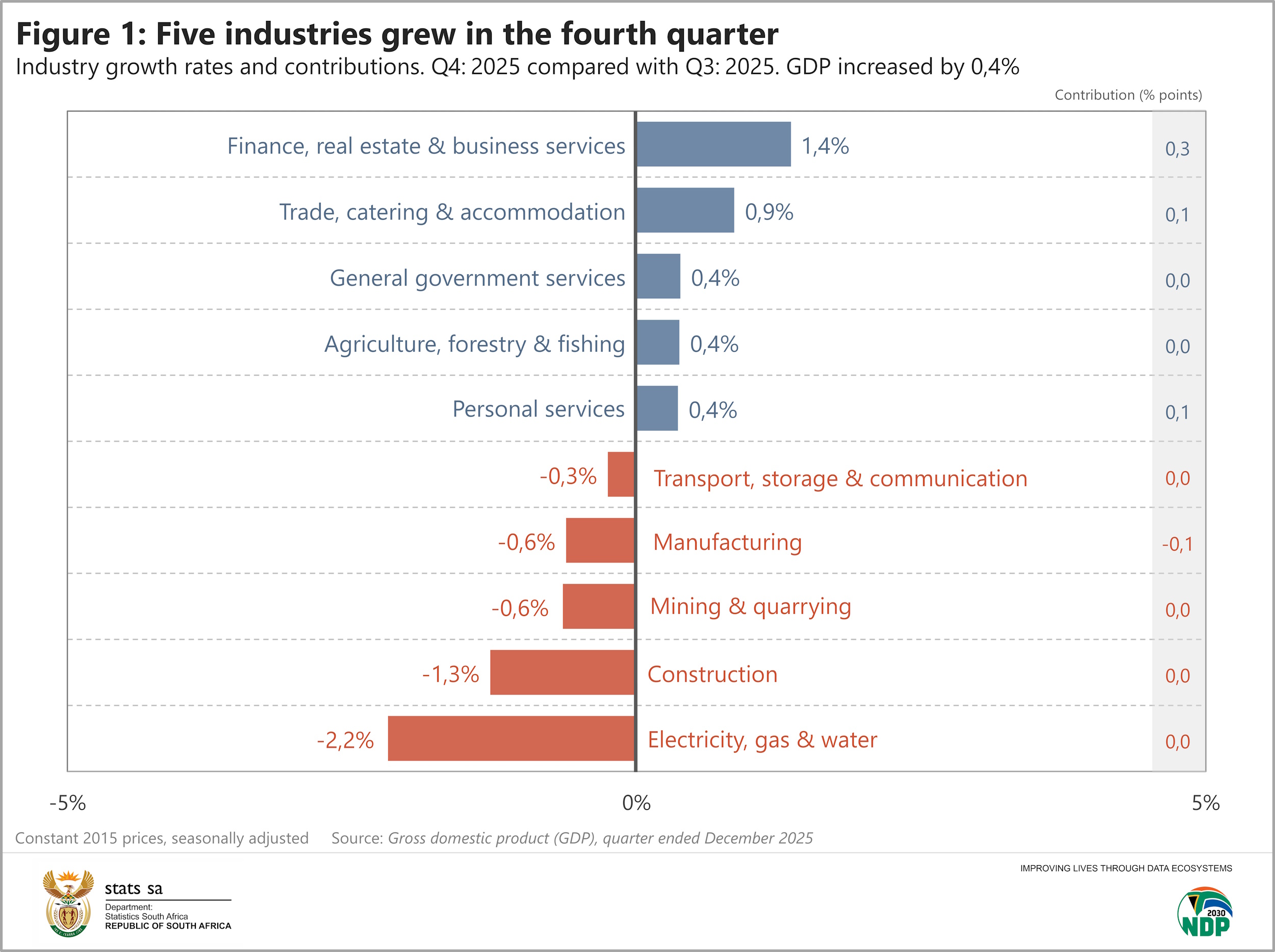
Trade, catering & accommodation and personal services also made notable positive contributions. Trade grew for a fifth consecutive quarter, supported by stronger results from wholesale trade, retail trade, motor trade, accommodation, and food & beverages. The personal services industry was driven higher by a rise in community services and other producers.
The provincial government and municipalities employed more civil servants in the fourth quarter, contributing to the 0,4% rise in general government services.
The agricultural industry recorded its fifth straight gain, supported by growth in field crops and horticulture products.
Not all was positive in the fourth quarter. Manufacturing was the largest negative contributor, shrinking by 0,6% and shaving 0,1 of a percentage point off GDP growth. The most significant downward pressure came from the automotive division; wood, paper & publishing; and food & beverages.
Following two quarters of growth, mining output disappointed. Coal, platinum group metals, gold and diamonds all declined in the fourth quarter. On the upside, there was a rise in the production of manganese ore, chromium ore, iron ore, nickel and copper, but not enough to keep the industry in positive territory.
Electricity, gas & water registered its second consecutive decline, contracting by 2,2%. This followed a revised 2,6% contraction in the third quarter.
Households, investments and the government lift expenditure on GDP
The demand side of the economy was also positive in the fourth quarter, with households, investments (gross fixed capital formation) and the government making positive contributions (see Figure 2 below).
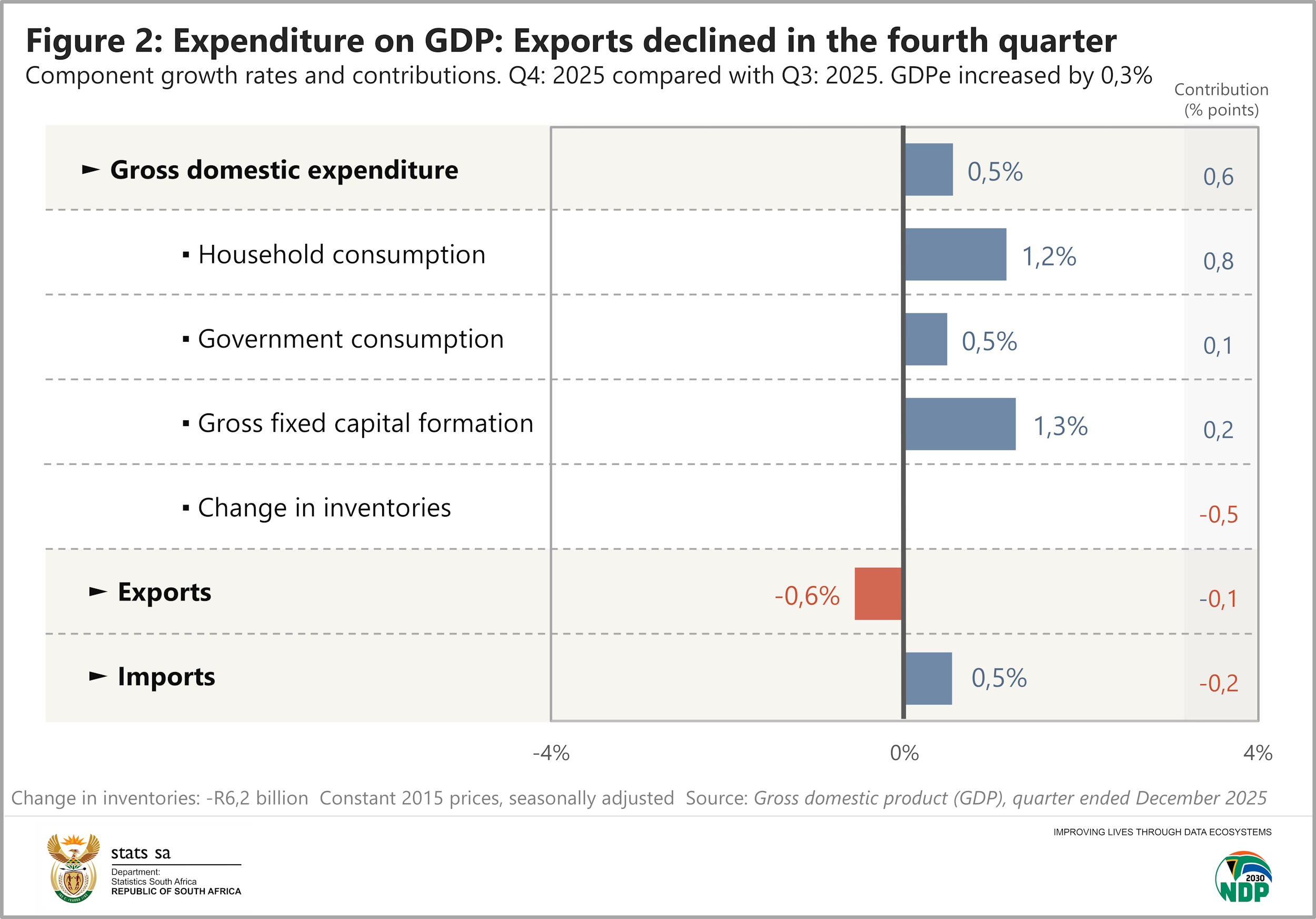
Household consumption spending expanded for a seventh consecutive quarter, rising by 1,2%. Consumers spent more across the board, most notably on miscellaneous goods and services (which includes insurance, for example); clothing & footwear; restaurants & hotels; and furnishings, household equipment & maintenance. Alcoholic beverages, tobacco and narcotics were less of a priority in the fourth quarter, with spending on this category declining by 0,2%.
Gross fixed capital formation, which includes investments in infrastructure, grew for a second consecutive quarter. The category ‘other assets’ was the most significant positive contributor, driven higher mainly by investments in computer software. Machinery & other equipment and construction works also contributed positively to gross fixed capital formation in the fourth quarter.
Exports declined by 0,6%, mainly due to a decline in the trade of vehicles & transport equipment (excluding large aircraft); vegetable products; and prepared foodstuffs, beverages & tobacco.
Imports increased by 0,5%, underpinned by a rise in the trade of machinery & electrical equipment; vehicles & transport equipment (excluding large aircraft); live animals & products; and vegetable products.
Winners and losers in 2025
The GDP estimates for the fourth quarter conclude the results for the calendar year. Real GDP expanded by 1,1% in 2025, led by growth in finance, real estate & business services; agriculture; and trade, catering & accommodation (see Figure 3 below). This follows the growth of 0,8% and 0,5% in 2023 and 2024, respectively.
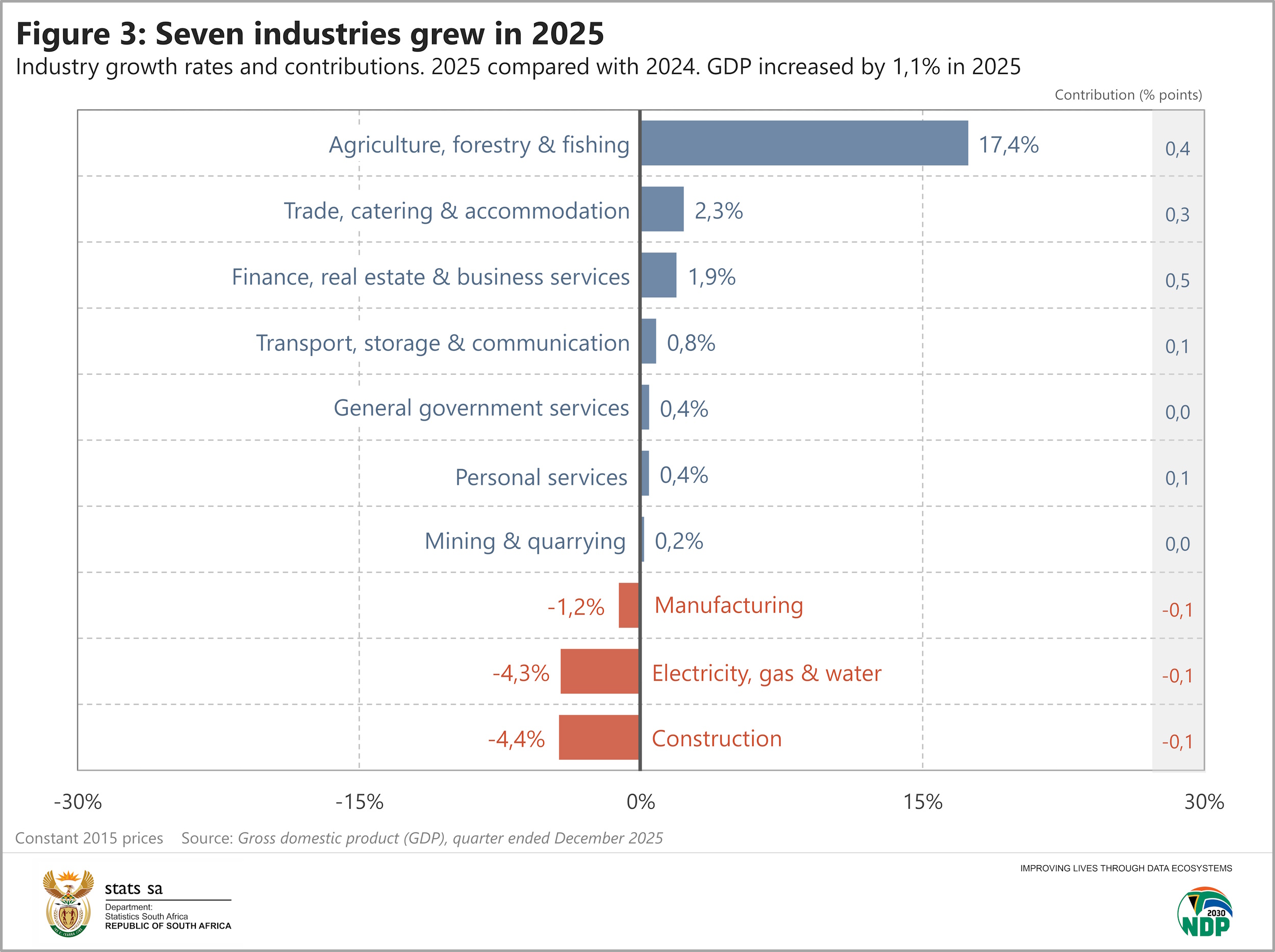
After a lacklustre 2023 and 2024, agriculture rebounded in 2025, expanding by 17,4%.
Manufacturing; electricity, gas & water; and construction disappointed in 2025, with manufacturing registering its second year of negative growth. Construction continued its long-term downward trend, posting its ninth straight year of decline.
For more information, download the GDP release, media presentation and Excel files here.
1 The quarter-on-quarter rates are seasonally adjusted and in real (volume) terms (constant 2015 prices).
Similar articles are available on the Stats SA website and can be accessed here.
For a monthly overview of economic indicators and infographics, catch the latest edition of the Stats Biz newsletter here.