Since South Africa’s transition to democracy in 1994, the nation has prided itself on its rich cultural and ethnic diversity, earning the title of the “Rainbow Nation.” Over the years, this diversity has not remained static – language, family structures, and religious affiliations have shifted, painting a dynamic picture of societal evolution.
A new report by Statistics South Africa, Cultural Dynamics in South Africa, explores the nation’s evolving social landscape. Part of the Census 2022 thematic series, the report provides a data-driven analysis of language use, multiracial households, religious affiliation, and marriage trends over the 26 years from 1996 to 2022.
IsiZulu Still Dominates, but South Africa’s Linguistic Landscape is Shifting
South Africa’s linguistic landscape has remained remarkably stable over the past three decades, with isiZulu maintaining its status as the most widely spoken language. In 1996, 22,8% of the population aged one year and older spoke isiZulu in their households. By 2022, this figure had edged up to 24,4%, reaffirming its dominance.
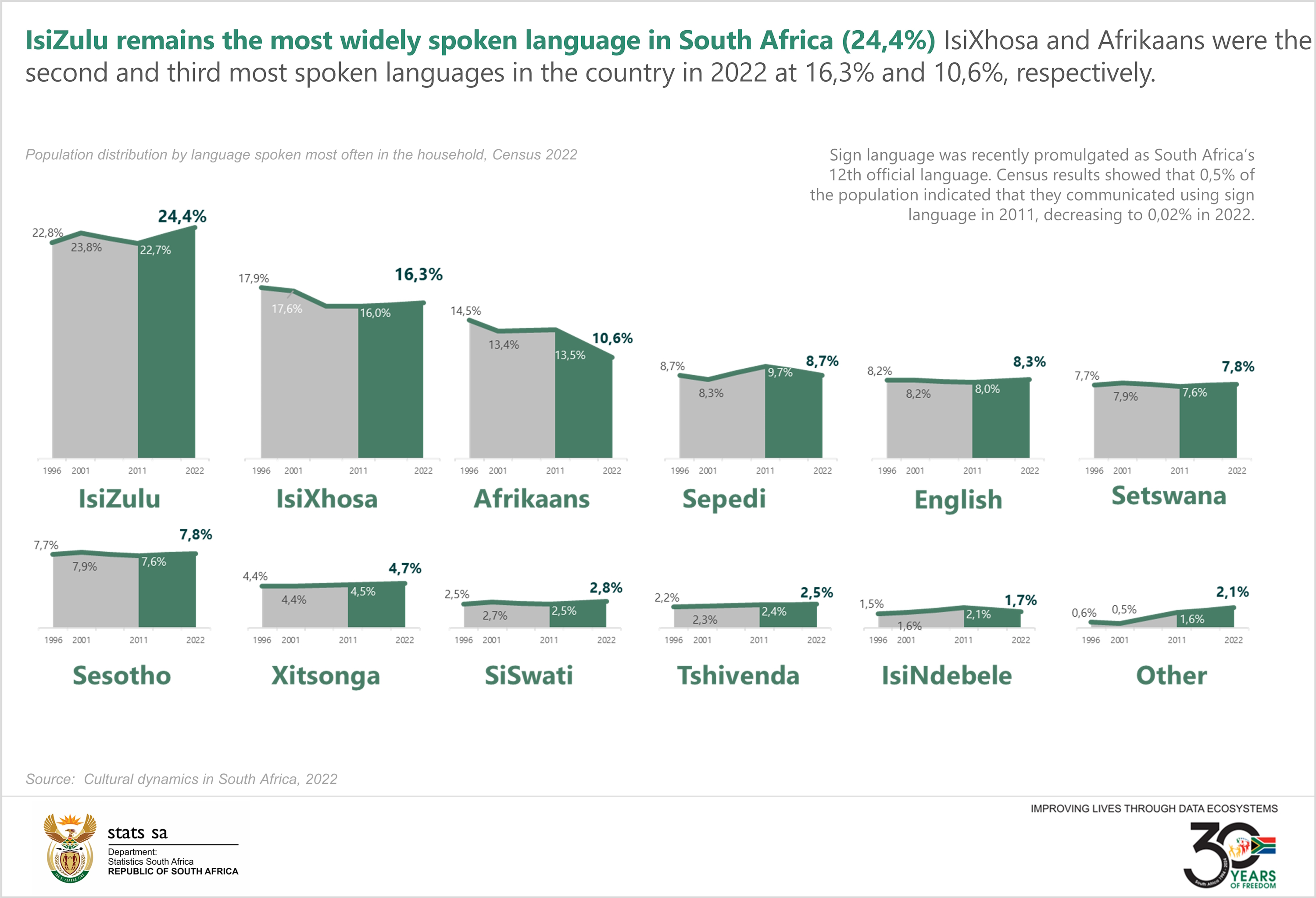
IsiXhosa and Afrikaans followed as the second and third most spoken languages in 2022, with 16,3% and 10,6% of the population using them as their primary means of communication in their respective households.
However, a closer look at the numbers reveals a growing linguistic diversity. Over 1,2 million South Africans spoke non-official languages in 2022, with Shona leading the pack at 721 124 speakers. Other widely spoken non-official languages included Chichewa/Chewa/Chinyanja/Nyanja (162 047), Portuguese (95 613), and a category of “other” languages (267 725). Meanwhile, Khoi, Nama, and San languages were still spoken by 6 124 individuals, predominantly in the Northern Cape.
Among the notable insights, multilingualism is on the rise, with an increasing number of households speaking multiple languages. In 1996, only 3,5% of households spoke more than one language. By 2022, this number had nearly tripled to 9,4%, with Gauteng at 17,0% and the Western Cape at 10,5% leading the trend – further evidence of South Africa’s evolving cultural tapestry.
The Rise of Multiracial Households in South Africa
South Africa’s social fabric is becoming increasingly diverse, with a sharp rise in multiracial households over the past two decades. Data reveal that the proportion of multiracial households has grown significantly – from just 1,3% in 2001 to 11,4% in 2022. This trend signals a shift in societal norms and greater racial integration in family structures.
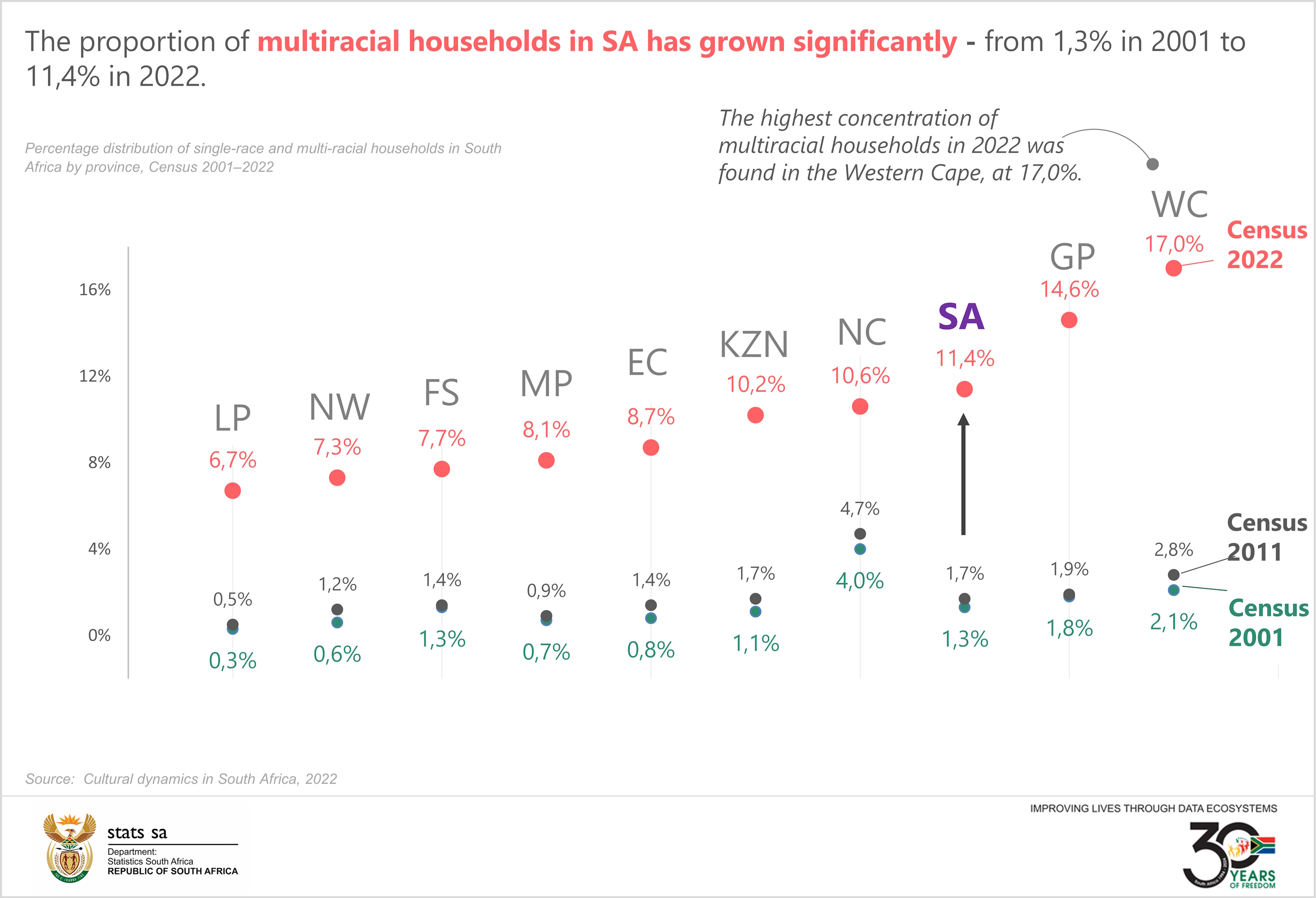
The highest concentration of multiracial households in 2022 was found in the Western Cape at 17,0%, and Gauteng at 14,6%. In contrast, Limpopo and North West recorded the lowest proportions at 6,7% and 7,3%, respectively, reflecting regional variations in demographic and social patterns.
Urban areas have been at the forefront of this transformation, with four out of five multiracial households located in cities. This urban dominance suggests that increased economic opportunities, diverse social interactions, and shifting cultural attitudes are fostering greater integration. Another striking feature of multiracial households is the role of women – 63,3% were female-headed in 2022, highlighting the evolving dynamics of household headship in South Africa.
Religion in South Africa: Christianity Dominates, but Secularism Rises
Religion remains deeply embedded in South African society, with most of the population identifying with a faith. Christianity continues to be the dominant religion, with 84,5% of South Africans affiliated with it in 2022. Among black Africans, coloureds and whites, over 85% reported Christian affiliation, reinforcing its stronghold across racial groups.
Hinduism remains a key religious identity within the Indian/Asian community, with 37,1% affiliating with the faith. This reflects the lasting influence of cultural and ancestral ties among South Africa’s Indian/Asian population.
However, a shift towards secularism is emerging, particularly among white South Africans. A multivariate analysis found that whites were 1,78 times more likely than black Africans to report having no religious affiliation.
Despite these changes, religion remains a central pillar of South African identity, shaping cultural traditions, social values, and community life across the nation.
Marriage in South Africa: A Declining Tradition Amid Changing Social Norms
Marriage in South Africa is undergoing a significant transformation, shaped by a blend of ethnic traditions, religious influences, and modern socio-economic factors. Over the years, evolving attitudes toward equality, individual rights, and personal freedom have redefined how South Africans approach marriage, leading to a noticeable decline in formal unions.
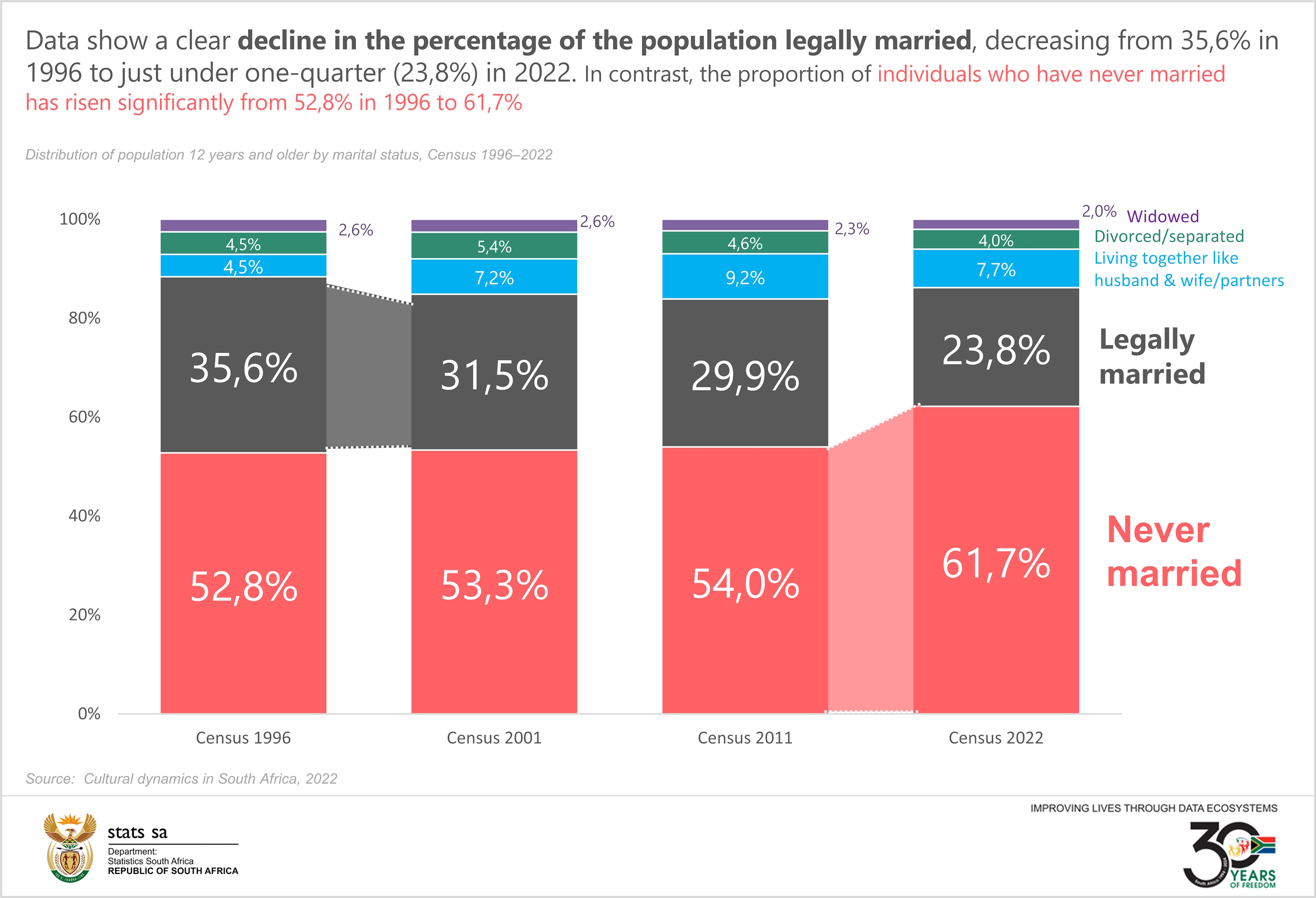
Statistics show a sharp drop in the percentage of legally married individuals, falling from 35,6% in 1996 to 23,8% in 2022. At the same time, the proportion of people who have never married has climbed significantly, from 52,8% to 61,7% over the same period. These figures suggest a shift away from conventional marital structures.
Marriage rates also vary across racial groups. In 2022, whites (54,8%) and Indians/Asians (48,5%) recorded the highest proportions of those who were married, while coloureds (30,2%) and black Africans (19,2%) recorded much lower marriage rates. This disparity may reflect historical, cultural, and economic differences in how marriage is perceived and practised among the different racial groups.
As societal expectations continue to evolve, South Africa’s approach to marriage appears to be shifting, with fewer people committing to legal unions and traditional marital norms.
South Africa’s cultural and social landscape is undergoing significant transformation. From a rise in multiracial and multilingual households to evolving marriage patterns and shifting religious affiliations, the nation’s diversity continues to grow. These changes reflect broader global trends of increased individualism and changing societal expectations. As South Africa navigates these shifts, it is clear that its social fabric is becoming more complex, diverse, and increasingly shaped by modern influences.
For more information, download the Cultural Dynamics in South Africa, here.