
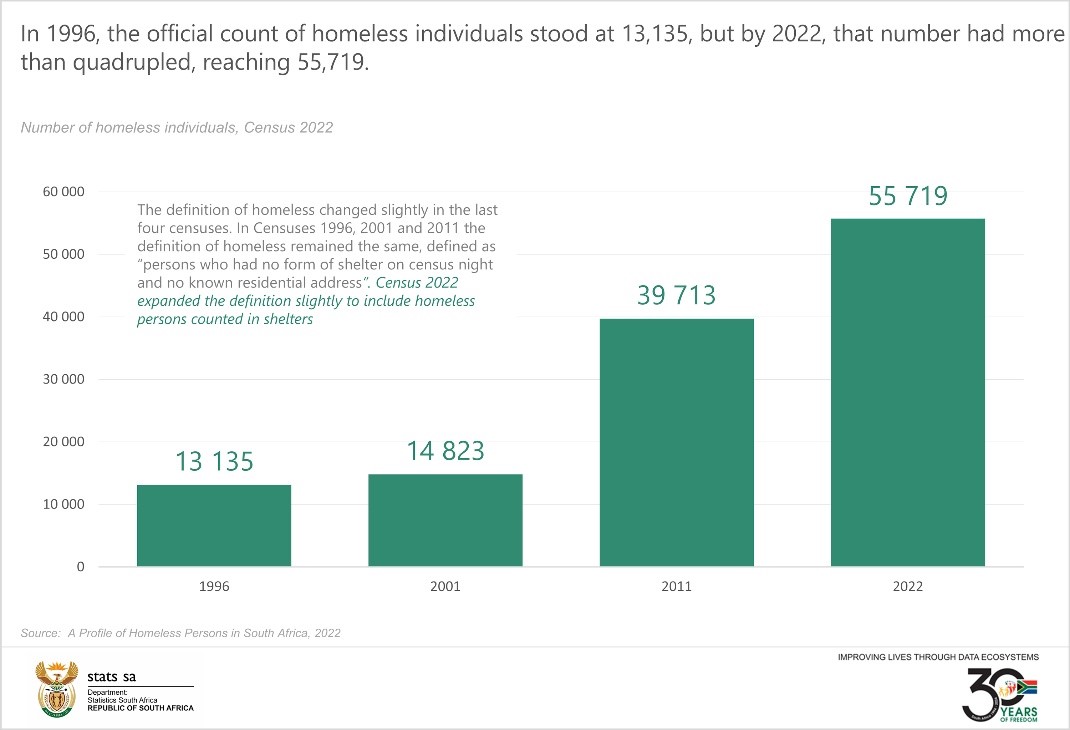
The number of homeless persons in South Africa has increased significantly over the past few decades, reflecting the ongoing challenges the country faces, particularly in the areas of inequality and poverty. According to a new report, A Profile of Homeless Persons in South Africa, 2022 released by Statistics South Africa (Stats SA), in 1996, the official count of homeless individuals stood at 13,135, but by 2022, that number had more than quadrupled, reaching 55,719.
Behind these numbers are real persons. They represent more than just numbers. They reflect the harsh reality faced by men, women, and children across the country who are forced to survive without stable shelter. Many are homeless , navigating unsafe and often inhospitable environments, while others find temporary refuge in shelters or makeshift accommodations.
A demographic analysis of the homeless population reveals that men make up the majority at 70,1%. Children (0-17 years) account for approximately 7%, while youth (15-34 years) represent 44%. Adults (35-59 years) comprise 45% of the total, and the elderly (60+ years) make up 7%.
Homelessness in South Africa varies across its nine provinces. Gauteng, the country’s economic hub, has the highest proportion of homeless individuals, with 46% of the national total. In contrast, Northern Cape and Mpumalanga have much smaller proportions, at 1,1% and 2,3%, respectively. At district level, homelessness is more common in metropolitan areas, which account for 74,1% of the homeless population. Non-metropolitan areas, including rural regions, account for 25,9% of the homeless population, showing that while urbanisation drives much of the homelessness, rural areas also face significant challenges in housing access and social support. Among the eight metropolitan areas, City of Tshwane has the largest share of homeless persons at 18,1%, followed by City of Johannesburg at 15,6%. Nelson Mandela Bay has the smallest proportion, with just 2,7%.
This geographical breakdown reveals the complexity of homelessness, which is generally classified into two main categories: primary homelessness (or rooflessness) and secondary homelessness. Primary homelessness refers to individuals who live without any shelter or permanent dwelling, such as those who sleep on the streets, in front of shops, on pavements, in parks, under bridges, in bushes or veldts, in abandoned buildings, or in vehicles. These individuals are often referred to as “roofless.” Secondary homelessness includes persons who frequently move between various types of accommodation, such as temporary dwellings, shelters, or other living arrangements. This category also covers individuals living in long-term “transitional” shelters, as well as those who, while residing in private homes, report having “no usual address” on their census form.
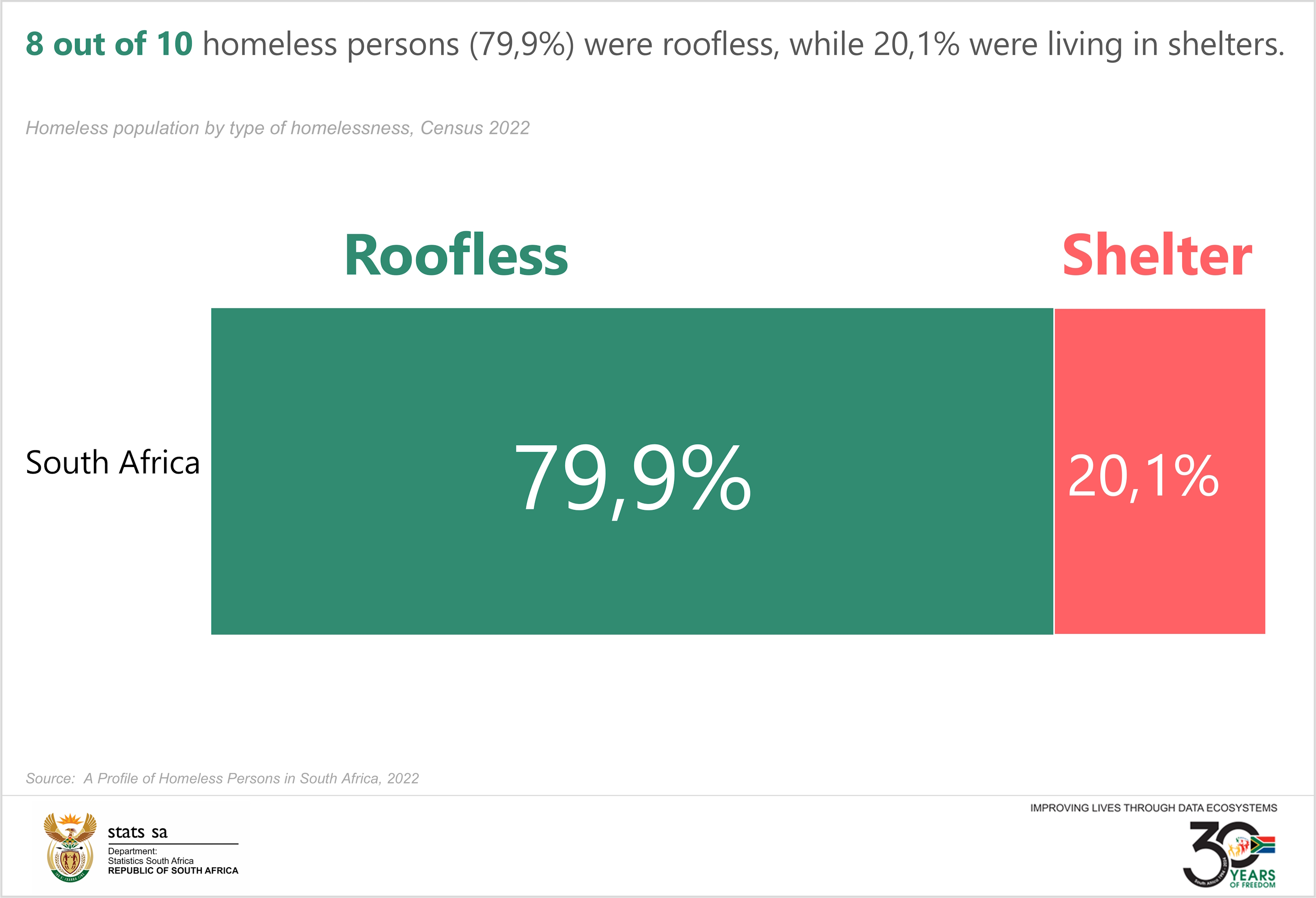
In the 2022 Census, homeless individuals were categorized into these two groups: those living on the streets or in makeshift shelters (roofless) and those residing in shelters. The results revealed that 8 out of 10 homeless persons (79,9%) were roofless, while 20,1% were living in shelters.
Homeless children under the age of 15 years were primarily in shelters (45,7%), followed by those in abandoned buildings or vehicles at 26,9%. Though a smaller proportion of the homeless population, children and the elderly are especially vulnerable, with homelessness exacerbating their risks.
The variations in population groups also highlighted that homelessness was most prevalent among black Africans, who accounted for 76,7% of the homeless population compared to other groups. Additionally, most homeless individuals were unmarried, with 84,5% falling into this category.
Unemployment was the primary reason for homelessness, cited by most of the homeless population at 54%. Drug and alcohol use contributed to 11,7%, while 8,4% reported a lack of income and 8% pointed to conflicts with friends and family. These findings align with studies that emphasise unemployment as a major stress factor for poor households in South Africa, often leading to homelessness. Substance abuse, family conflicts, and domestic violence are also commonly identified as contributing factors.
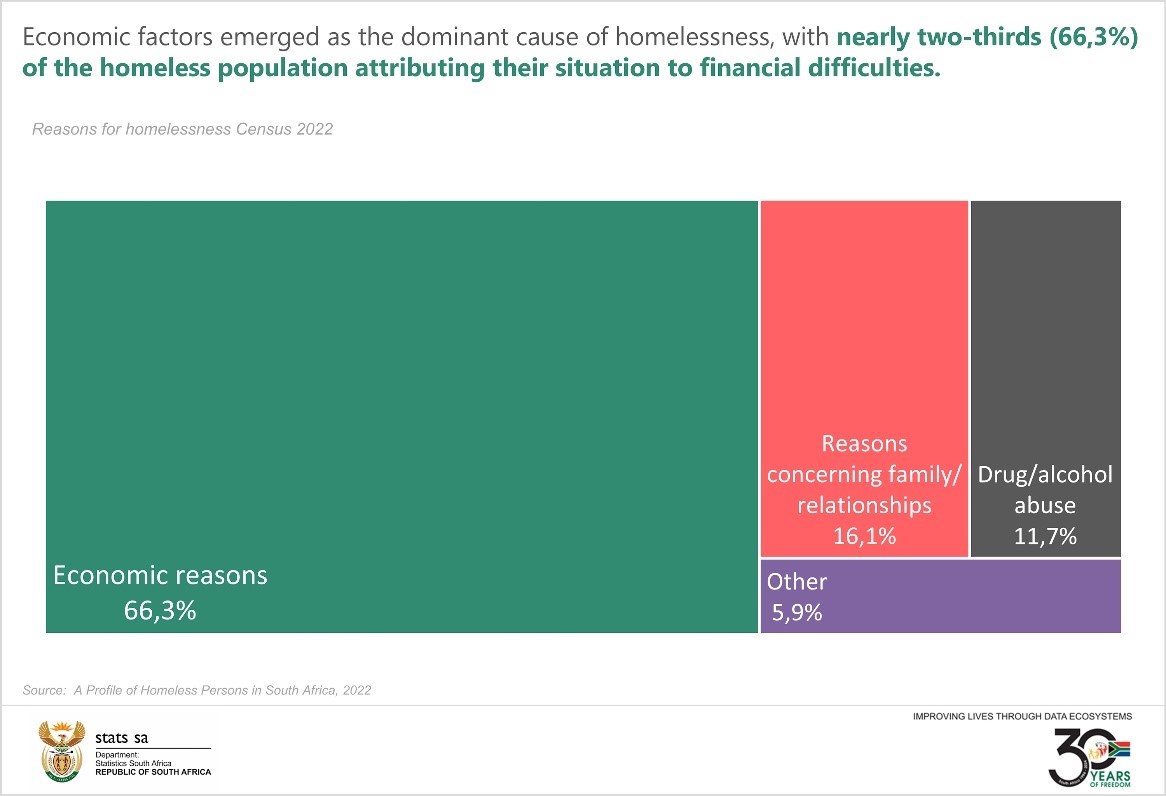
When the reasons for homelessness were grouped, economic factors emerged as the dominant cause, with nearly two-thirds (66,3%) of the homeless population attributing their situation to financial difficulties. Family-related issues (16,1%), substance abuse (11,7%), and other reasons (5,9%) made up the remaining third. Breaking down these reasons by gender reveals further distinctions.
Among homeless men, economic reasons were the most common (56,2%), followed by drug/alcohol abuse (14,5%) and arguments with friends or family (9,2%). For homeless women, economic reasons were even more prevalent, cited by nearly four-fifths (78,4%) of respondents. However, slightly more women than men reported arguments with friends and family (4,8%) as the cause, compared to drug or alcohol abuse (4,4%).
Reasons for homelessness also differ by age, revealing distinct patterns across age groups. Younger individuals, particularly those between the ages of 15 and 34, are almost three times more likely to cite drug or alcohol use as the cause of their homelessness (7,4%) compared to those aged 35–59 (21,2%).
Economic reasons, such as unemployment and a lack of affordable housing, are the most common causes of homelessness among older individuals, particularly those aged 35 to 39, who make up 62,4% of those citing economic reasons. Additionally, family-related issues such as divorce, arguments with family, and domestic violence were more likely to affect those in the 15–34 (63,3%) and 35–39 (31,7%) age groups.
Homelessness in South Africa varies across provinces due to factors such as migration, economic activity, and social issues. For instance, Western Cape faces high in-migration, expensive housing, and widespread substance abuse (Roets et al., 2016; Herron, 2023). In Gauteng, economic opportunities drive many migrants to the province. Economic factors were the main cause of homelessness across all provinces, with significant regional variation. In Eastern Cape, 85,2% of homelessness was driven by economic factors, followed by 79,4% in Free State and 69.3% in KwaZulu-Natal. However, in Northern Cape, only 43,9% cited economic reasons, with 39,7% attributing homelessness to family issues. Limpopo had 23,1% of cases linked to substance abuse. These regional differences highlight the need for tailored solutions to address homelessness.
For more information, download the full report here.