South Africa, a country shaped by its young population, is quietly undergoing a demographic shift that could reshape its future. While the country still has a relatively young population compared to many developed nations, declining birth rates and increasing life expectancy are steadily pushing the median age upward. As the working-age population shrinks in proportion, the question arises: Is South Africa ready for an aging society, or will we be caught unprepared?
A new report from Statistics South Africa (StatsSA) titled South African Age-Sex Structure, 1996-2022: Is the Population Ageing? highlights an upward trend in the country’s median age across all population groups, although the shift is not uniform. The report reveals that while the median age for the white population increased from 33 years in 1996 to 45 years in 2022, the rise among black Africans has been less consistent. By 2022, whites (45) and Indians/Asians (37) recorded the highest median ages, while the black African population remained significantly younger at a median age of just 27. According to the data, all population groups—except for the black African community—are now considered to be aging.
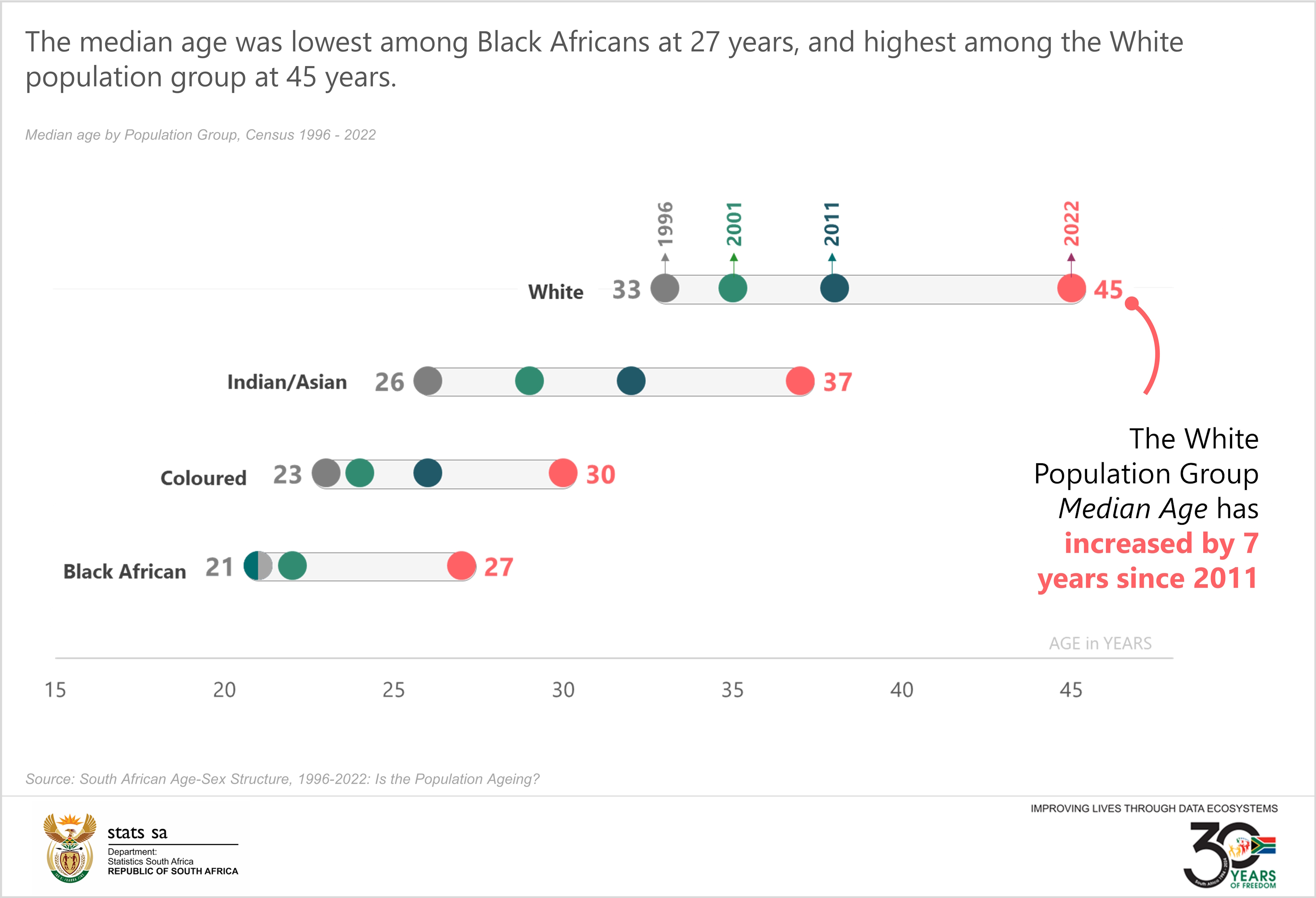
Median age is a key measure used to understand a country’s population structure. This figure helps determine whether a population is considered young, intermediate, or old. According to experts, a median age below 20 indicates a young population, between 20 and 29 is classified as intermediate, and 30 or older means the population is aging.
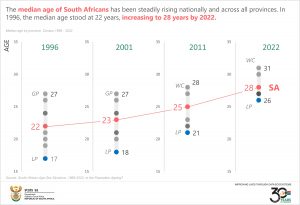
According to the data, the median age of South Africans has been steadily rising nationally and across all provinces. In 1996, the median age stood at 22 years, increasing to 28 years by 2022. Western Cape (31) and Gauteng (30) recorded the highest median ages, making them the only provinces now classified as having an “old” population. In contrast, Limpopo had the lowest median age at 26 years. All other provinces, except for Western Cape and Gauteng, still fall within the “intermediate” age category
Proportion of the population aged 60 years and older
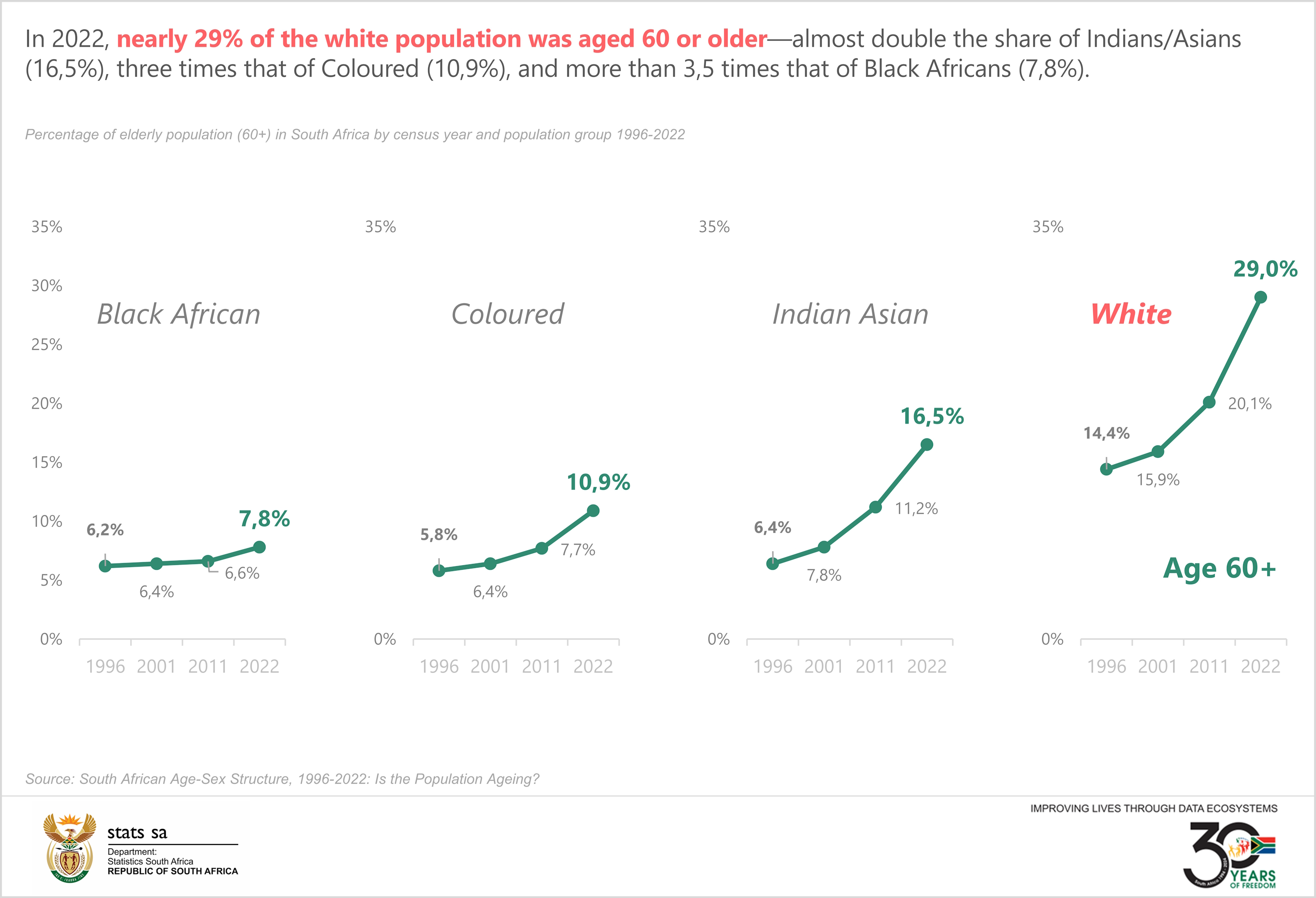
The proportion of South Africans aged 60 and older has been steadily increasing, rising from 7,0% in 1996 to 9,8% in 2022. Among population groups, the white population have the highest percentage of elderly citizens, followed by the Indian/Asian community, while black Africans have the lowest. In 2022, about 29% of the white population was aged 60 or older—almost double the share of Indians/Asians (16,5%), three times that of Coloured (10,9%), and more than 3,5 times that of black Africans (7,8%).
The proportion of South Africans aged 60 years and older has increased in every province, according to new data. In 2022, the Eastern Cape recorded the highest percentage of elderly residents at 12,3%, followed by the Western Cape (11,0%) and Free State at 10,6%. In contrast, Gauteng and Mpumalanga had the lowest share of residents in this age group.
South Africa’s Elderly Population Growing Faster Than Youth in Some Population Groups
The aging index measures how many people aged 60 and older exist for every 100 children under the age of 15. If the index is below 100, there are more young people than elderly, but if it’s above 100, older people outnumber the young.
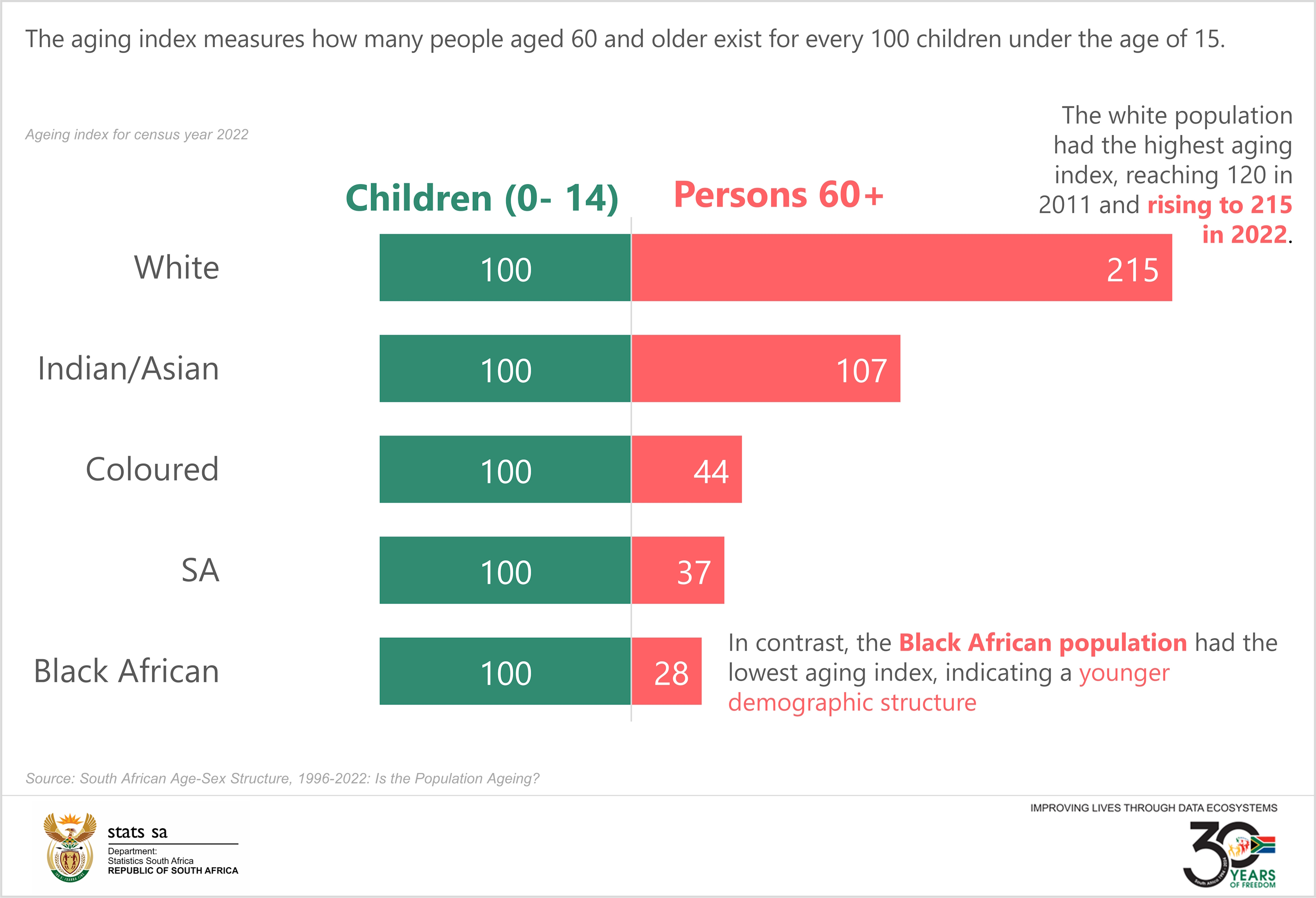
According to the data, South Africa’s aging index has been rising across all population groups and by sex. The white population had the highest aging index, reaching 120 in 2011 and rising to 215 in 2022. The Indian/Asian population also saw a notable increase, reaching 107 in 2022. In contrast, the black African population had the lowest aging index, followed by the coloured population, indicating a younger demographic structure in these population groups.
In 2022, the Western Cape had the highest aging index at 49, while Mpumalanga recorded the lowest at 29. Throughout the study period, the Western Cape consistently remained the highest with elderly residents, whereas Mpumalanga maintained the youngest population.
South Africa’s Population Still Youthful, But Aging Trends Emerging
While South Africa remains a predominantly young nation, clear aging trends are emerging. The white and Indian/Asian populations, along with residents of the Western Cape and Gauteng, show the most significant shifts toward an older demographic. These patterns reflect differences in fertility, mortality, and migration across population groups, shaping the country’s evolving age structure.
For more information, download the full report here.