
The 2025 State of the Nation Address (SONA) underscored South Africa’s pressing labour market challenges, with unemployment remaining a top national concern. The Quarterly Labour Force Survey (QLFS) reports an unemployment rate of 31,9% in Q4: 2024, reflecting the continued difficulty many South Africans face in securing jobs. Beyond unemployment, time-related underemployment remains a challenge, recorded at 4,6% in the same quarter.
Time-related underemployment is defined as all persons in employment who wanted to work additional hours, whose working time in all jobs was less than 35 hours a week, and who were available to work additional hours given an opportunity for more work. Approximately 788 000 employed South Africans struggled to secure enough working hours in the fourth quarter of 2024.
Trends of time-related underemployment
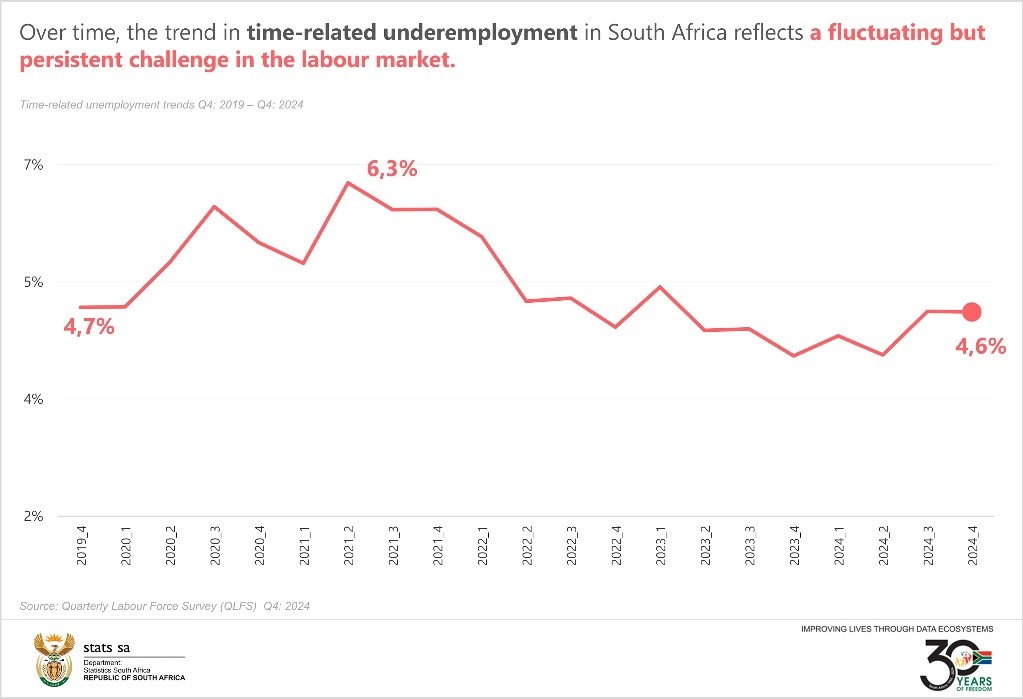
Over time, the trend in time-related underemployment in South Africa reflects a fluctuating but persistent challenge in the labour market. The underemployment rate was recorded at 4,7% in Q4: 2019, increasing by 0,8 of a percentage point to 5,5% in Q4: 2020. This likely reflects the impact of the COVID-19 pandemic and subsequent economic disruption. The rate increased to 5,9% in Q4: 2021 before falling to 4,4% in Q4:2022 and further declining to 4,1% in Q4: 2023. While the downward trend from 2021 to 2023 suggests some slight recovery in the labour market, the current underemployment rate remains slightly below pre-pandemic levels at 4,6%, a difference of 0,1 of a percentage point. Despite improvements, many workers are still unable to secure enough working hours, pointing to ongoing issues with job quality and the availability of full-time work opportunities.
Industry Breakdown: Where is underemployment the highest?
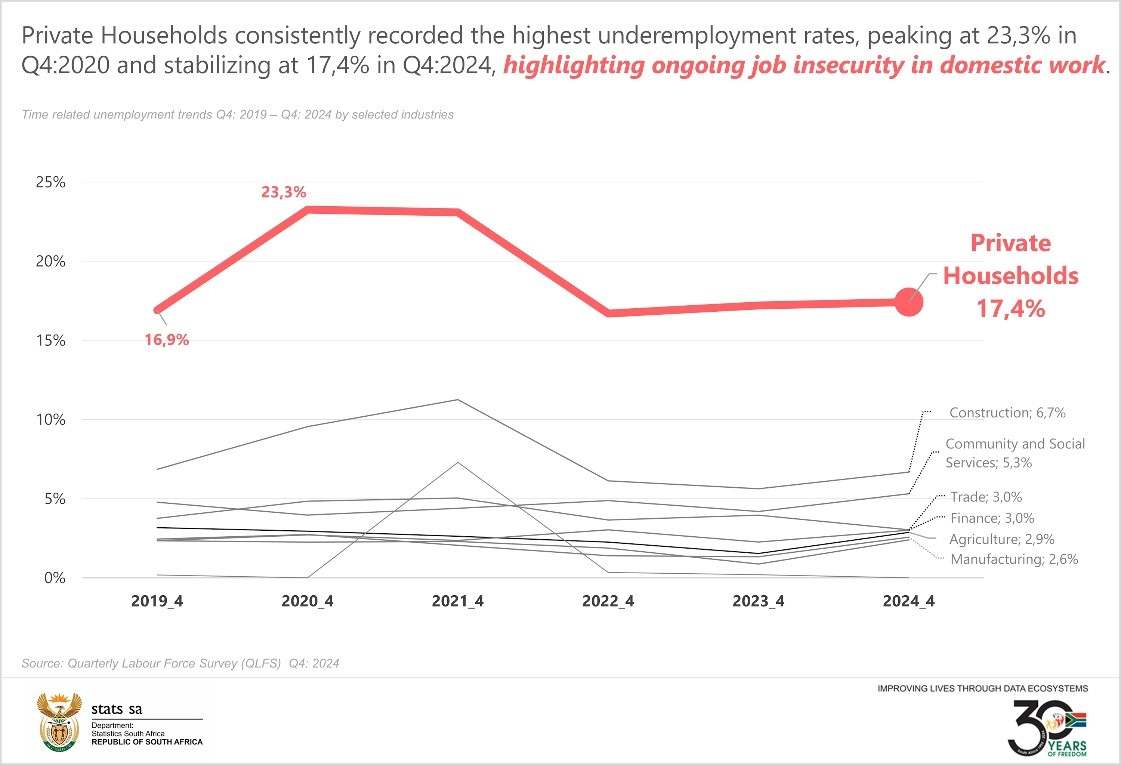
Between Q4: 2019 and Q4: 2024, time-related underemployment trends varied widely across industries, influenced by sector-specific challenges and the long-term repercussions of the COVID pandemic. Private households consistently recorded the highest underemployment rates, peaking at 23,3% in Q4: 2020 and stabilising at 17,4% in Q4: 2024, highlighting ongoing job insecurity in domestic work. Construction experienced a sharp rise to 11,3% in Q4: 2021 before declining to 6,7% in Q4: 2024, though it remained relatively high. Similarly, Trade and Community & social services maintained moderate levels of underemployment, while Agriculture, Manufacturing, and Transport experienced steady declines, suggesting improving job stability. Mining stood out for its volatility, rising to 7,3% in Q4: 2021 before dropping back to 0,2% in Q4: 2023 indicating recovery and a return to more stable employment patterns. These trends underscore the uneven recovery across industries, with some stabilising while others – particularly domestic work and construction – continue to face persistent employment challenges.
Uneven impact on certain groups: Who bears the greatest burden?
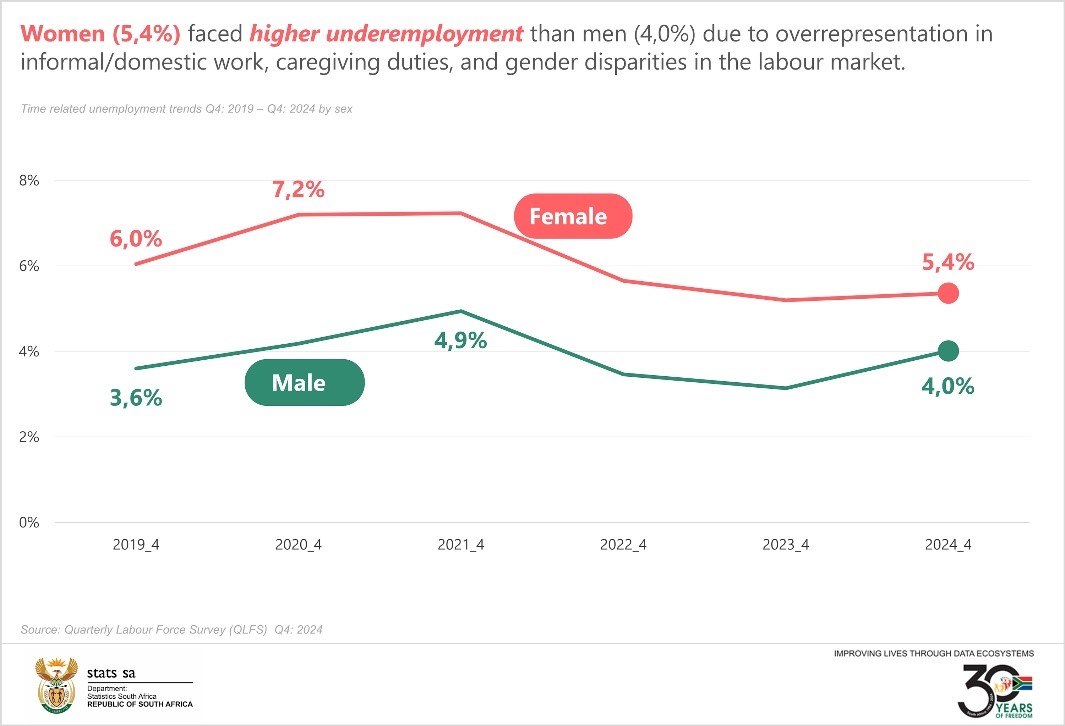
In Q4: 2024, underemployment remained uneven across demographic groups. Women (5,4%) faced significantly higher underemployment than men (4,0%) largely due to their over-representation in informal and domestic work, caregiving responsibilities and broader gender disparities in the labour market. The youth (15–34 years) reported an underemployment rate of 4,3%, slightly lower than the national underemployment rate of 4,6%. In contrast, adults (35–64 years) had an underemployment rate of 4,8%; this is higher than the national underemployment rate, suggesting that while the youth face challenges in the labour market, adults are experiencing a higher level of underemployment than the general workforce.
Data for Q4: 2024 reveal significant provincial variations in time-related underemployment. Limpopo (7,4%), Free State (6,3%), Eastern Cape (6,1%), Mpumalanga (5,3%), and KwaZulu-Natal and Northern Cape (both at 5,0%) recorded the highest rates, highlighting challenges in securing sufficient working hours. In contrast, Gauteng (3,8%), Western Cape (3,4%) and North West (2,2%) had the lowest rates. The disparity between provinces highlights significant regional inequalities and the prevalence of inadequate employment opportunities.
These trends reveal the instability faced by vulnerable groups in the labour market, necessitating targeted interventions to strengthen job security, enhance working conditions, and promote stable employment.
The International Labour Organization (ILO) recommends that countries should measure labour underutilisation, which refers to mismatches between labour supply and demand, which translates into an unmet need for employment among the population. One of the measures of labour underutilisation is time-related underemployment. The ILO defines this as “when the working time of persons in employment is insufficient in relation to alternative employment situations in which they are willing and available to engage.”[1]
For more information, download the Quarterly Labour Force Survey (QLFS) here.
[1] ILO Resolution concerning statistics of work, employment and labour underutilization