


South Africans may feel relatively safe in their neighbourhoods during the day, but that sense of security changes considerably after dark. The latest findings from Statistics South Africa’s (Stats SA’s) Governance, Public Safety and Justice Survey (GPSJS) 2025/26 show a mixed picture: while most individuals continue to feel safe walking alone in their neighbourhoods during the day, fewer than two in 5 feel safe doing so when it is dark.
In 2025/26, 80,7% of individuals said they felt safe walking alone in their neighbourhood during the day, down slightly from 81,0% in 2024/25. When it is dark however, the picture was different. About 37,9% felt safe walking alone, an improvement from 36,1% in 2024/25.
Where individuals live also matters. Limpopo stood out as the province where individuals felt safest, with 98,0% of individuals saying they felt safe walking alone in their neighbourhood during the day and 69,1% feeling safe when it is dark.
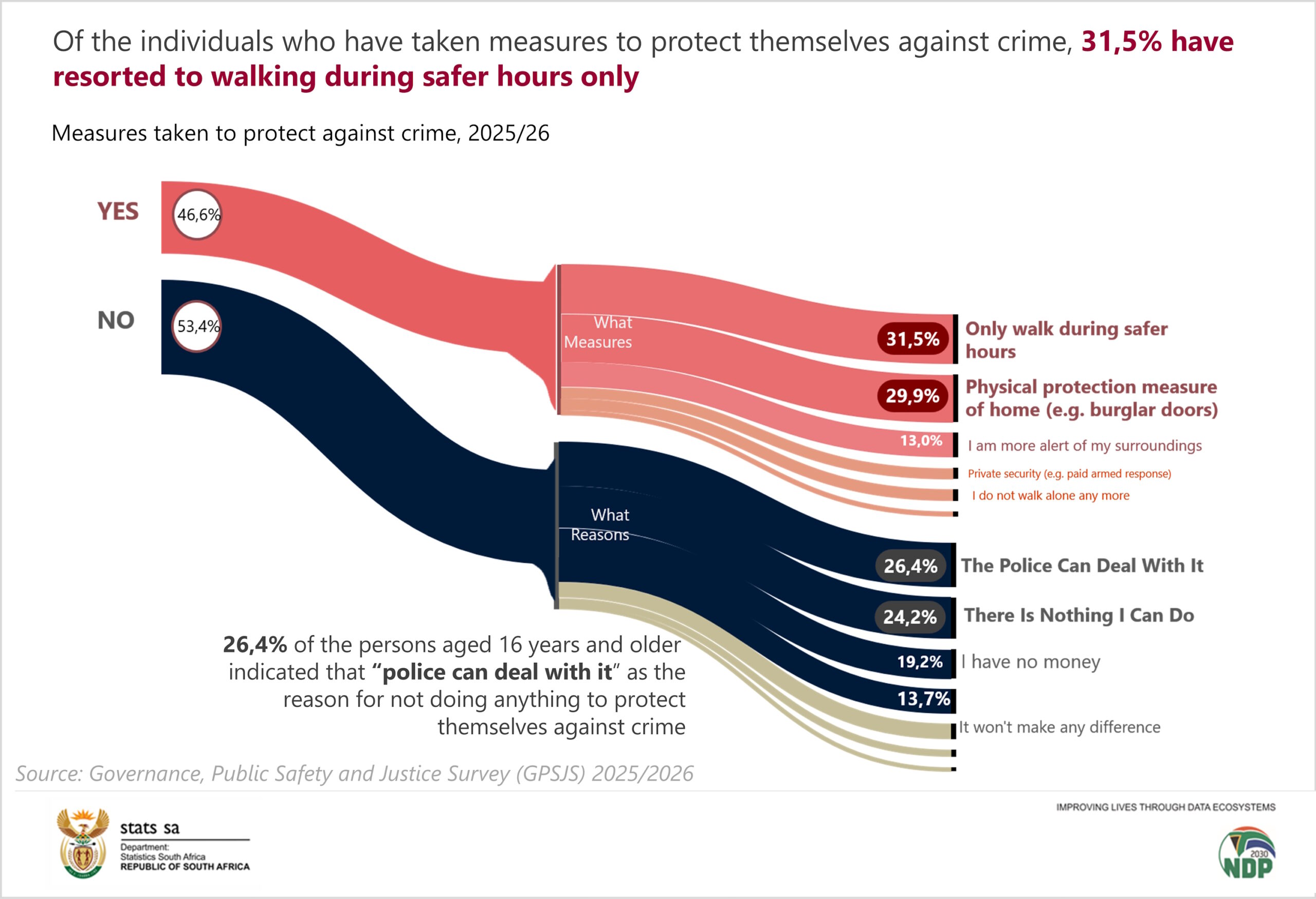
That sense of caution is also reflected in the steps individuals take to protect themselves. The proportion of individuals who had done something to protect themselves against crime increased from 43,3% in 2024/25 to 46,6% in 2025/26. The most common measure was to resort to only walking during safer hours (31,5%) followed by those who installed physical security measures (29,9%), such as burglar doors, to protect themselves against crime.
At home, housebreaking remains the biggest threat
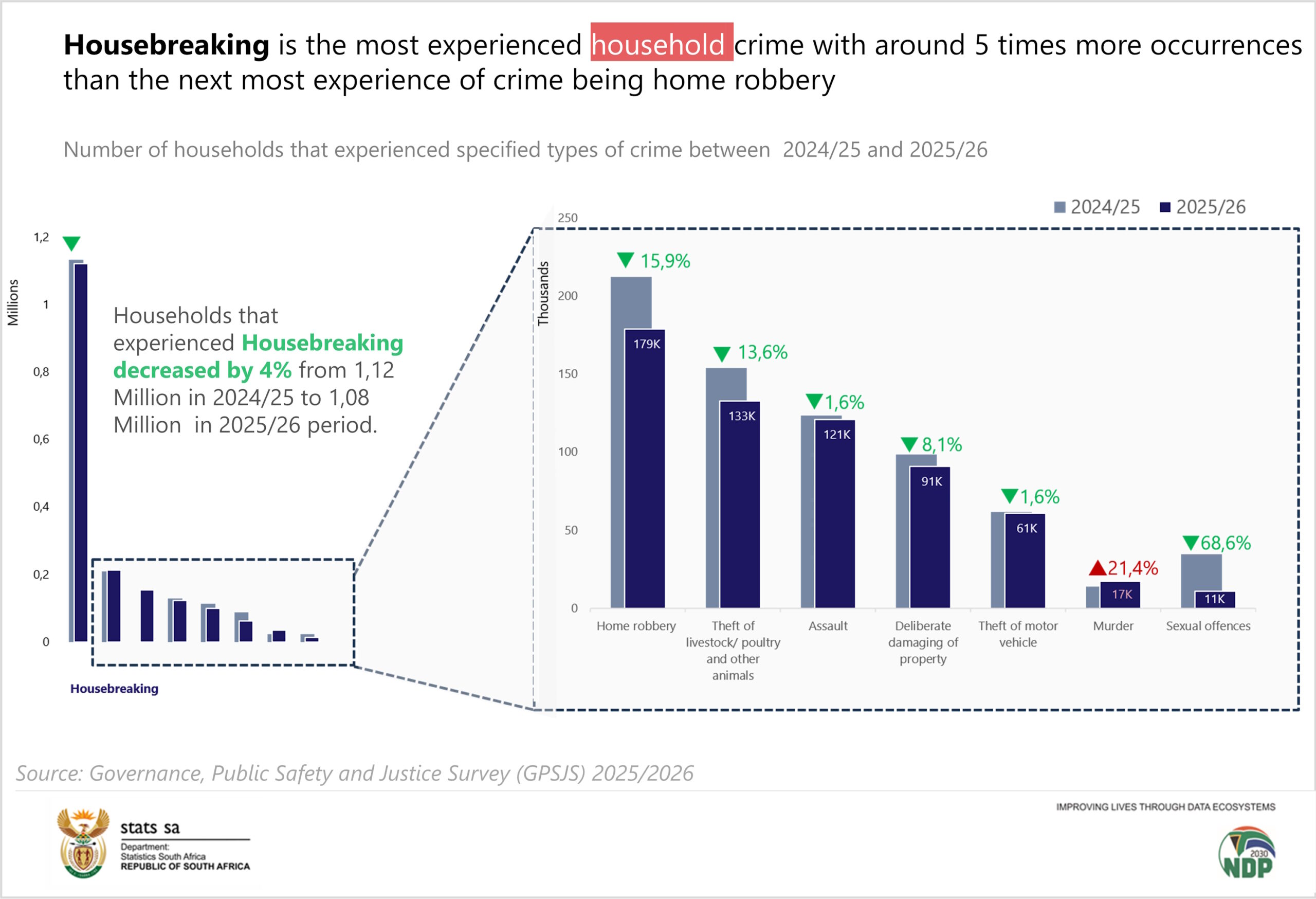
The precautions people are taking are not without reason. “Home robbery” is regarded as a violent crime because people are at home when it takes place as compared to “housebreaking” (burglary), which occurs when the family is away from home. Housebreaking/burglary remained the most common crime experienced by households in 2025/26, despite most household crimes showing slight decreases compared with the previous year. Home robbery was the second most common household crime.
An estimated 1,5 million incidents of housebreaking were recorded during the year, affecting 5,3% of households across the country. Male-headed households, households where the head had a post-school qualification, and households in KwaZulu-Natal and Northern Cape were most affected.
However, the experience of crime does not always translate into a police report. Only about 48% of households affected by housebreaking reported their cases to the police. This was an improvement of 4,8 percentage points from the previous year; however, it still means that more than half of affected households did not report the crime.
For individuals, theft is the most common experience
The pattern shifts when looking beyond the household to crimes experienced by individuals. Theft of personal property was the most common personal crime in 2025/26, affecting about 1,2 million individuals, or 2,6% of individuals aged 16 years and older.
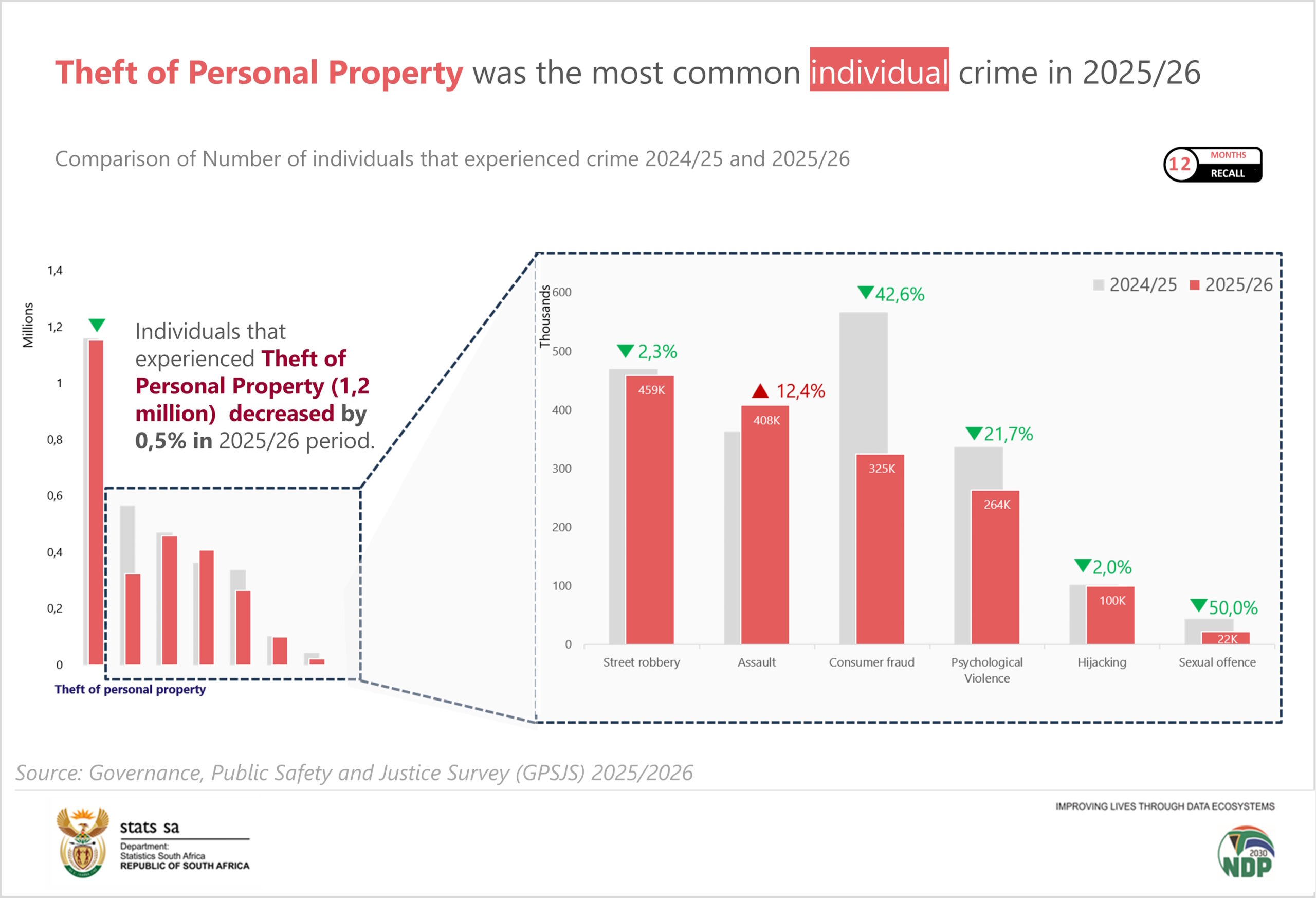
An estimated 1,4 million incidents of personal theft took place during the year. Males and individuals living in Western Cape and KwaZulu-Natal were more likely to experience these thefts.
As with housebreaking, many incidents never reached the police. 62,7% of victims chose not to report their experience of theft of personal property, while 37,3% reported some of or all the incidents.
Street robbery was the next most common personal crime. Unlike theft of personal property, its incidence fell slightly, from 529 000 in 2024/25 to 515 000 in 2025/26. The proportion of street robbery incidents reported to the police increased from 36,4% to 41,7%.
Assault cases rise as other individual crimes fall
Not all individual crimes followed the same downward pattern. The number of individuals who experienced assault increased from 363 000 in 2024/25 to 408 000 in 2025/26.
Men experienced assault more often than women. However, the relationship between victims and perpetrators reveals a notable gender difference: 31,4% of female victims, compared with 2,2% of male victims, said the perpetrator was a spouse or intimate partner.
Most victims reported that a weapon had been used during the assault. Knives were the most used weapon, followed by sticks or clubs.
A picture that goes beyond reported crime
The GPSJS 2025/26 paints a picture of crime that cannot be understood through police statistics alone. It shows not only the crimes that households and individuals experience, but also how individuals perceive their safety, the measures they take to protect themselves and the incidents that never make it into police records.
For South Africans, the experience of crime therefore extends beyond the number of cases reported. It can shape whether someone feels comfortable walking home after dark, whether a household invests in additional security and whether a victim ultimately decides to report what happened. Together, these experiences provide a broader picture of how crime continues to shape everyday life in the country.
For more information, download the full report here.