
While most learners in South Africa are able to access education, particularly at basic education level, a new report by Statistics South Africa highlights those who remain excluded from the education they aspire to, largely due to cost pressures. Despite education being a national priority, rising education-related expenses continue to place learning opportunities beyond the reach of many vulnerable households.
According to the Household and Government Expenditure on Education, 2025 report, close to 1,3 million people in 2015 and 1,4 million people in 2024 aged 5–24 who were not attending school said it was because they had already completed the level of education they wanted or that they were working. Together, these reasons accounted for about one out of every four cases in both years (26,3% in 2015 and 26,5% in 2024), showing that many young people exit education as part of normal life transitions.
Cost, however, remains a major barrier. Nearly one‑third of non‑attending individuals said they could not afford school fees, with 31% reporting this in 2015 and about 30% in 2024. While the national picture shows little change, the situation worsened in some provinces. In Gauteng, the share of young people excluded because of cost rose from 37,6% in 2015 to 42% in 2024, while in Mpumalanga it increased from 33,9% to 39%. These trends show that for many households, the cost of education remains out of reach.
Affordability encompasses a wide range of costs, including tuition fees, accommodation, transport, learning materials, and the opportunity cost of foregone income. The variable used here captures only whether tuition itself is considered affordable and does not account for these additional expenses.
The cost of education becomes most visible when looking at how far young people get before money runs out. In 2015 around 1,4 million and in 2024, around 1,5 million people aged 5–24 said they were not in school simply because they could not afford the fees. In 2015, almost 60% of this group had already reached Grade 12. Others fell out earlier: about 12% after Grade 11, roughly 7% after Grade 10, and a similar share after Grade 9.
By 2024, the data shows that financial pressure was increasingly felt after matric, rather than earlier in the school system. Nearly three‑quarters (73%) of those excluded for financial reasons had completed matric, showing that the barrier is no longer getting through school, but what comes next. Even with financial aid available through the National Student Financial Aid Scheme (NSFAS), many matriculants are still unable to make the jump into post‑school education.
Fewer learners are leaving the education system before Grade 10 than in the past; however, those learners leaving after Grade 11 remain relatively high, suggesting that young people are staying in the system longer before financial pressures interrupt their progress — often at the point where further study becomes more costly.
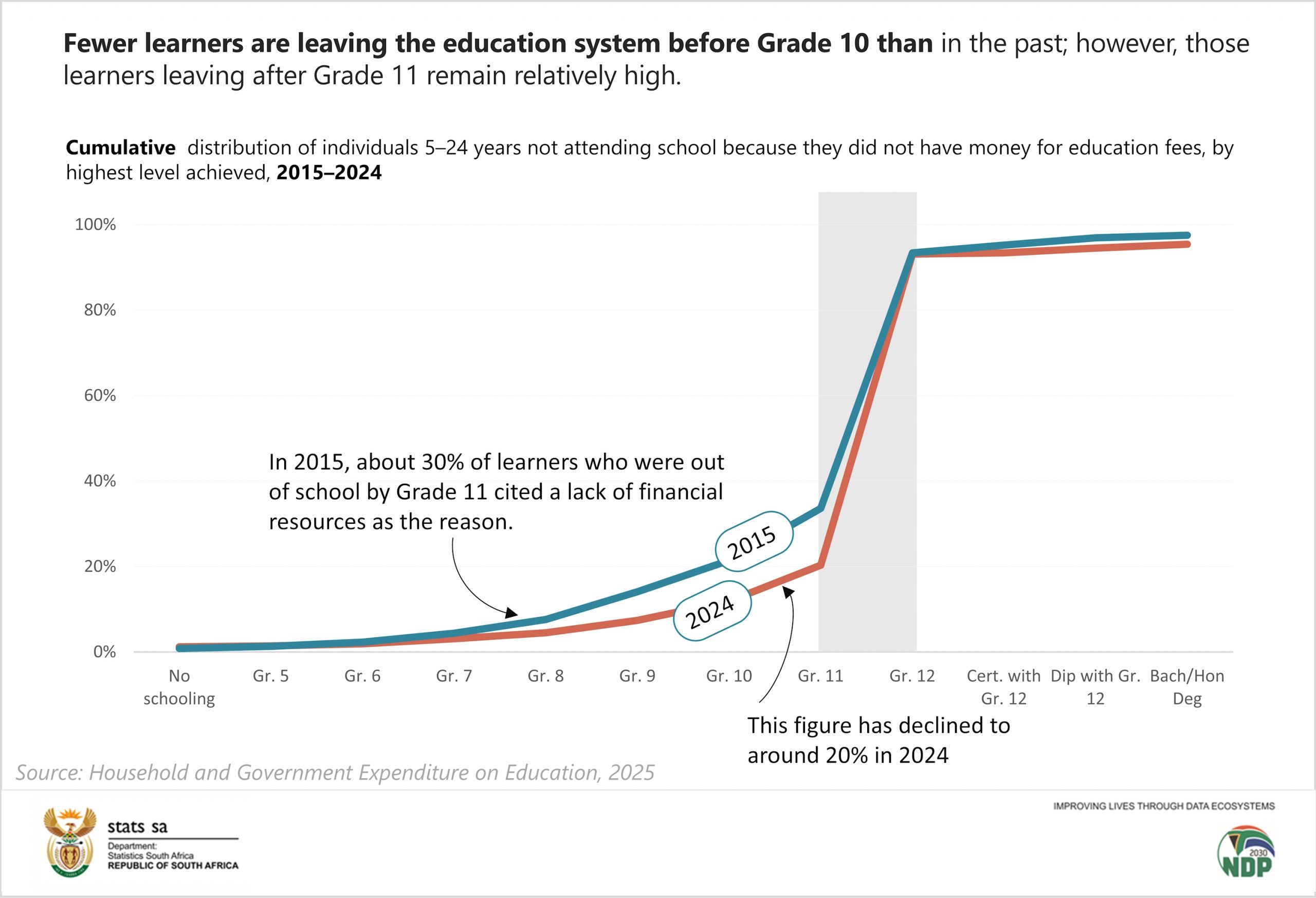
By 2024, certificates had become less common, while more learners emerged with diplomas and bachelor’s degrees. For this minority, pathways have opened. For many others, however, the price of post‑school education continues to decide how far learning can go.
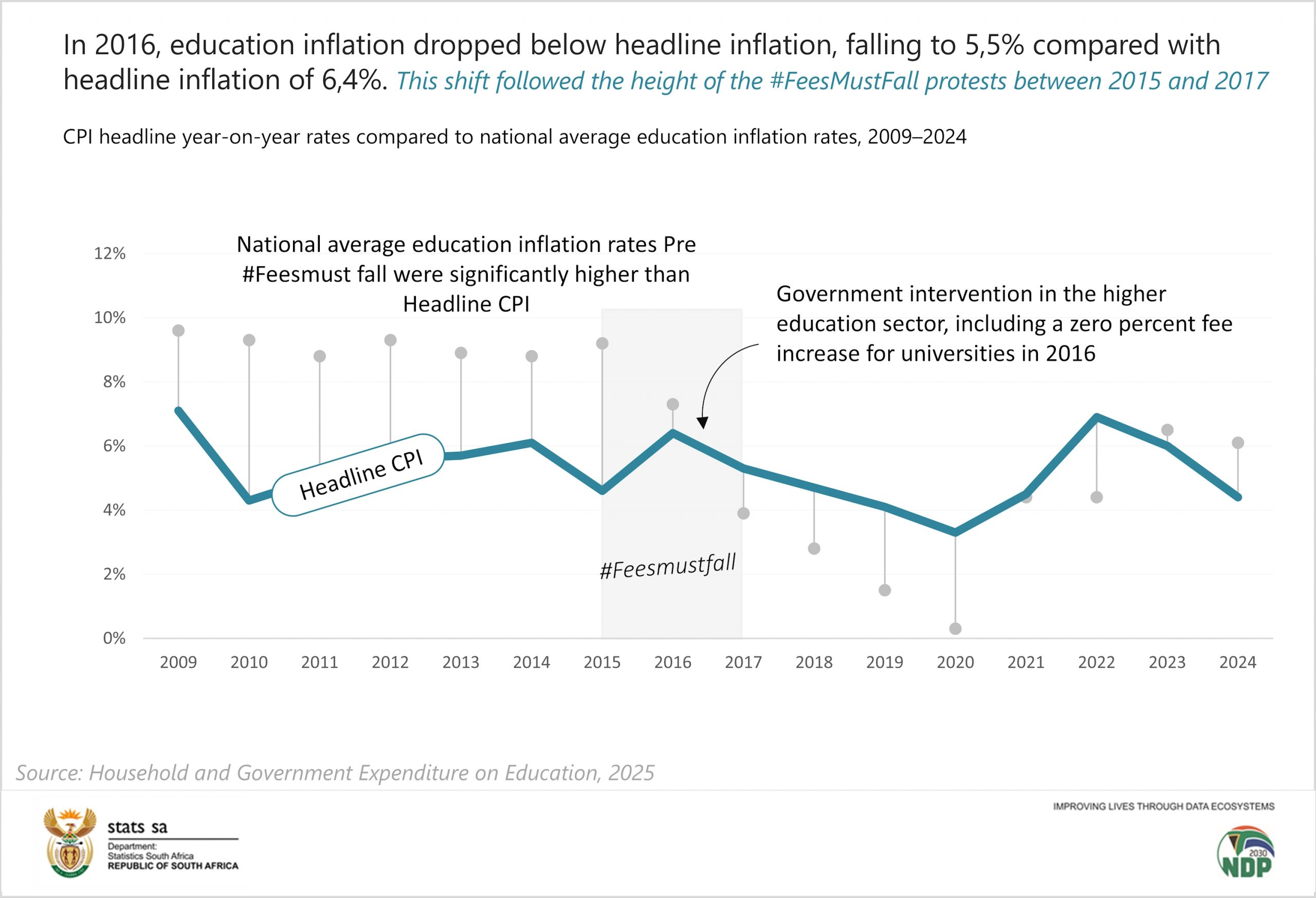
Growing pressure on household budgets is also reflected in education‑specific inflation trends. For much of the period, the cost of education rose faster than headline consumer inflation, confirming that schooling and study costs have increased more quickly than everyday living expenses.
There are key exceptions. In 2016, education inflation dropped below headline inflation for the first time, falling to 5,5% compared with headline inflation of 6,4%. This shift followed the height of the #FeesMustFall protests between 2015 and 2017 and coincided with government intervention in the higher education sector, including a zero percent fee increase for universities in 2016. As a result, overall education inflation fell sharply from 9,2% in 2015 to 5,5% in 2016.
Note: Average headline and education inflation used
A similar break in the pattern appears between 2021 and 2023. While headline inflation rose to a peak of 6,9% in 2022 due to global price pressures, education inflation moved in the opposite direction, reaching a record low of 4,4%. This easing reflects continued limits on tuition increases, alongside financial strain in the higher education system following the expansion of NSFAS and tighter fiscal conditions.
Before these shifts, the period from 2009 to 2015 was characterised by high education inflation over time, driven largely by university fee increases. The period after 2015 therefore represents a clear turning point. While measures introduced in the wake of #FeesMustFall have helped slow tuition growth, households — particularly in urban areas — continue to face rising costs linked to transport, accommodation and learning materials.
Taken together, the data show that while tuition inflation has been contained at times, education remains a growing burden on household finances, with underlying funding pressures continuing to shape who can afford to access and complete education.
At a national level, South Africa’s education spending compares well with international benchmarks. UNESCO recommends that countries spend 4–6% of GDP or 15–20% of total government expenditure on education. In 2024/25, South Africa slightly exceeded both targets, allocating close to 21% of total government spending to education, up from 20% in 2015/16, and increasing education expenditure from 6,3% to 6,7% of GDP over the same period.
Much of this funding is directed at foundational learning. In 2024/25, basic education accounted for about 72,1% of total education spending, largely supporting public schools that serve low‑income households. While this focus promotes access, it also means that gaps in infrastructure, staffing and school quality continue to fall most heavily on disadvantaged learners, particularly in rural areas.
Shifts within the budget further illustrate the trade‑offs. Spending on education infrastructure declined from 6,1% in 2015/16 to 5,0% in 2024/25, while funding for early childhood development rose from 1,8% to 3,3%.
For households, these pressures are compounded by education costs that rise faster than overall inflation. As schooling becomes more expensive, families are forced to devote a larger share of their income to education, often cutting back on essentials such as food, healthcare and housing. Higher‑income households are better able to absorb these costs, while poorer households face growing limits on their options.
For more information, download the full report here.