
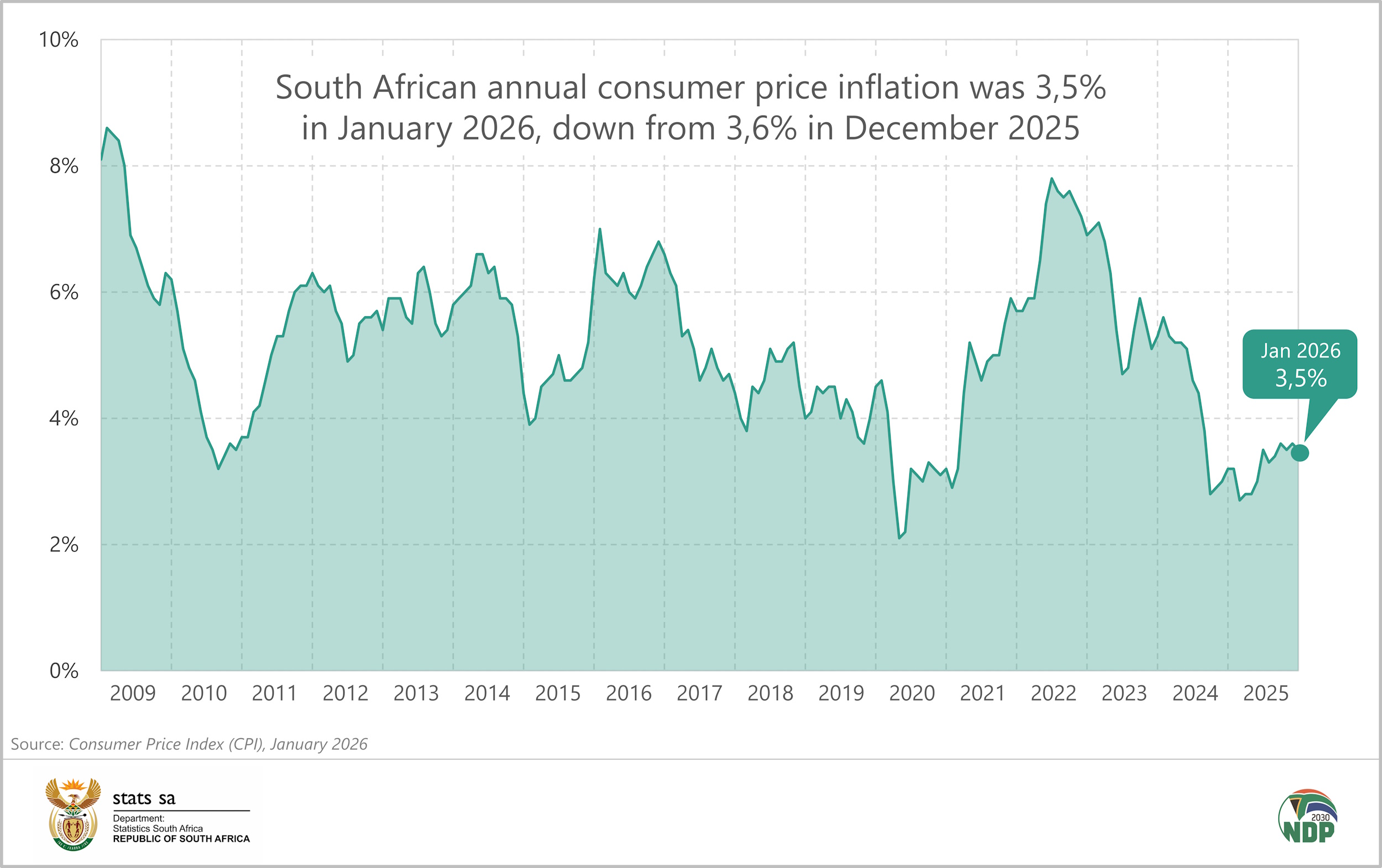
Consumer price inflation dipped to 3,5% in January from 3,6% in December, returning to its November 2025 level. Stable food inflation and lower fuel prices contributed to the lower headline rate. The monthly change in the consumer price index (CPI) was 0,2%, the same as December’s reading.
Food inflation remained at 4,4% for a third consecutive month. The annual rate for cereal products slowed significantly in January, declining to 0,6% from 2,1% in December. White rice recorded a rate of -11,0%, representing an eleventh consecutive month of deflation. Maize meal inflation declined notably from 9,5% in December to 2,6% in January.
The rate for oils & fats softened to 4,0% from 4,6% in December. Olive oil is 7,9% and butter 0,7% cheaper than a year ago.
The milk, other dairy products & eggs category registered -0,5%, higher than December’s -1,1%. Fresh full-cream milk (-1,4%), fresh low-fat milk (-1,6%) and eggs (-7,6%) contributed to the deflationary trend. Eggs are becoming more affordable. The average price for a tray of six eggs was R22,90 in January, down from R24,51 in January 2025 and much lower than the peak of R25,85 recorded in December 2023.
Rising meat prices, however, continue to place pressure on consumer wallets. The annual rate for meat accelerated further to 13,5% from December’s 12,6%. This is the highest print for the category since December 2017 (13,9%).
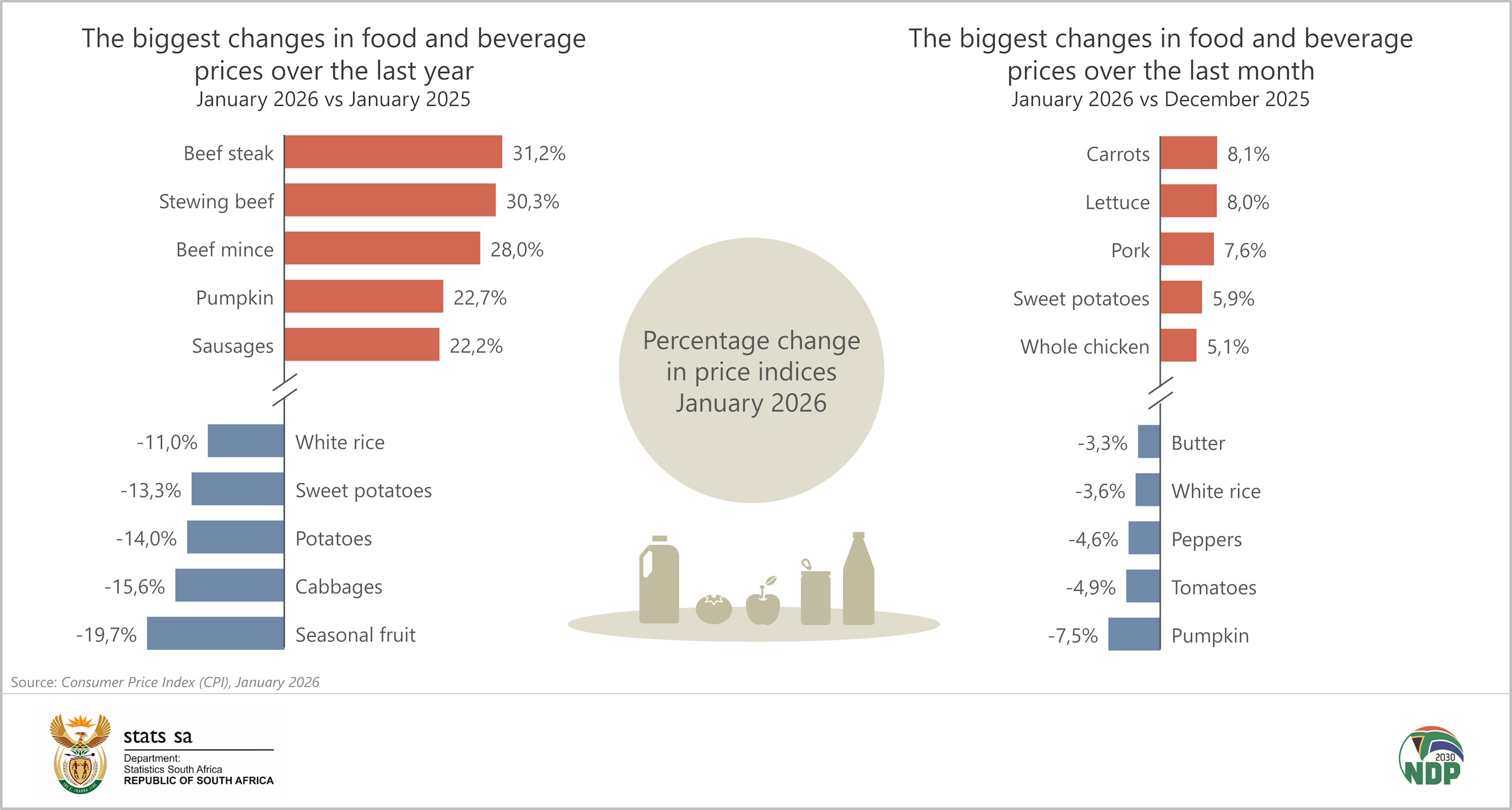
Three beef products recorded the highest annual rates of all 391 products in the CPI basket. These were beef steak (31,2%), stewing beef (30,3%) and beef mince (28,0%). More affordable beef products were not immune to sharper price increases, with the rate for beef offal accelerating to 17,2% from 10,5% in December. Pork also experienced a significant rise, climbing to 19,5% from 11,5%.
The graph below shows the food and beverage products that recorded the sharpest price increases and decreases.
Other notable price changes
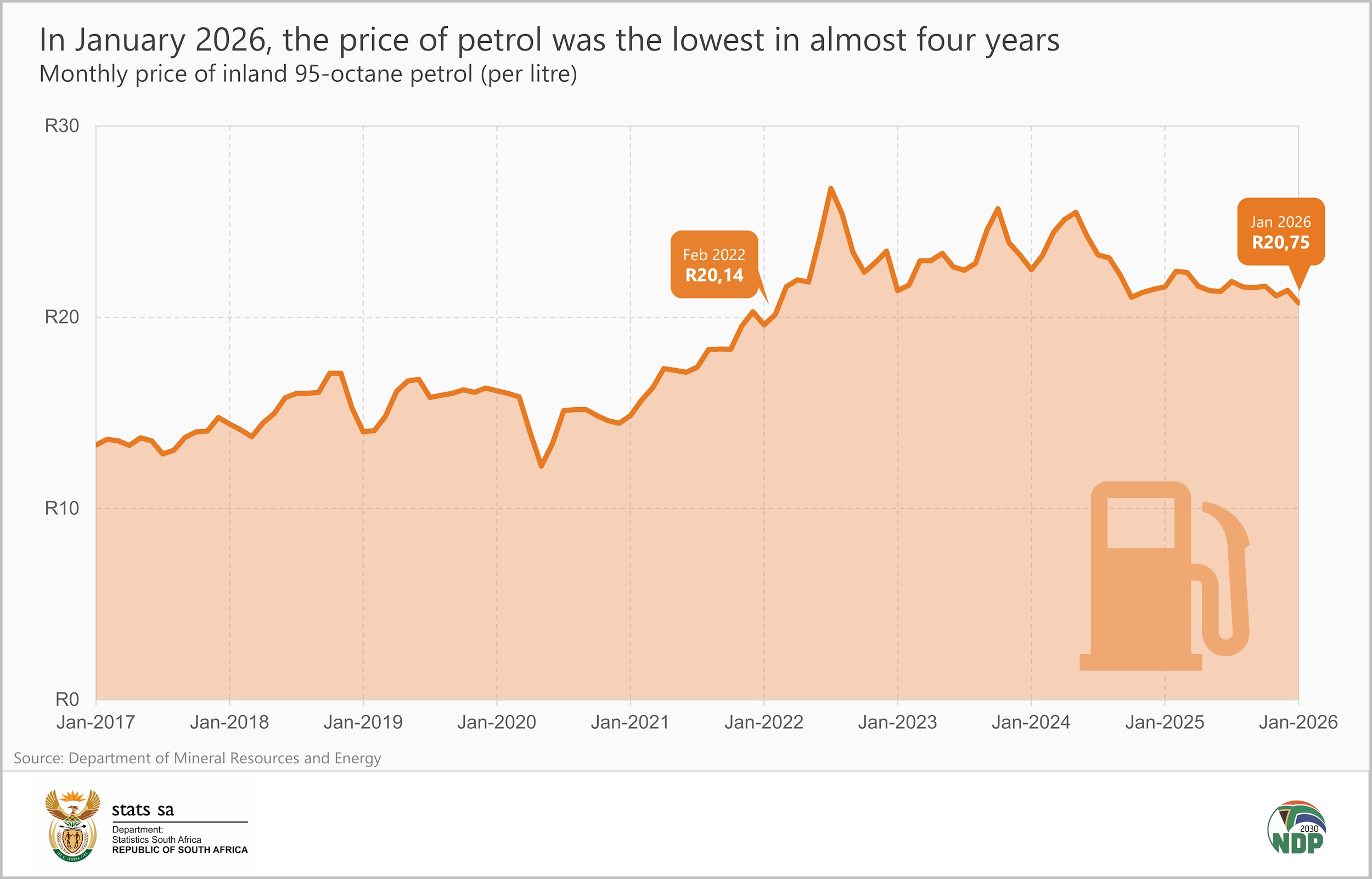
The index for fuel decreased by 3,7% in the 12 months to January. The monthly change for petrol was -3,1% and diesel -5,4%. The price of inland 95-octane petrol was R20,75 per litre in January, the lowest in almost four years, that is since February 2022 (R20,14).1
Several banks increased their annual fees in January, resulting in an average rise of 4,1% in the financial services index compared with December. This contributed to the annual rate of 4,9%.
January also marks the beginning of the new school year. Stats SA has included school uniform items in the CPI basket since January 2025. These items recorded higher inflation rates than the average clothing & footwear print of 1,2%. For example, prices for school jerseys rose by 7,0% compared with January 2025. School skirts or dresses increased by 3,2% and school shoes by 4,1% over the same period.
Stationery items registered sharp monthly decreases in January, with pens 9,8%, writing books 5,0% and printing paper 3,5% cheaper than in December 2025. Textbooks decreased by a monthly 1,3%, taking the annual rate for textbooks to -3,3%.
For more information, download the January 2026 CPI statistical release and associated Excel files with indices and average prices here.
1 Department of Mineral Resources and Energy. Comparing prices for petrol, diesel and illuminating paraffin (IP) (click here).
Similar articles are available on the Stats SA website and can be accessed here.
For a monthly overview of economic indicators and infographics, catch the latest edition of the Stats Biz newsletter here.