
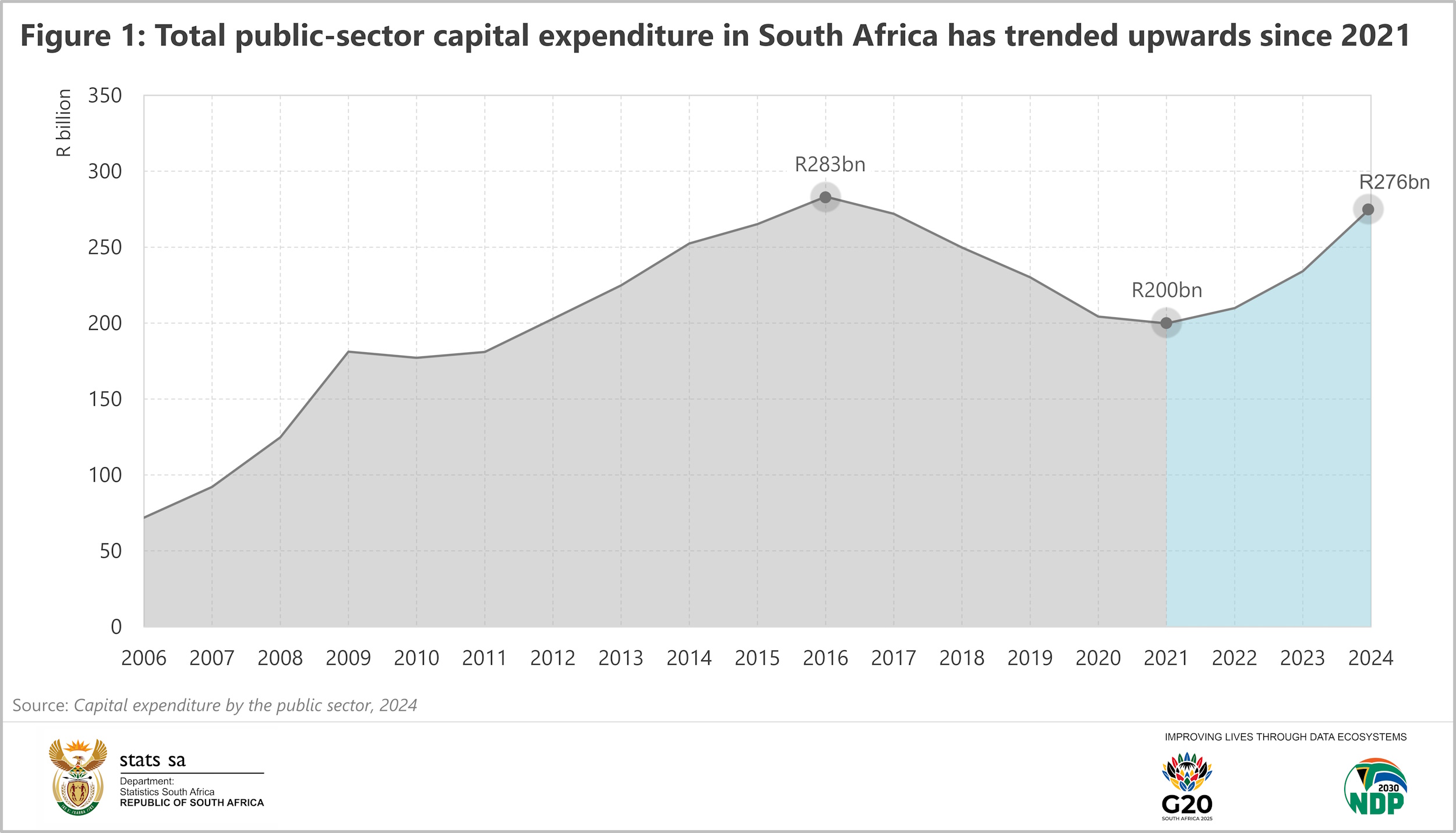
Public-sector spending on infrastructure and other fixed assets continued an upward trajectory, rising to R276 billion in 2024 from R234 billion in 2023. This marks a third successive increase following a five-year downturn.
Despite the positive momentum, the total remains below the peak of R283 billion in 2016.
The public sector includes national government and provincial government departments, municipalities, public corporations, higher education institutions and extra-budgetary accounts and funds (EBAs). The complete list includes 748 institutions, all of which were covered by the latest Capital expenditure by the public sector survey.
The biggest movers: Electricity, rail, and roads are the major focus areas
Increased work on electricity infrastructure was largely responsible for the lift in 2024. Eskom boosted its capital spending by R10,2 billion (from R39,3 billion to R49,5 billion), focusing on its capacity expansion programme and ongoing projects at Medupi and Kusile power stations (Figure 2).
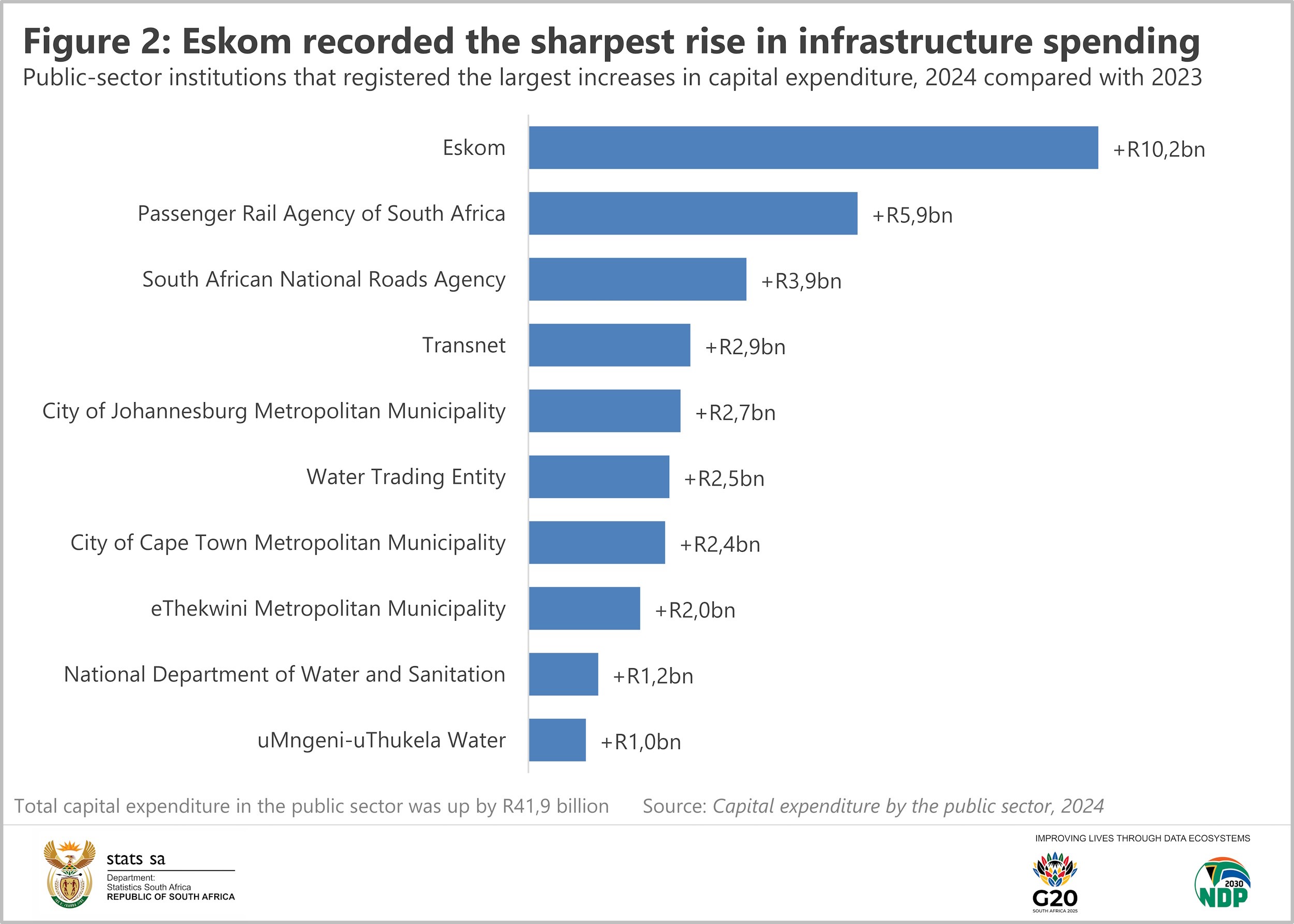
South Africa’s rail network received a larger allocation, with the Passenger Rail Agency of South Africa (PRASA) increasing capital expenditure by R5,9 billion (from R15,9 billion to R21,8 billion). Primarily responsible for urban commuter rail services, the agency restored infrastructure on key service lines. It also reintroduced several lines, including the Johannesburg-Naledi and Pretoria-Pienaarspoort routes.
The country’s national road network benefited from a R3,9 billion rise (from R9,4 billion to R13,3 billion) in capital expenditure by the South African National Roads Agency (SANRAL), which intensified the repair and construction of key roads.
PRASA’s focus on the rail network was supported by Transnet, which recorded an increase of R2,9 billion (from R15,3 billion to R18,3 billion) to maintain capacity on port, pipeline and rail infrastructure.
Other notable contributors to the R41,9 billion rise in public-sector capital expenditure include three metropolitan municipalities (Johannesburg, Cape Town and eThekwini), the Water Trading Entity, the National Department of Water & Sanitation and uMngeni-uThukela Water.
The biggest contributors: Eskom takes the largest slice
Eskom’s R10,2 billion rise saw its contribution to total public-sector capital expenditure increase from 16,8% in 2023 to 17,9% in 2024. It is the largest spender on infrastructure in the public sector (Figure 3).
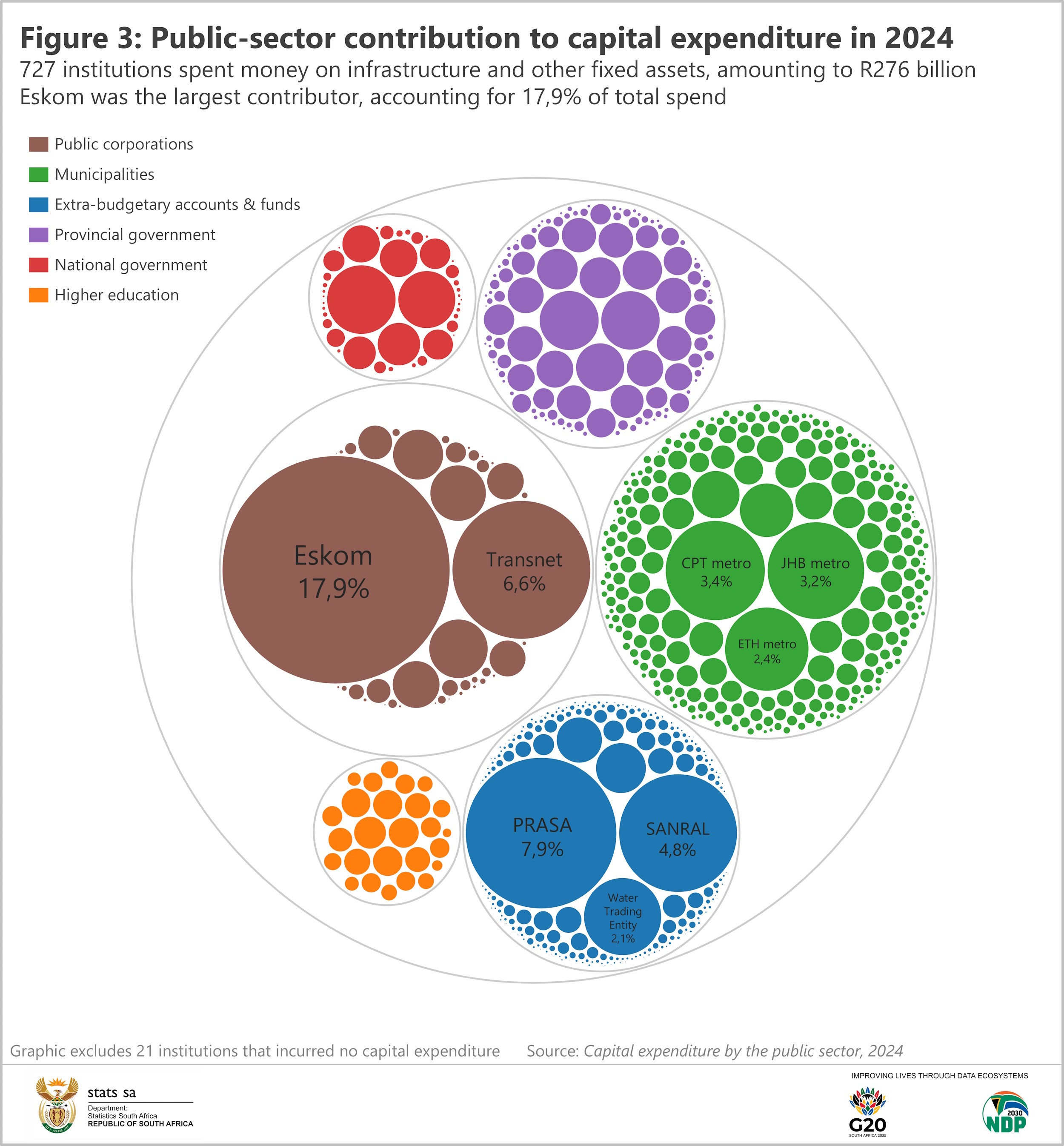
Eskom and Transnet dominated the public corporations’ category. As a group, public corporations accounted for 30,6% of total spend in 2024.
Municipalities contributed 25,9%, with the City of Cape Town, the City of Johannesburg and the eThekwini Metropolitan Municipality the most significant contributors in this group. EBAs, public institutions that are responsible for delivering services on behalf of the government, accounted for 19,6%. PRASA, SANRAL and the Water Trading Entity were the heavyweights in this group.
The provincial government (13,6%), the national government (6,1%) and higher education institutions (4,1%) reported the smallest shares of capital expenditure.
Infrastructure forms the backbone that connects different parts of the economy, supporting the flow of goods, travel and communication. Ongoing investment and maintenance by both the public and private sectors help ensure the smooth flow of economic activity across the country.
For more information, download the 2024 Capital expenditure by the public sector statistical release and Excel unit data here.
Similar articles are available on the Stats SA website and can be accessed here.
For a monthly overview of economic indicators and infographics, catch the latest edition of the Stats Biz newsletter here.