
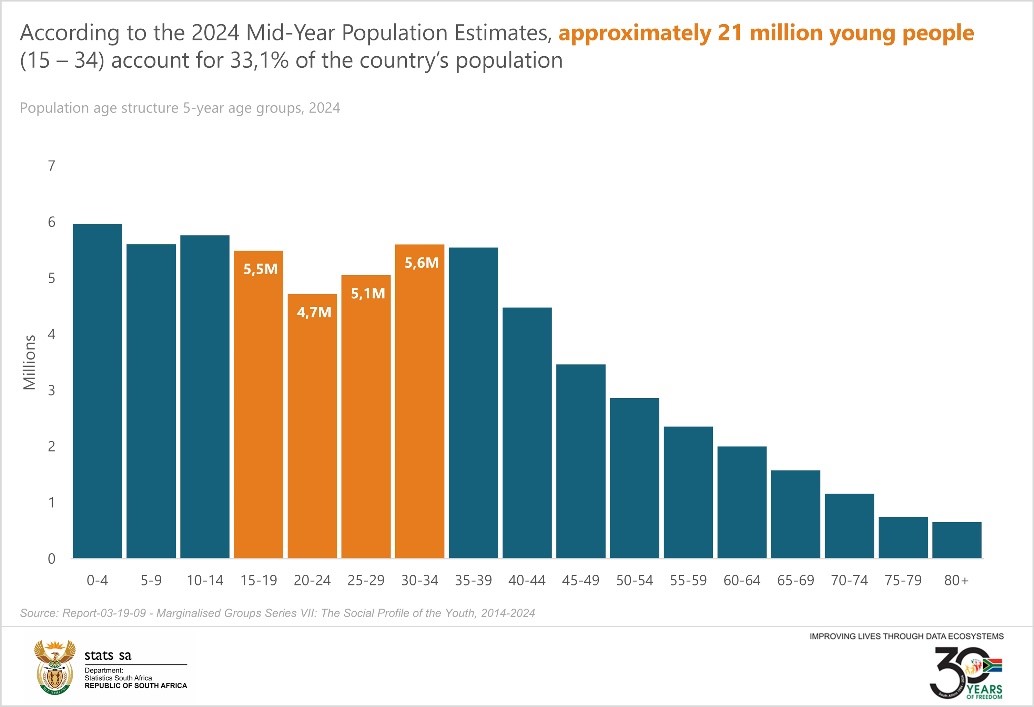
South Africa’s youth, defined as individuals aged 15–34 years, form a crucial demographic and make up nearly one-third of the population. They represent a dynamic generation navigating a rapidly evolving society influenced by the labour market, poverty, crime and access to quality education. According to the 2024 Mid-year Population Estimates, approximately 21 million young people account for 33,1% of the country’s population, underscoring their significant role in shaping the nation’s social and economic landscape. Between 2014 and 2024, the youth population grew by 2,3%, while the overall population increased by 13,9%. Despite overall population growth in all provinces, the youth population declined in Eastern Cape and Free State, signalling migration trends and economic challenges.
Youth Unemployment and Labour Market Challenges
A new report released by Statistics South Africa (Stats SA) titled Marginalised Groups Series VII: The Social Profile of the Youth, 2014–2024 provides a comprehensive overview of the experiences of young people in South Africa.
Despite comprising a large share of the labour force, South African youth continue to grapple with high unemployment, largely due to a lack of relevant skills. While the National Development Plan has introduced policy interventions to address youth employment, joblessness has persisted and even worsened over the past decade.
Between 2014 and 2024, the number of people working or looking for work – known as labour force participation – fluctuated for both youth and adults. However, adults were consistently more likely to be employed than younger workers.
Over the decade, the percentage of young people who found jobs dropped by 2,8 percentage points from 30,5% in 2014 to 27,7% in 2024. Among adults, this rate fell by 3,3 percentage points from 57,6% in 2014 to 54,3% in 2024.
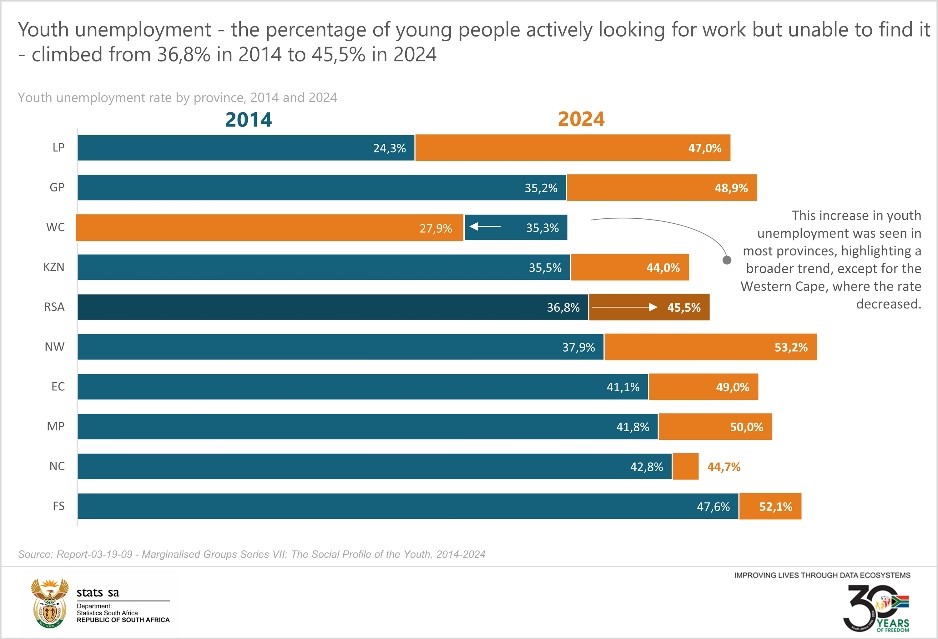
Youth unemployment – the percentage of young people actively looking for work but unable to find it – climbed from 36,8% in 2014 to 45,5% in 2024. This increase in youth unemployment was seen in most provinces, highlighting a broader trend, except for the Western Cape where the rate decreased.
Education remains a crucial factor in employment outcomes. The share of unemployed young people without a matric qualification dropped by 10,3 percentage points (from 61,6% in 2014 to 51,3% in 2024), while those with matric saw a decrease of 7,2 percentage points (from 77,2% in 2014 to 70,0% in 2024). The number of young people who were not in employment, education, or training (NEET) reached 43,2% in 2024, marking a 5,0-percentage point increase from 2014.
Economic Inactivity and Household Livelihoods
The inactivity rate for both youth and adults saw fluctuations over the decade, peaking in Q3 of 2020. Nationally, the youth inactivity rate decreased by 2,6 percentage points (from 51,8% in 2014 to 49,2% in 2024), while the adult rate dropped by 1,7 percentage points (from 31,9% to 30,2%).
Income sources for households with youth remained largely unchanged between 2014 and 2023, with salaries, wages, commissions, social grants and remittances being the primary contributors. However, income from salaries and wages declined in 2023. In rural areas, social grants remained the second most relied-upon source of income, though their share slightly declined by 0,1 of a percentage point (from 37,5% in 2014 to 37,6% in 2023).
At the household level, employment scarcity remained a pressing issue. The percentage of youth living in households without an employed adult increased, with the rate for males rising from 21,8% in 2014 to 23,8% in 2023, while for females it climbed from 24,5% to 25,5%. Hunger among youth households also intensified, with the percentage of young people living in food-insecure homes increasing by 2,3 percentage points (from 13,5% in 2014 to 15,8% in 2023).
Living Conditions, Safety and Crime
Housing conditions for youth have improved over the decade, with the majority residing in formal dwellings. The proportion of youth living in formal housing increased by 4,4 percentage points (from 79,6% in 2014 to 84,0% in 2023), with the largest improvements recorded in Eastern Cape and KwaZulu-Natal.
However, safety concerns among young people revealed that the percentage of youth who felt safe during the day declined by 1,8 percentage points (from 83,0% in 2018/19 to 81,2% in 2023/24), while those feeling safe walking alone at night remained stagnant at 34,9%. Young people aged 16–34 were more likely to be victims of assault, street robbery, and property theft crimes compared to older adults. Gender disparities in crime exposure remained evident, with young males more frequently targeted for assault, street robbery, and theft of personal property crimes than their female counterparts in 2023/24.
Education and Youth Development
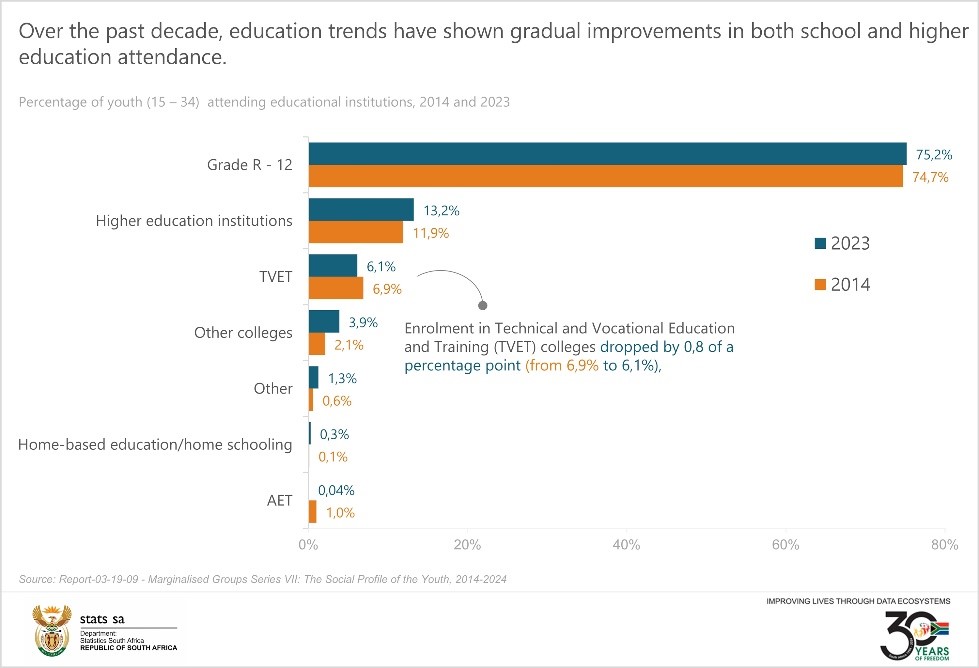
Over the past decade, education trends have shown gradual improvements in both school and higher education attendance. From 2014 to 2023, youth school attendance rose slightly by 0,5 of a percentage point, from 74,7% to 75,2%. This increase in school attendance is reflected in a rise in higher education enrolment as well, which grew by 1,3 percentage points from 11,9% to 13,2%. Young graduates with degrees or other tertiary qualifications were also the least likely to be unemployed, further highlighting the value of continued education.
Despite these gains, some areas saw declines. Enrolment in technical and vocational education and training (TVET) colleges dropped by 0,8 of a percentage point (from 6,9% to 6,1%), and adult education and training (AET) participation fell to 0,04% from 1,0%, signalling a shift away from these options. However, there were slight increases in enrolment in home-schooling and other alternative education programmes, suggesting a growing interest in non-traditional education pathways.
Among population groups, Indian/Asian and white youth had the highest participation rates in higher education at 45,7% and 31,1%, respectively – a disparity that underscores the ongoing challenge of improving educational outcomes for all demographic groups.
Across all nine provinces, most youth reported having less than a matric qualification, while only a smaller number had completed matric. Overall, while the gap is narrower in Gauteng, the data consistently show that across all provinces, a greater share of youth have not reached the matric level compared to those who have. This disparity highlights a common challenge across regions in achieving secondary education completion, which can have important implications for workforce skills and economic development in these areas.
Over the past decade, South Africa’s youth have faced persistent economic and social challenges, particularly in employment, education and safety. While there have been improvements in access to formal housing and higher education, high unemployment, economic inactivity, and safety concerns continue to shape the realities of young people across the country.
The Social Profile of the Youth, 2014–2024 report focuses on the socio-economic and demographic profile of the youth over a period of ten years (2014–2024). It offers a broad understanding of the situation of young people in South Africa by analysing data that highlight some of the concerns, challenges and successes experienced by the youth.
For more information, download the full report here.