
Stats SA kick-started the year with 20 statistical releases, with fresh economic data for November 2025.
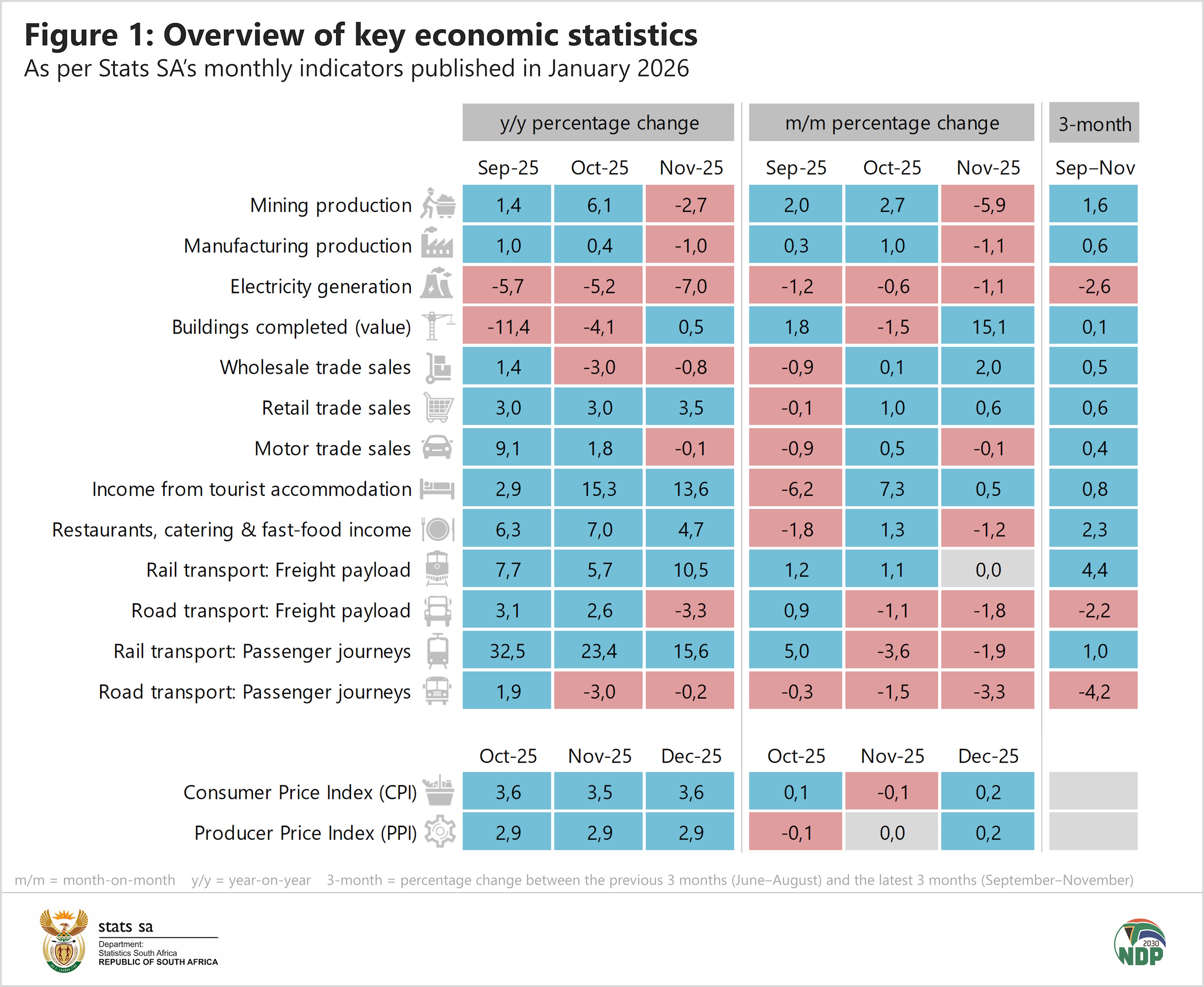
Indicators that were positive year-on-year in November 2025 include construction (buildings completed as reported by large municipalities); retail trade; tourist accommodation; restaurants, catering & fast-food; and rail transport (freight and passenger). Mining, manufacturing, electricity generation, wholesale trade, motor trade and road transport (freight and passenger) were negative (Figure 1).
Hotels continue to shine
Income from tourist accommodation rose by 13,6% year-on-year, driven mainly by hotels. Digging a little deeper into the statistical release reveals an uptick in hotel use. The occupancy rate for hotels climbed to 61,6% in November 2025, the highest in six years (since November 2019, when it was 64,4%). However, the occupancy rate for guest-houses/farms continues to lag pre-pandemic highs.
Positive news on the tourism front was reported in the latest International tourism statistical release. In December 2025, 997 165 tourists visited South Africa, 8,4% more than in December 2024.
Retail remains positive while mining and manufacturing dip
Retail trade sales rose by 3,5% in November 2025, representing 21 consecutive months of positive year-on-year growth. Six of the seven retail groups posted a stronger month, with general dealers the most significant positive contributor. On the downside, food & beverages was the only retail group that weakened, edging lower by 0,8%.
Activity in the mining industry decreased by 2,7% year-on-year, mainly due to weaker coal production. Iron ore, gold, platinum group metals and chromium ore also performed poorly. On the positive side, the industry produced more diamonds, manganese ore, copper and nickel.
Manufacturing output was also lacklustre, with production slowing by 1,0% year-on-year. The decline was led by the wood, paper, publishing & printing; iron, steel & metal products; and automotive divisions.
Consumer inflation in 2025 the lowest in 21 years
The December consumer price inflation print wrapped up results for the calendar year. On average, the cost of living rose by 3,2% in 2025 compared with 2024. This is the lowest average inflation rate since 2004 (1,4%).
December results show some pressure points. Meat inflation, for example, continues to accelerate, with the annual rate for meat the highest since January 2018. Consumers are also feeling the pinch with several other food and beverage products, most notably, pumpkin, instant coffee, samp, maize meal and cheese.
What to look forward to in February
Notable releases scheduled in the month include the latest manufacturing utilisation data (to be released on 05 February 2026) and labour force figures for the fourth quarter of 2025 (to be released on 17 February 2026).
Interested to know more? Keep up to date with our publication schedule here. For a comprehensive list of products and releases, download our catalogue here. For a regular update of indicators and infographics, visit our data story feed and download the latest edition of the Stats Biz newsletter.