


In 2019, almost everyone who was employed in the third quarter—94,0% to be exact—was still employed in the fourth quarter. Fast forward to 2024, and that figure has dipped slightly to 91,8%. While the decline is modest (2,2 percentage points), it signals a notable shift in employment stability.
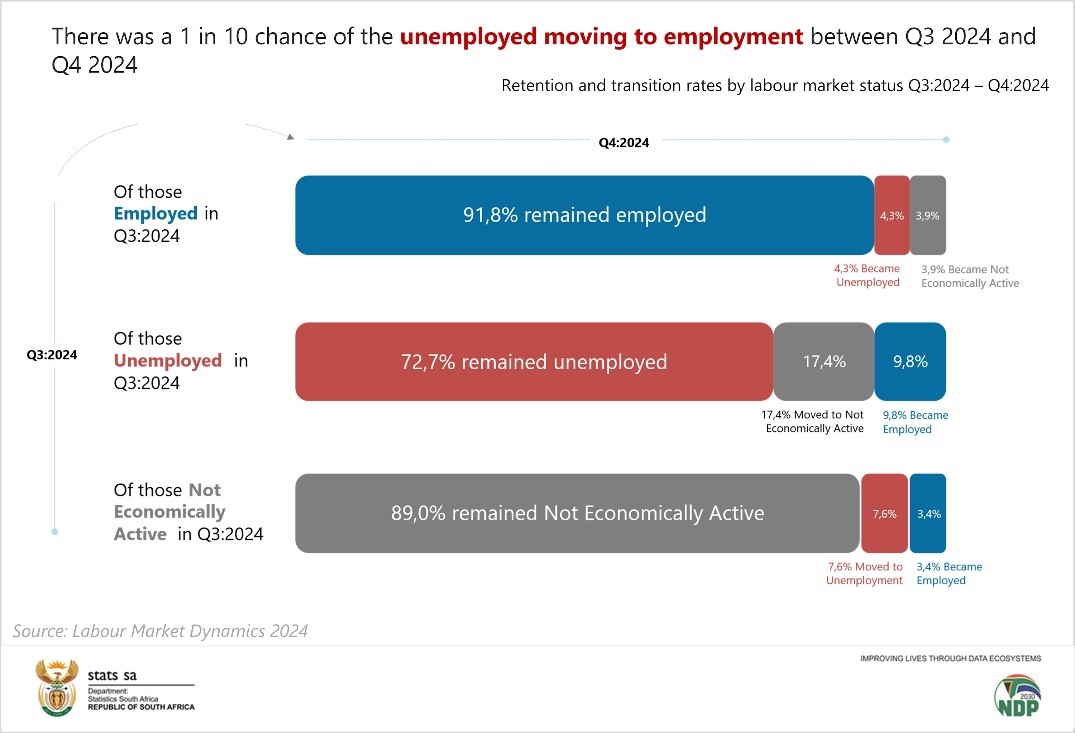
The same trend appears among people who were not economically active. In 2019, 90,7% stayed in that category between Q3 and Q4, compared to 89,0% in 2024. For those who were unemployed, the change is even more noticeable: 74,2% remained unemployed between the two quarters in 2019, while in 2024, that number fell to 72,8%. These small changes tell a bigger story about movement in the labour market.
So why does this matter? The Quarterly Labour Force Survey (QLFS) tracks the same individuals over time, making it possible to see who stays in the same category and who moves between employment, unemployment, and inactivity. This kind of data is crucial for shaping policies that help people—especially young people—find work. One clear opportunity is education: investing in higher education for those who struggle to access it could make a real difference in helping them transition into employment.
Who Is More Likely to Find Work – And Who Isn’t?
The data shows some interesting patterns about who transitions into employment. People with prior work experience had a much better chance of finding a job in 2024—9,8% compared to 2,6% for those without experience. Education also matters: those with a tertiary qualification saw a 7,5% transition rate, while people without matric managed only 4,8%.
Age and gender play a role too. Youth had a transition rate of 4,3%, and women 4,6%, both lower than adults (7,3%) and men (6,5%).
Where You Live Makes a Difference
Retention rates vary across provinces. Western Cape led the way with 93,9% of employed people staying in employment, while Free State had the lowest retention rate at 87,8%. When it comes to moving into employment, North West recorded the lowest transition rate at 4,4%.
Job Security and Contract Type
Permanent contracts offer the most stability. People on permanent contracts were far more likely to stay employed than those on limited or unspecified contracts. Interestingly, employees with unspecified contracts were the most likely to move into roles as employers or own-account workers (2,6%), compared to 1,4% for limited contracts and 1,0% for permanent ones.
Skills and Industry Matter
Low-skilled workers faced the highest risk of leaving employment—12,3% in 2024—followed by semi-skilled workers at 8,2%. Skilled workers were much more secure, with only 2,8% moving out of employment. Industry trends show a similar pattern: those in primary sector industries had an 11,5% likelihood of leaving employment, higher than other sectors.
Short-Term vs Long-Term Unemployment
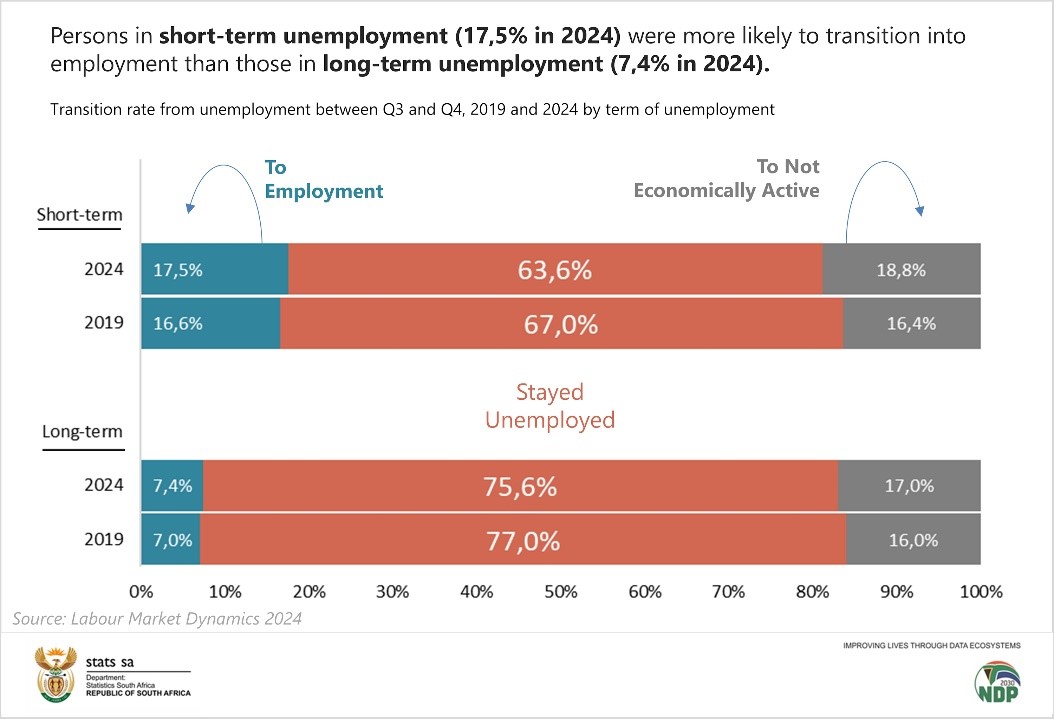
The longer someone is unemployed, the harder it becomes to find work. People in short-term unemployment had a 17,5% chance of transitioning into employment in 2024, compared to just 7,4% for those in long-term unemployment.
Overall, the data paints a clear picture of how employment dynamics have shifted over time. While retention rates remain high, slight declines suggest growing movement within the labour market. Factors such as education, work experience, age, gender, and contract type continue to influence who stays employed and who transitions into employment. Regional differences and industry trends further highlight the complexity of employment patterns. Understanding these shifts is key to appreciating the challenges and opportunities within South Africa’s labour market as it evolves.
For more information, download the full report here.