What happens when everyday problems, from disruption of the supply of utilities (e.g. water, electricity, etc.) to family property ownership become disputes that affect people’s lives?
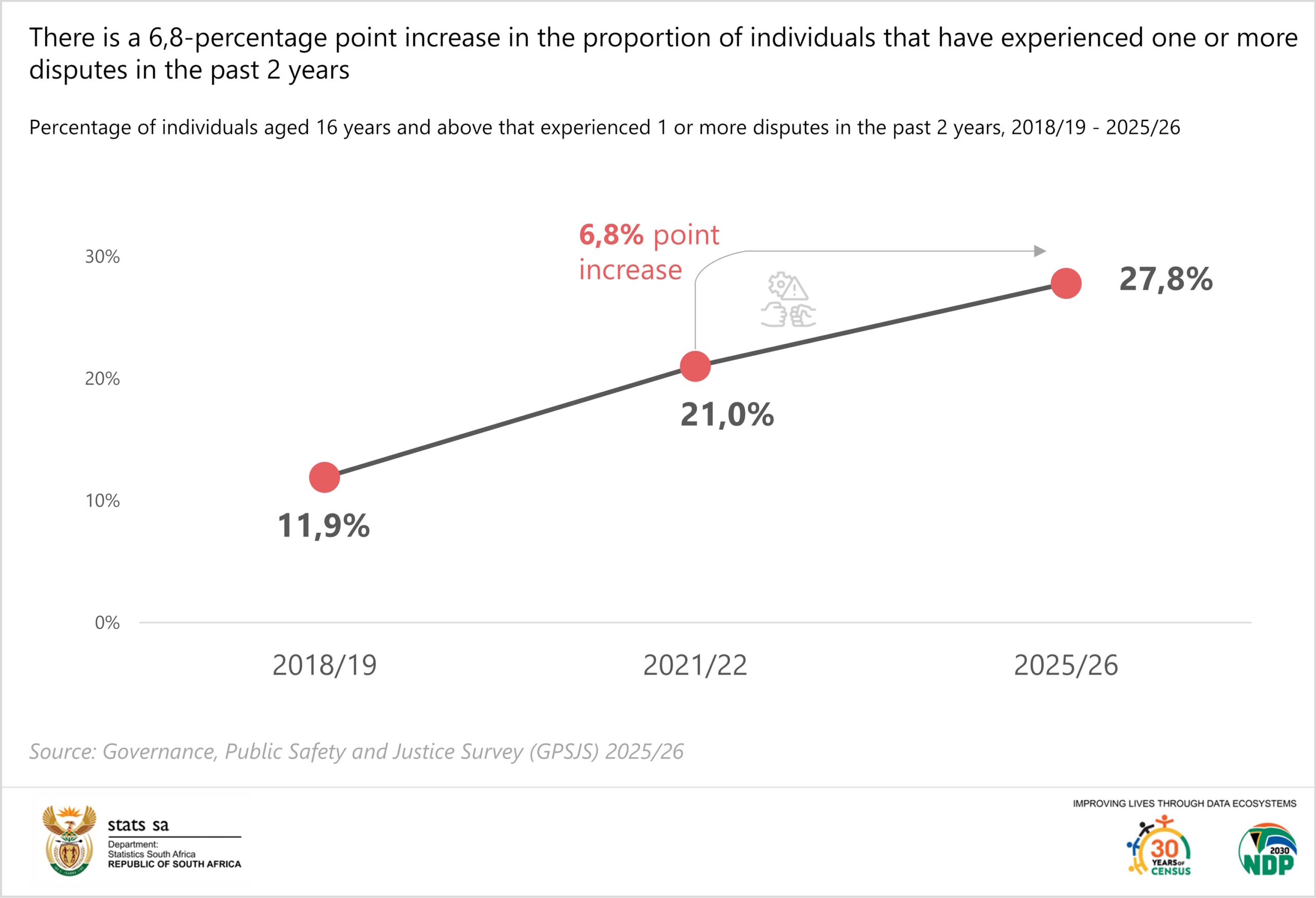
According to a new report released by Statistics South Africa (Stats SA), the proportion of individuals who experienced one or more disputes increased between the 2021/22 and 2025/26 reporting periods.
Disputes are not limited to court cases or disagreements that end up before a judge. They can arise from everyday problems that have legal implications, such as interrupted water or electricity supplies, poor service from government departments or businesses, lack of access to housing and basic services, or unauthorised deductions from a bank account by a business. A dispute refers to a problem between individuals or between an individual and an organisation or other entity that may give rise to legal issues. These problems are considered justiciable regardless of whether those affected recognise them as legal matters or take legal action to resolve them.
According to Statistics South Africa’s Governance, Public Safety and Justice Survey (GPSJS) 2025/26, an estimated 28% of individuals aged 16 years and older experienced at least one dispute or problem in the two years preceding the survey, up from 21,0% in 2021/22.
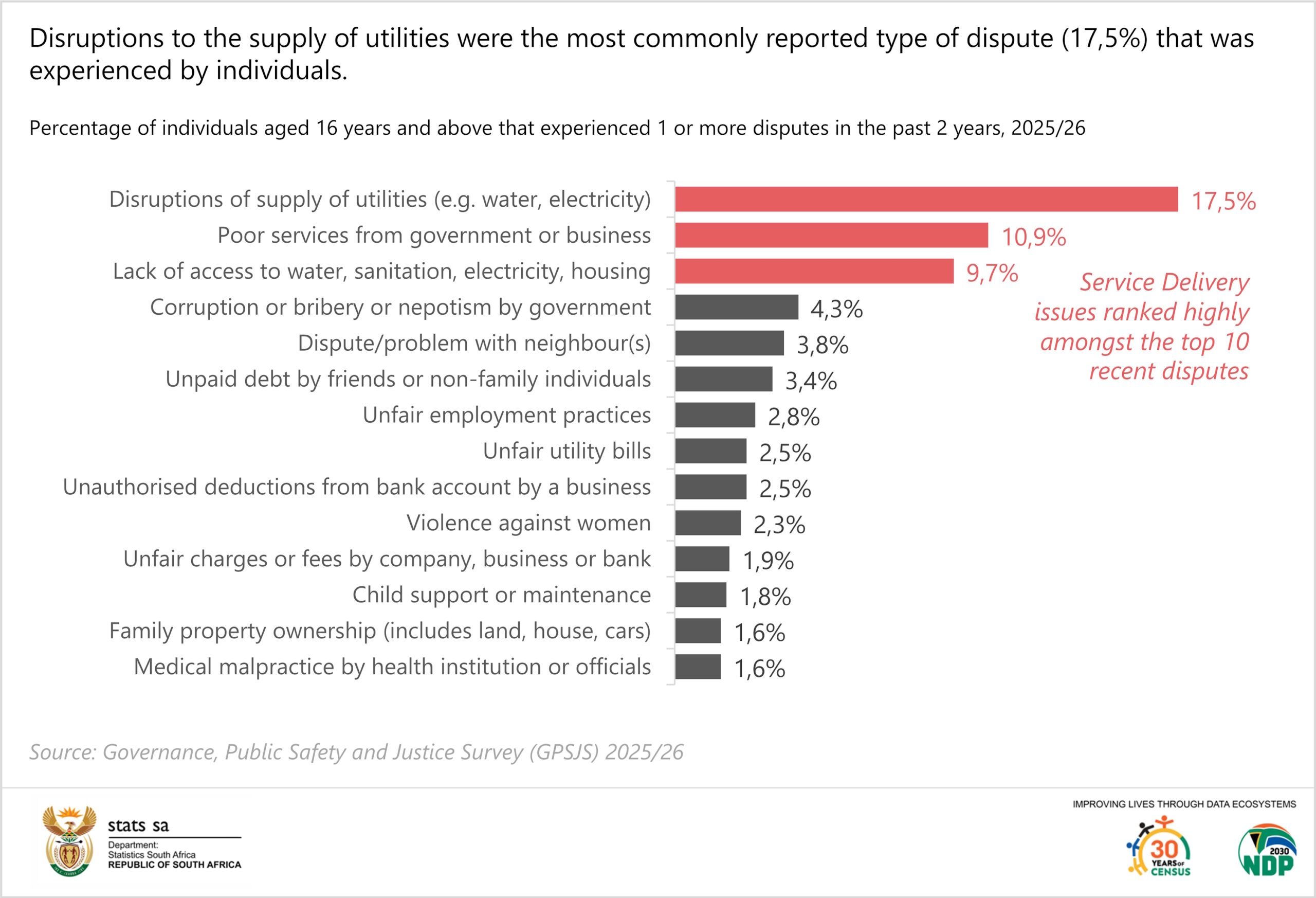
Disruptions to the supply of utilities were the most reported type of dispute, increasing from 1,9% in 2021/22 to 17,5% in 2025/26.
Experiences also varied across provinces. Limpopo recorded the highest proportion of individuals who experienced at least one dispute (31,0%), while the Western Cape recorded the lowest (14,1%) in 2025/26.
The experience of disputes varied by marital status. In 2025/26, individuals who were separated but still legally married recorded the highest proportion of people who had experienced at least one dispute, at 35,5%.
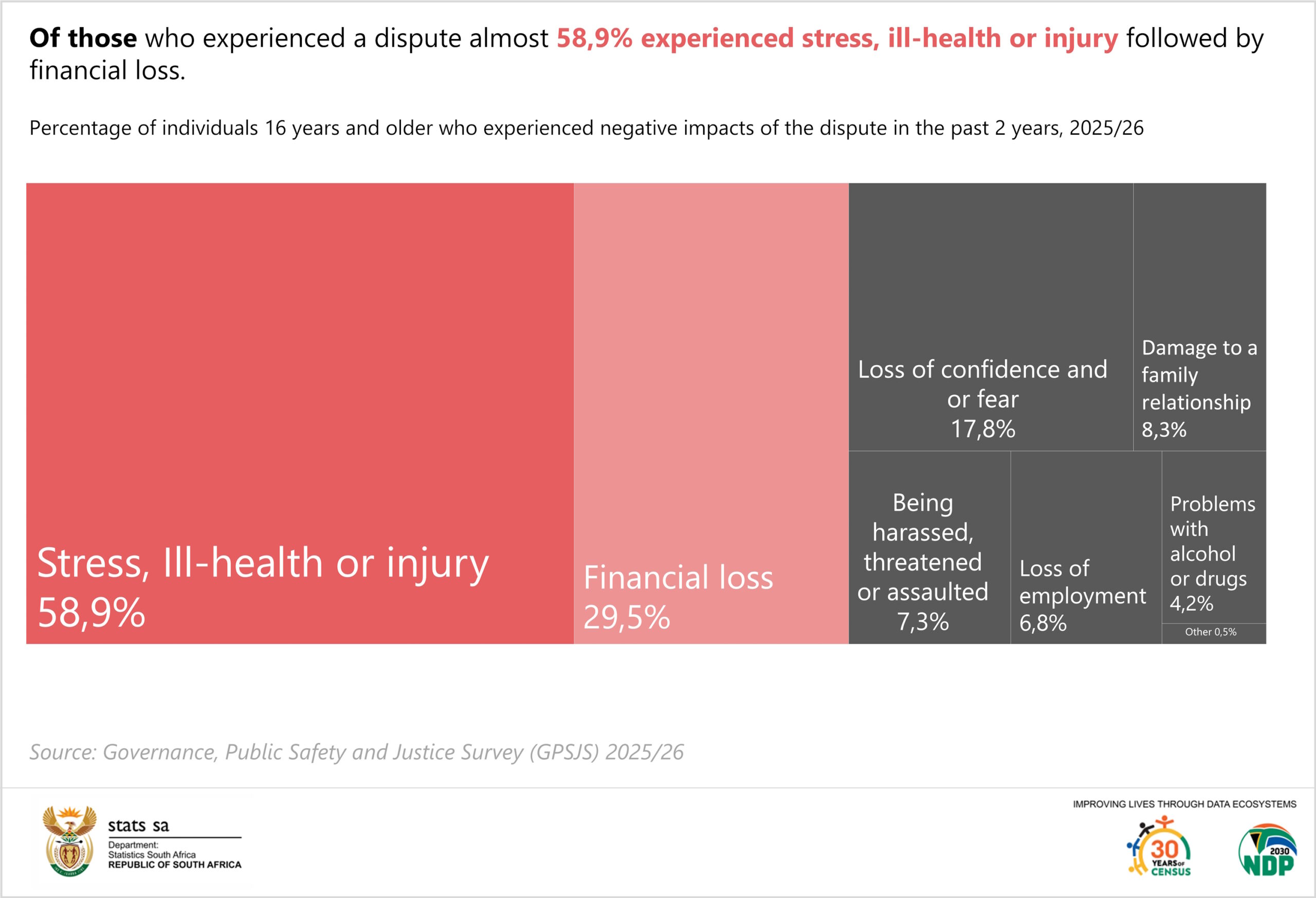
Beyond the nature and frequency of disputes, their impact on those affected is also important. Of individuals aged 16 years and older who had experienced one or more disputes, 58,9% reported stress, ill-health or injury as a consequence. Financial loss was reported by 29,5%, while 17,8% experienced a loss of confidence or fear. These findings illustrate how disputes can extend beyond the original problem, affecting people’s well-being, financial circumstances and sense of security.
Peaceful and inclusive societies are central to achieving the Sustainable Development Goals (SDGs). Access to justice is a fundamental right and an important foundation for social and economic development. The GPSJS supports the monitoring of SDG 16, including indicator 16.3.3 on the proportion of people who experienced a dispute and accessed a formal or informal dispute resolution mechanism.
Beyond the experience of disputes, the report examines other aspects of governance and public life, including awareness and perceptions of the Constitution and human rights, perceptions of democracy, and experiences of discrimination among individuals aged 16 years and older.
For more information, download the full report here.