


How are South Africans travelling within their own country, and how much are they spending along the way? Domestic tourism offers a glimpse into how households use their time and money to travel within and explore the country, whether through short day trips or overnight stays at destinations across its nine provinces.
The latest results from Statistics South Africa’s Domestic tourism survey (DTS), 2025 reveal a shift in domestic travel patterns between 2024 and 2025. In 2025, an estimated 29,1 million day trips were undertaken, compared with 33,5 million trips in 2024, indicating a decrease in the number of day trips. Overnight trips also declined, from 26,2 million in 2024 to 24,5 million in 2025. Overall, the number of both day and overnight trips decreased between 2024 and 2025. Yet, despite this decrease in travel volumes, domestic tourism expenditure increased by R2,6 million.
These contrasting trends offer insight into changing domestic travel patterns, including where South Africans are travelling, how often they take trips and how much they spend on their journeys. By examining travel patterns alongside expenditure, the survey provides a better understanding of the changing dynamics of domestic tourism and its contribution to the country’s tourism landscape.
Tourism Expenditure
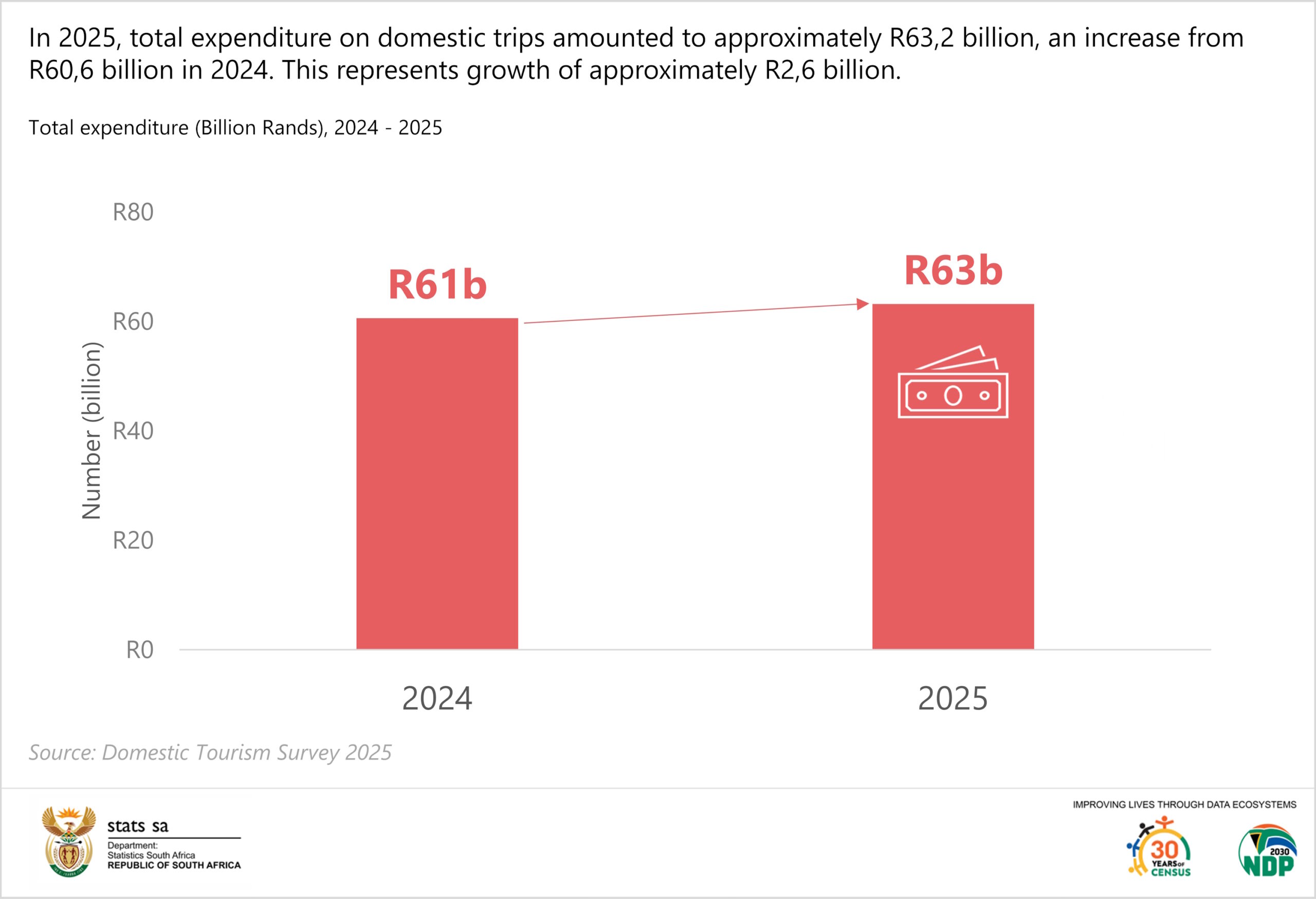
Tourism expenditure is one of the inputs used to estimate the contribution of tourism to the South African economy through the Tourism Satellite Account. In 2025, total expenditure on domestic trips amounted to approximately R63,2 billion, an increase from R60,6 billion in 2024. This represents growth of approximately R2,6 billion. Expenditure on day trips increased from
R22,2 billion in 2024 to R22,7 billion in 2025. Spending on overnight trips also increased, rising from R38,4 billion in 2024 to R40,5 billion in 2025.
Monthly travel patterns reflect changing activity
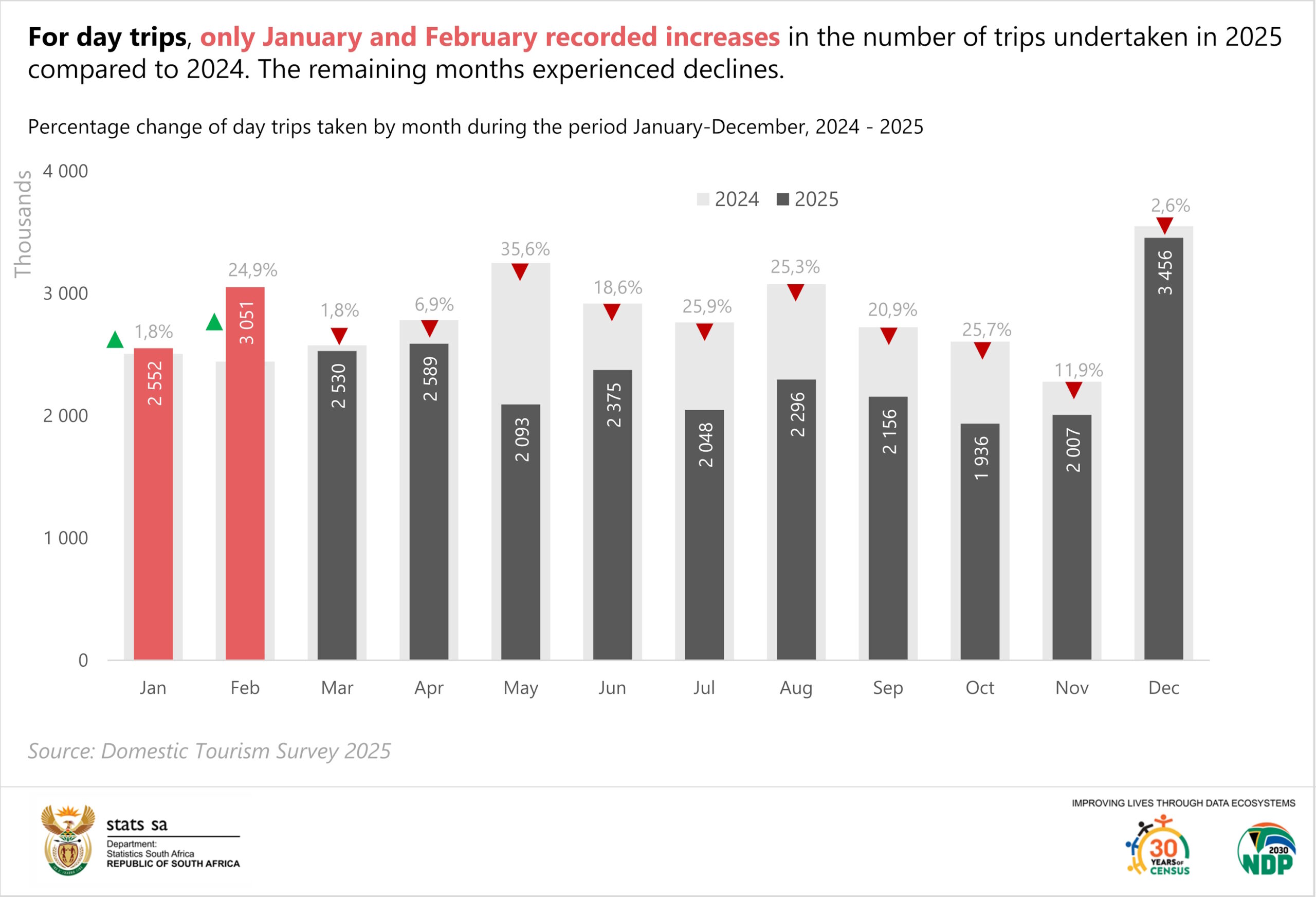
Domestic travel activity followed different patterns throughout 2025 compared with the previous year, with the number of trips declining in most months.
For day trips, January and February were the only months in which the number of trips increased in 2025 compared with 2024. The remaining months recorded declines.
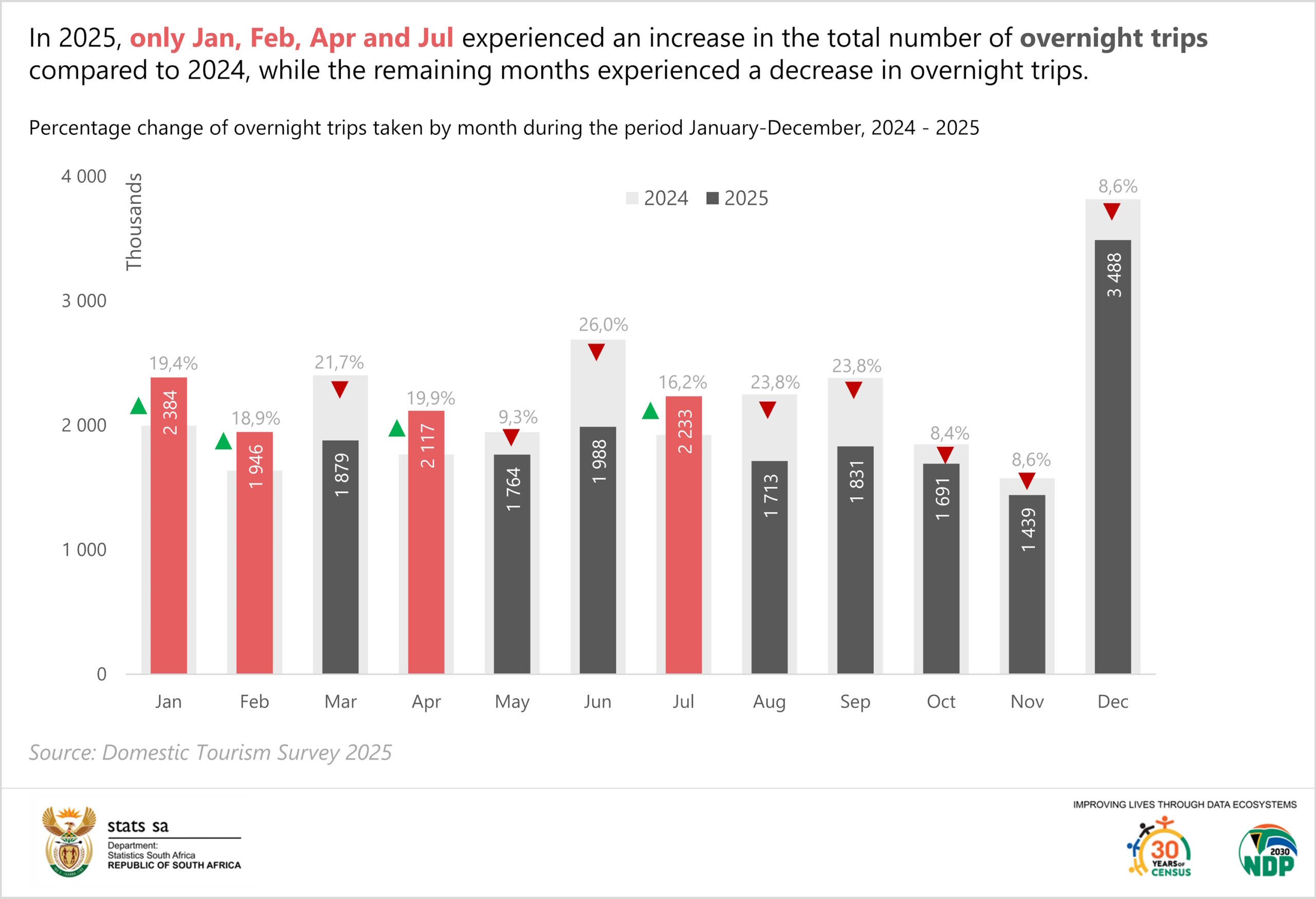
Overnight travel followed a slightly different pattern, with increases recorded in January, February, April and July, while the number of trips decreased in all other months.
Most recent trips reveal changing travel patterns
Looking at respondents’ most recent trips provides a clearer picture of domestic travel, including why people travel, where they go, how they get there and what accommodation they use. These indicators are measured using information about respondents’ most recent day and overnight trips.
Between 2024 and 2025, the number of most recent day trips declined, while the number of most recent overnight trips increased. Because each traveller reports only one most recent trip, these figures reflect the number of travellers rather than the total number of trips. The findings provide a closer look at the destinations and travel choices of South Africans who undertook these trips.
Limpopo becomes the leading overnight destination
The leading destination provinces for domestic travellers shifted between 2024 and 2025, with Limpopo gaining ground as a destination for both day and overnight travel.
In 2024, Gauteng, the Western Cape and Limpopo were the leading destinations for day travellers. Gauteng retained its leading position in 2025, while Limpopo overtook the Western Cape to become the second-leading destination province for day trips.
The ranking of overnight destinations also changed. KwaZulu-Natal was the leading destination province in 2024, followed by Limpopo and the Western Cape. In 2025, however, Limpopo moved into first place, followed by KwaZulu-Natal and the Western Cape.
Visiting friends and relatives remains a key reason for travel
Personal shopping was the main purpose of the most recent day trip in both 2024 and 2025. Visiting friends and relatives ranked second, followed by leisure activities.
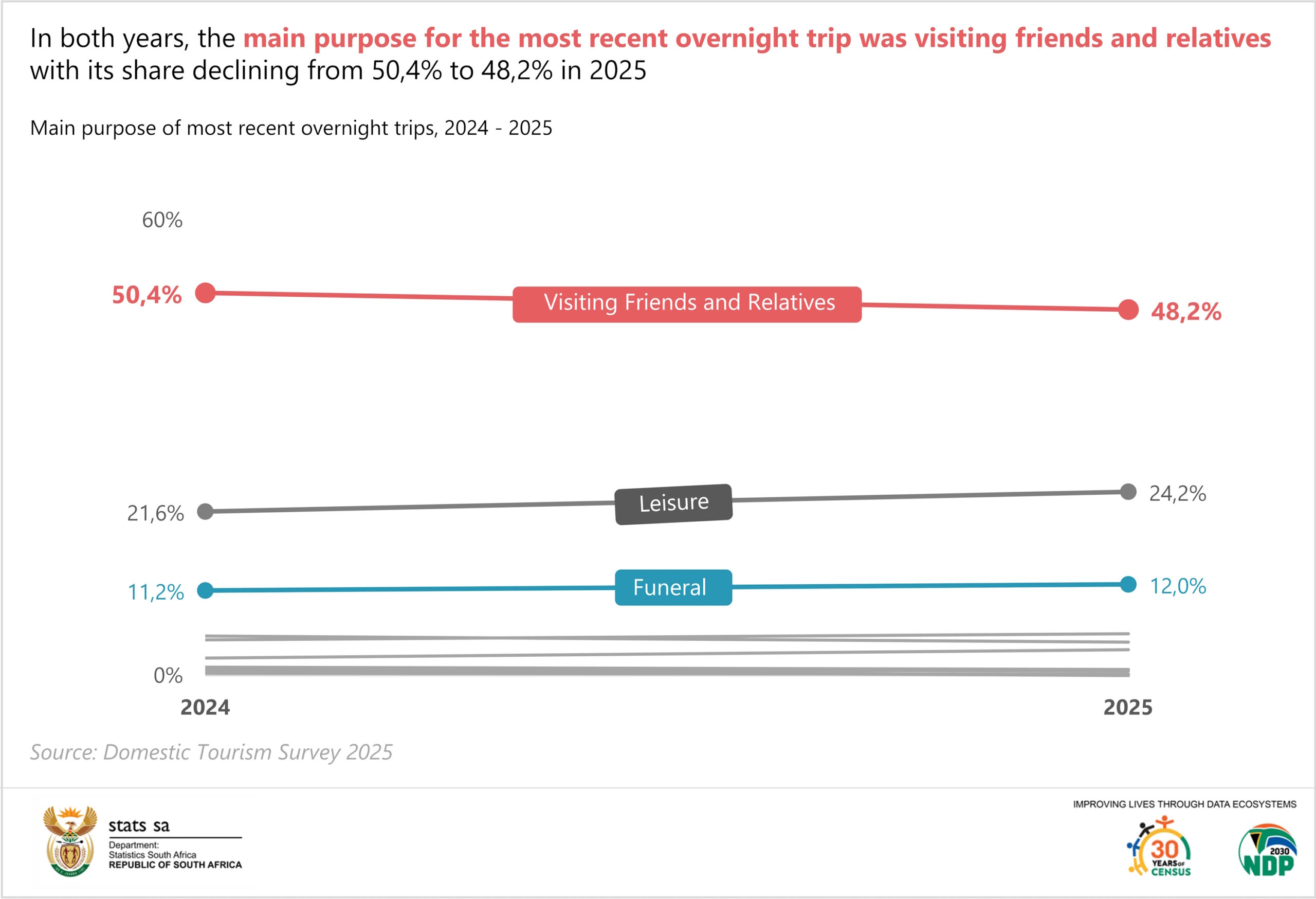
For overnight trips, visiting friends and relatives remained the leading reason for travel, although its share declined from 50,4% in 2024 to 48,2% in 2025. Leisure travel accounted for 21,6% of the most recent overnight trips in 2024, rising to 24,2% in 2025. Trips to attend funerals increased from 11,2% to 12,0% over the same period.
Private cars remain the preferred mode of transport
Private cars remained the most used mode of transport for both day and overnight trips in 2024 and 2025. Taxis and buses followed, maintaining their place among the main transport options used by domestic travellers.
For overnight trips, staying with friends and relatives was the most common accommodation arrangement. Self-catering establishments ranked second, followed by hotels.
Who is travelling within South Africa?
The survey findings also provide insight into the characteristics of domestic travellers. Individuals aged 35 to 44 years accounted for the largest proportion of both day travellers and tourists. People who had completed some secondary education undertook the highest number of day and overnight trips, while individuals who had never married were more likely to travel than those in other marital-status groups.
Financial constraints keep many South Africans at home
While some South Africans continued to travel within the country, many did not undertake any trips during the reference period. Financial constraints were the main reason cited for not travelling, while others indicated that they had no particular reason to take a trip.
These findings point to the role household finances play in decisions about domestic travel, with affordability remaining a key consideration for those who do not travel.
Domestic tourism expenditure rises despite fewer trips
Although the total number of day and overnight trips declined between 2024 and 2025, domestic tourism expenditure increased. The contrasting trends show that lower travel volumes did not translate into lower overall expenditure on domestic tourism.
Limpopo’s rise as a leading destination for both day and overnight travel, Gauteng’s continued popularity for day trips and KwaZulu-Natal’s position among the leading overnight destinations also illustrate how travel preferences vary across the country. Together, the findings offer insight into the changing patterns of domestic tourism and spending associated with travel within South Africa.
For more information, download the report here.