


Poverty and age often move hand in hand, affecting people in different ways across the life cycle. A recent report by Statistics South Africa (Stats SA), “Poverty trends in South Africa: An examination of absolute poverty between 2006 and 2023”, sheds new light on how poverty has evolved over nearly two decades. Drawing on data from the Income & Expenditure Survey (IES) 2022/23, the report analysed poverty levels among individuals and households, providing a detailed breakdown by various demographic, socio-economic, and geographic characteristics, including age.
Individual Poverty and Age
In South Africa, children (0 to 17 years) remain one of the most vulnerable groups in the country, making up 43,1% of the poor population in 2023. Between 2006 and 2023, when examining poverty by age we see a pattern of poverty that starts high among the child population (0 to 17 years), declined for ages 18 to 54 years, and then rose again for ages 55 to 64. However, the trend shifted slightly between 2015 and 2023, with poverty increasing among those aged 55 to 64 years, but falling among individuals aged 65 years and older.
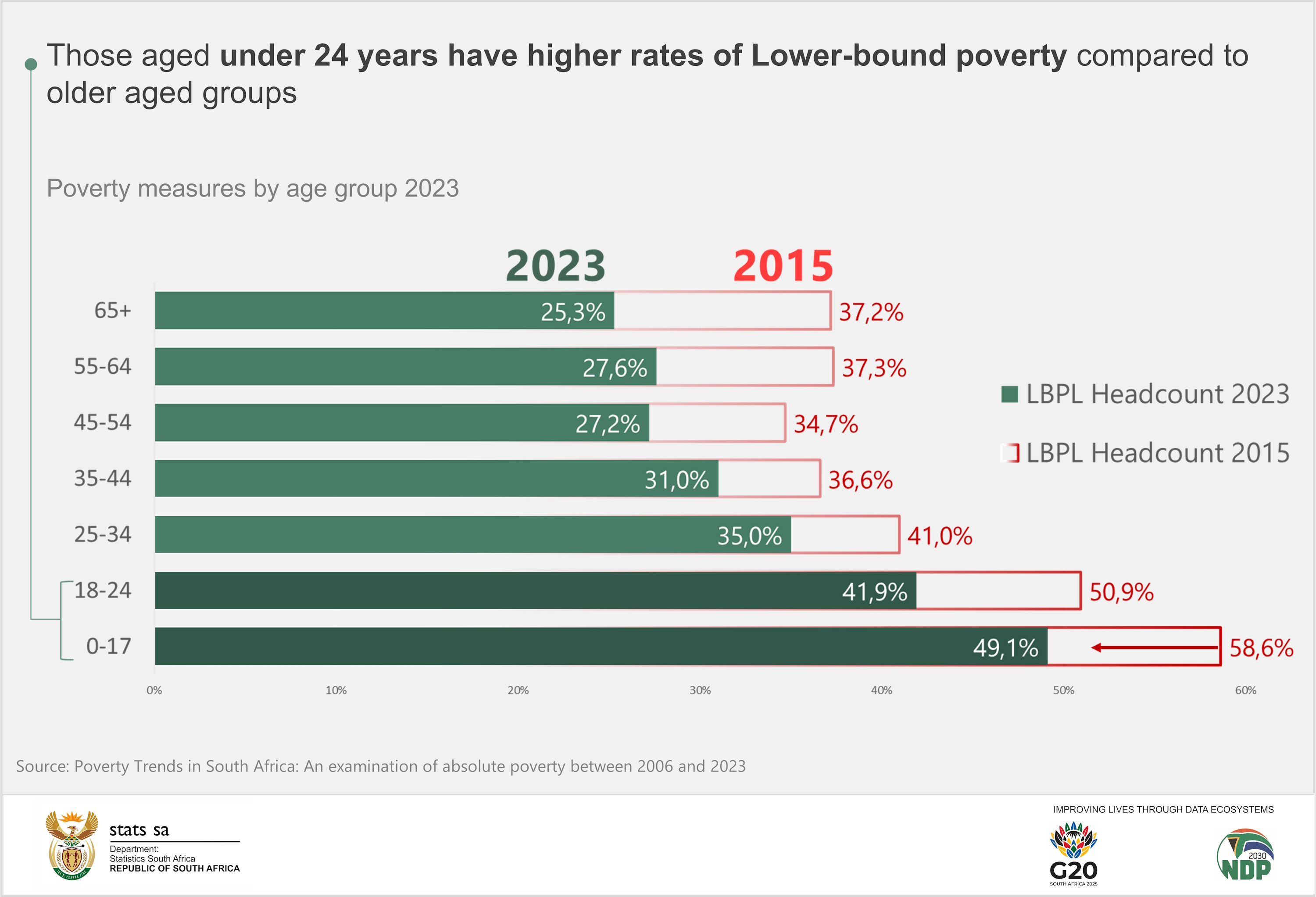
Between 2006 and 2023, older persons (65 years and above) saw the largest improvement in their poverty status, with their headcount dropping by 54,8% (a 30,6 percentage point decline), followed by children (0 to 17 years) with a notable decrease of 29,3% (a 20,3 percentage point drop). Between 2006 and 2023, child poverty declined from 69,4% in 2006 to 49,1% in 2023. Although this represents a significant decline, the poverty rate of 49,1% remained the highest for any age group, with nearly half of all children still living in poverty.
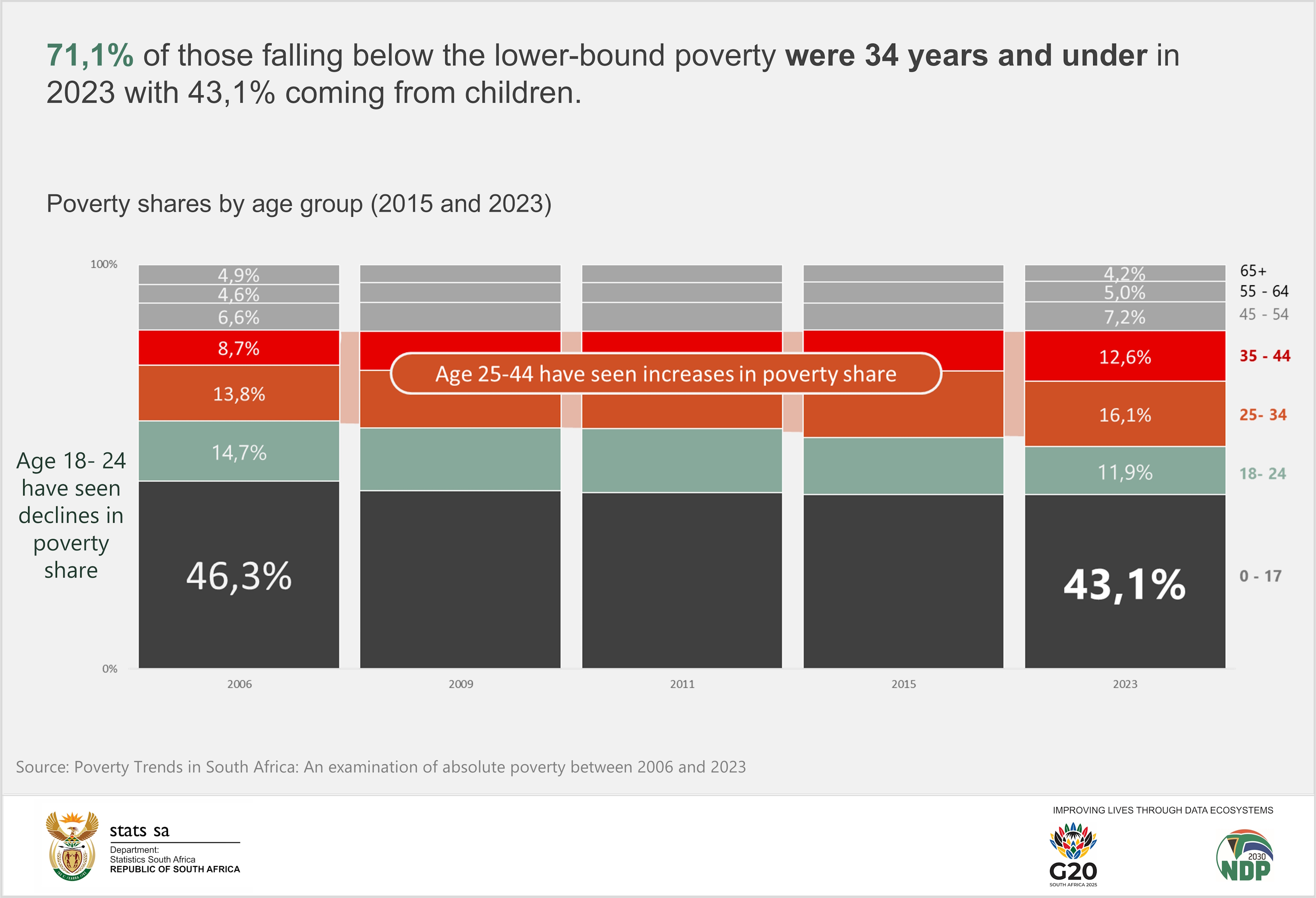
The pattern of poverty shares has also shifted over time. Between 2006 and 2023, the share of poverty among children (0 to 17 years), youth (18 to 24 years), and older persons (65+ years) decreased, while individuals in other age groups (from 25 to 64 years) saw their poverty shares increase. The largest rise was among those aged 35 to 44 years, whose poverty share grew from 8,7% in 2006 to 12,6%, in 2023, followed by the 25 to 34 age group, with an increase from 13,8% to 16,1% over the same period. Despite these changes, older persons had the lowest poverty share in 2023 at 4,2%.
Household Poverty and Age
Between 2006 and 2023 there was a general decline in the incidence of household poverty across all age groups. The biggest improvement was among households headed by older persons (65+ years), while the smallest decrease occurred in child-headed households (0–17 years). Poverty was highest in child-headed households and declined as the age of the household head increased. This pattern is expected, given the small number of child-headed households and the fact that children and young people make up the majority of poor persons in the country.
Households headed by 18–24-year-olds saw poverty rise by 8,7% between 2006 and 2009 (from 35,6% to 38,7%), before dropping steadily to 17,8% in 2023. For households headed by 45 to 54-year-olds, poverty fell from 43,5% in 2006 to 33,0% in 2011, rose slightly to 33,5% in 2015, then declined again to 24,4% in 2023.
Overall, from 2006 to 2023, poverty shares fell for households headed by children (0 to 17 years), youth (18–34 years) and older persons (65+ years). Households headed by individuals aged 35 to 64 years accounted for a higher proportion of poor households in 2023.
Poverty by Age and Sex
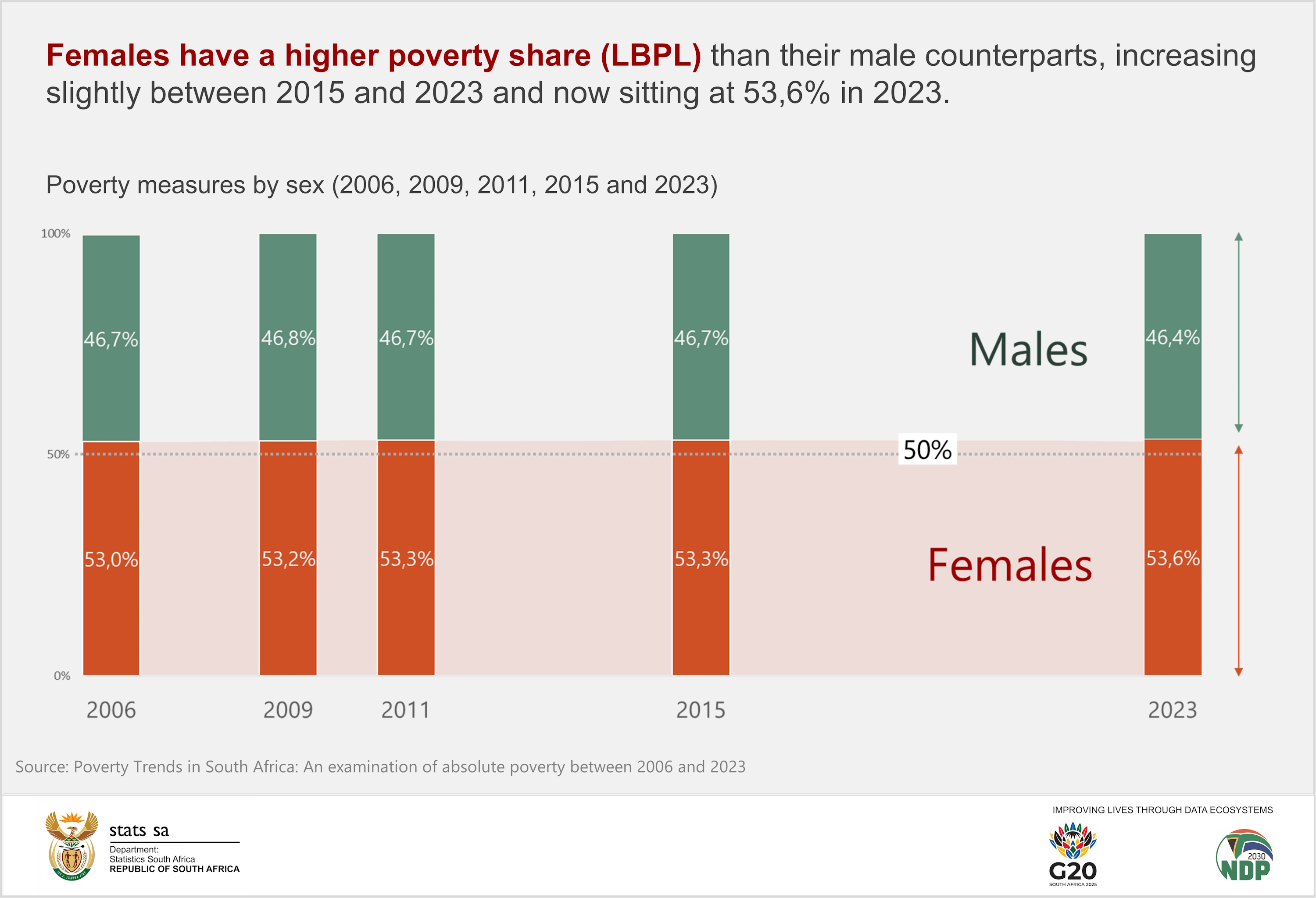
Poverty declined for both males and females across all age groups between 2006 and 2023, but females consistently recorded slightly higher poverty headcounts. Children (0–17 years) and youth (18–24 years) were the most affected, regardless of sex.
Among female children (0 to 17 years), poverty dropped by 20,6 percentage points, from 70,1% in 2006 to 49,5% in 2023. Male children saw a similar decline of 20,1 percentage points (from 68,8% to 48,6%). Poverty among young females (18–24 years), fell by 19,1 percentage points, while males recorded a comparable decline of 19,2 percentage points from 2006 to 2023.
For both sexes, the sharpest improvement was among older persons (65+ years). Poverty among older males fell by 58,3%, from 52,5% in 2006 to 21,9% in 2023, while older females saw a 53,0% drop, from 58,1% to 27,3%.
Poverty by Age and Settlement Type
Between 2006 and 2023, rural areas continued to bear the impact of poverty. Across all age groups, rural poverty rates were roughly double those in urban areas in 2023. While poverty declined in both settings, rural poverty levels remained significantly higher throughout the period.
Children (0 to 17 years) and youth (18 to 24 years) in both rural and urban settlements had the highest poverty rates compared to other age groups throughout the period. Rural child poverty fell from 86,9% in 2006 to 64,3% in 2023 (a 22,6 percentage point decline), indicating that more than six out of ten rural children were still living in poverty in 2023. Among rural older persons (65+ years), poverty dropped by 36,3 percentage points, from 78,3% in 2006 to 41,9% in 2023, making them the least poor age group in rural areas by 2023.
Urban areas showed similar trends, with children (0 to 17 years) consistently experiencing higher poverty rates. The largest reduction in poverty was among older persons (65+ years), whose poverty fell by 17,8 percentage points, from 34,3% in 2006 to 16,6% in 2023.
The Big Picture
South Africa has made progress in reducing poverty across all age groups, but the progress has not been equal. Children remained the most vulnerable, with nearly half still living below the poverty line in 2023. Rural areas continue to face deep poverty, while older persons saw the most dramatic improvements. These patterns show how age and location shape the experience of poverty and why understanding these dynamics matters in reducing poverty
For more information, download the Poverty Trends in South Africa report here.