
Each province forms a unique slice of the national economy. The latest provincial gross domestic product (GDP) estimates provide insight into the current state of our regional economies, shedding light on the industries that drive production across the country.
Six provinces are better off
Of the nine provinces, six recorded a rise in economic activity in 2024. Limpopo, Gauteng and Western Cape registered the strongest growth rates (Figure 1). Limpopo expanded by 0,9%, driven mainly by two industries: finance, which includes real estate and business services, and personal services. Other industries in Limpopo that recorded gains include utilities (i.e. electricity & water); transport & communication; general government; manufacturing and trade. Agriculture, construction and mining performed poorly, but not enough to derail Limpopo’s positive showing.
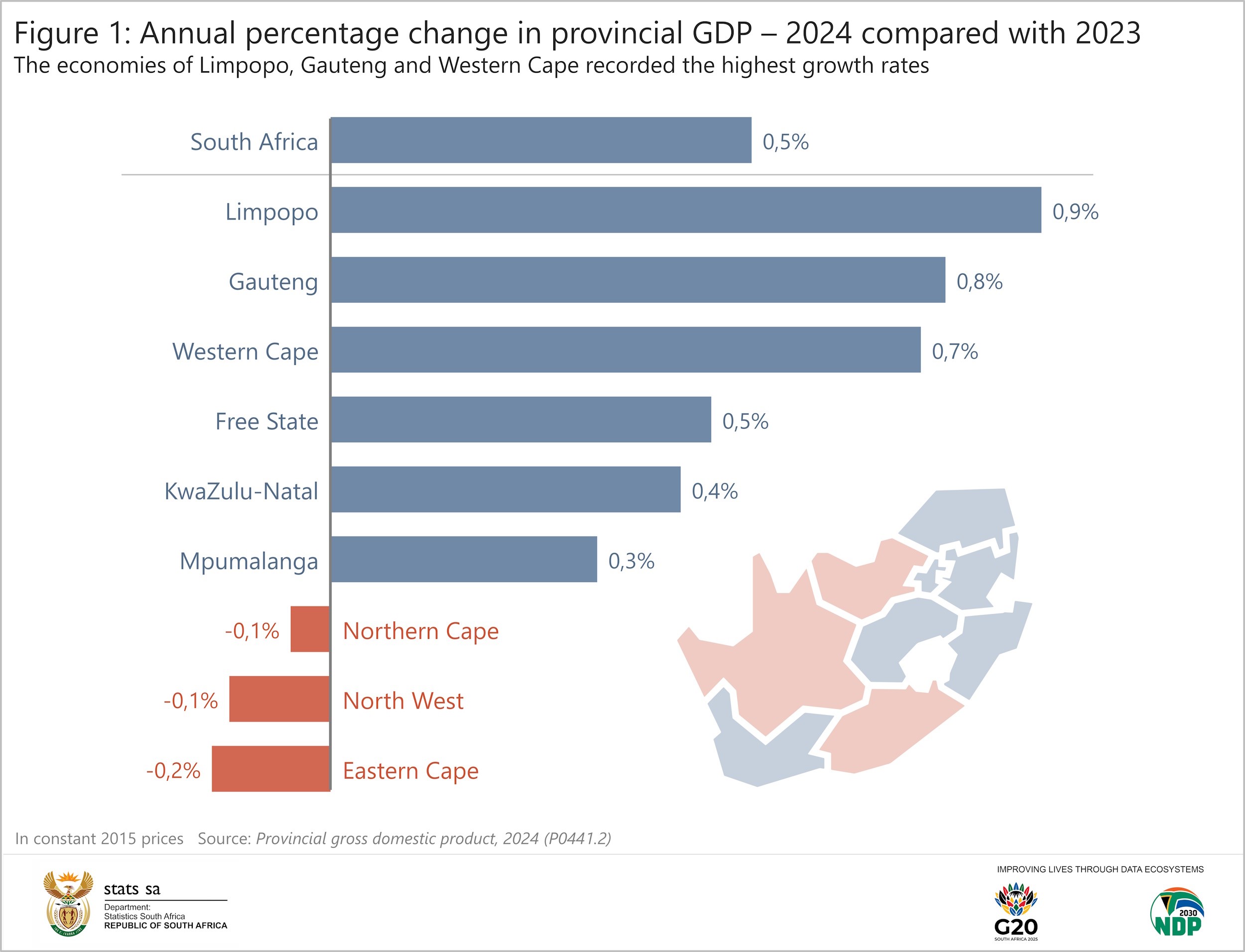
Finance was also the most significant positive contributor to growth in Gauteng and Western Cape, with notable support from personal services and utilities. In fact, finance was the main driver of growth across all provinces.
Three provincial economies contracted. In Eastern Cape, seven of the ten industries declined, with trade, manufacturing and agriculture the most significant negative contributors. North West also disappointed, pulled lower by trade, agriculture, transport, construction, manufacturing and mining. Softer agricultural production was the largest drag on growth in Northern Cape.
Gauteng remains the largest economy
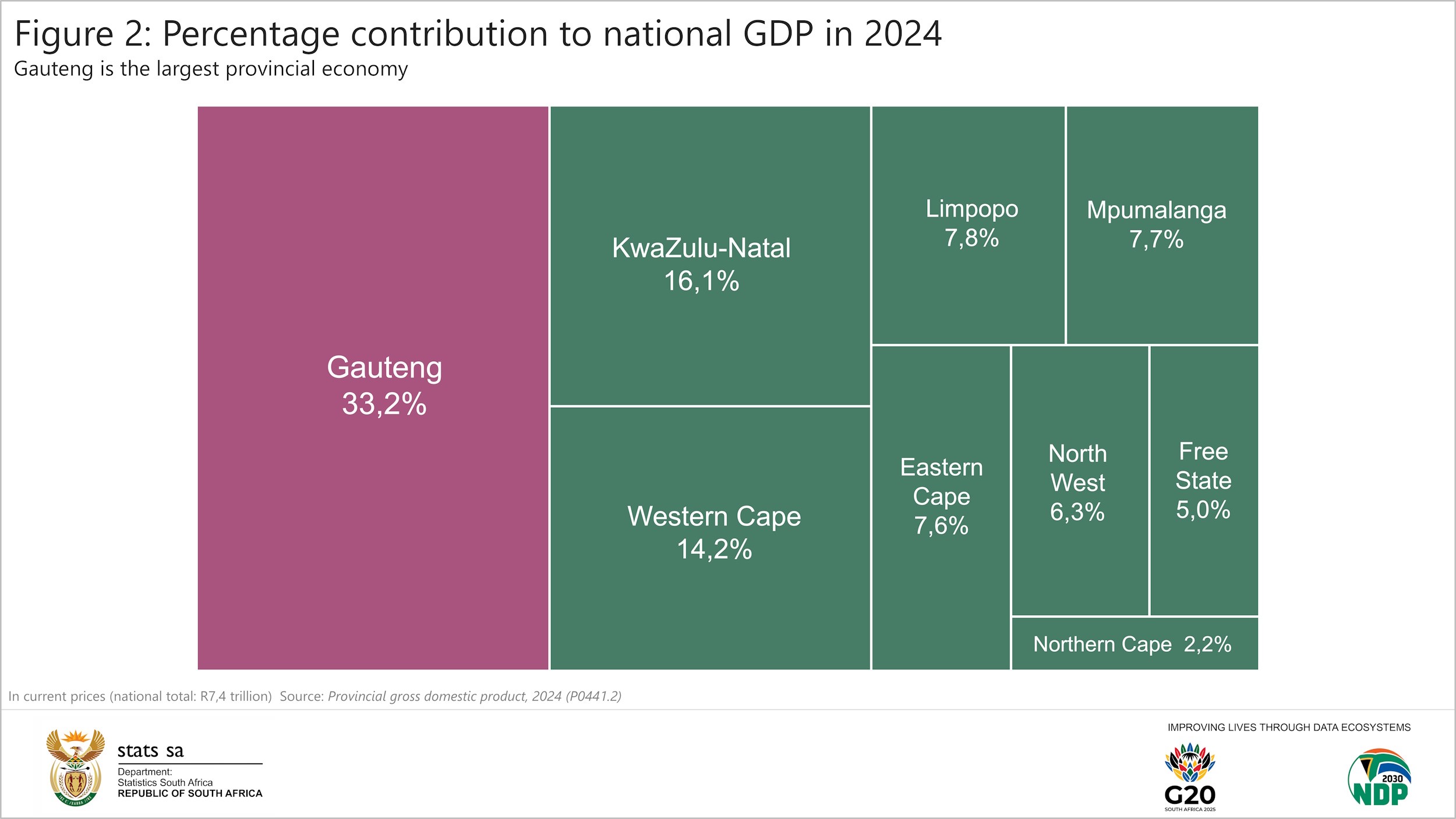
Despite these ups and downs, there was little change in provincial contributions to the South African economy. Gauteng remains the largest, accounting for a third of national output (Figure 2).
The most important industries
In each province, the top four largest industries include a mix of finance, personal services, mining, manufacturing and trade. In 2024, mining was the main driver of economic activity in Mpumalanga, North West and Northern Cape, and the second largest in Limpopo (Figure 3). Finance was the most influential industry in Gauteng, Western Cape and Free State.
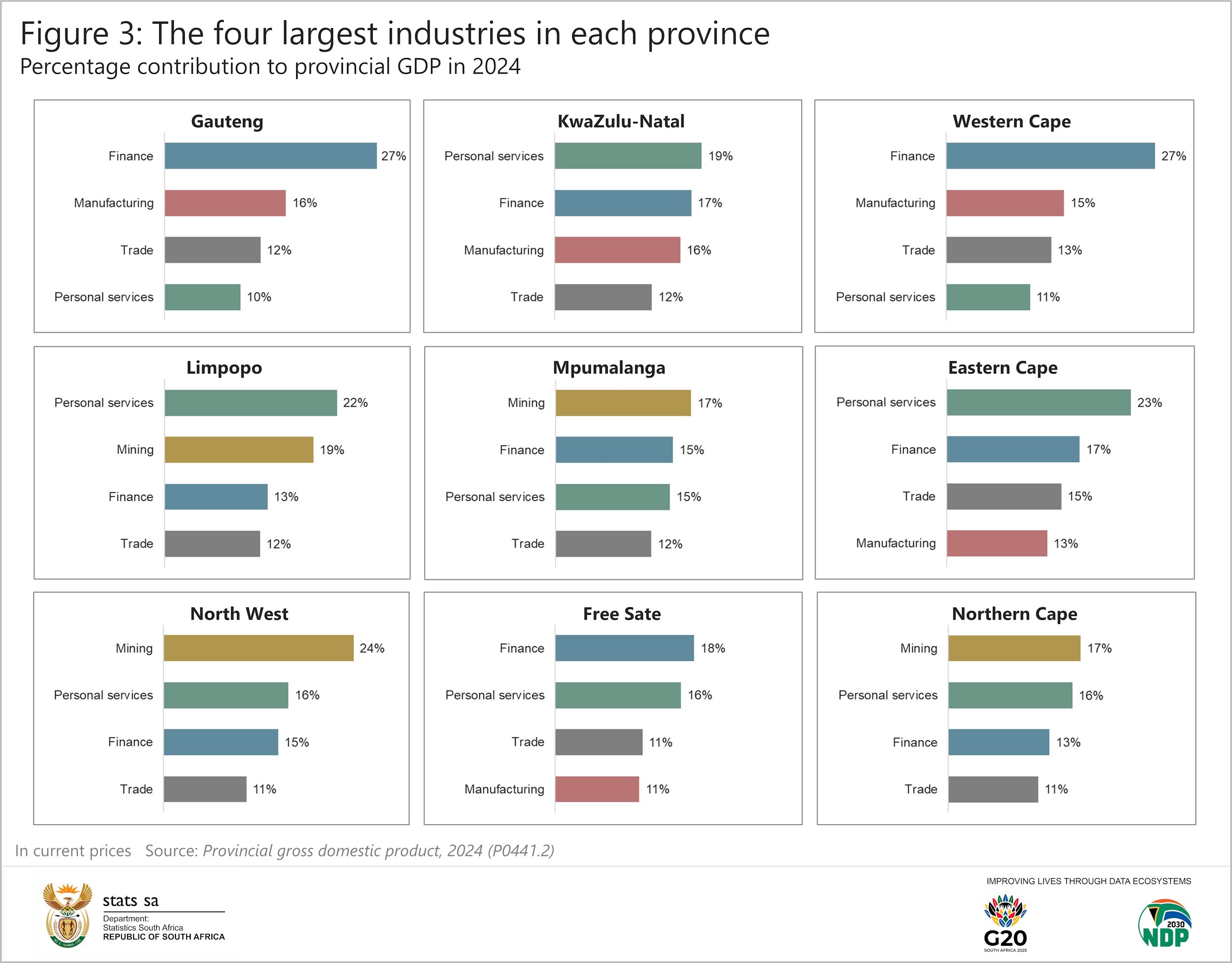
Personal services, which includes health and education, was the largest industry in KwaZulu-Natal, Limpopo and Eastern Cape.
The concentration of industrial activity
Economic activity is not evenly distributed across the country. Agriculture, for example, is primarily concentrated in Western Cape, KwaZulu-Natal and Free State. Together, these three provinces account for 56% of national agricultural production (Figure 4).1
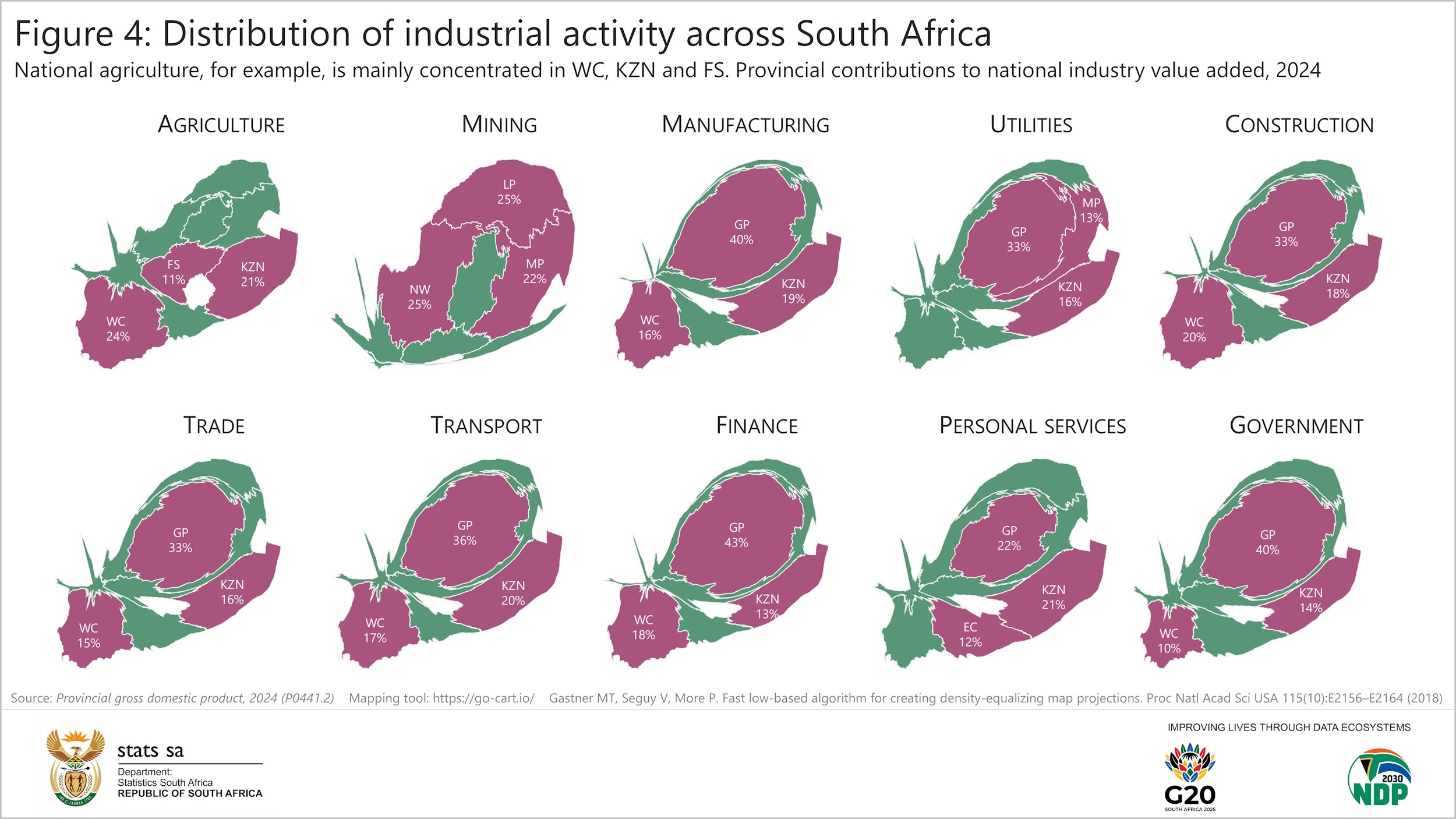
Mining activities mainly take place in North West, Limpopo and Mpumalanga. Gauteng, KwaZulu-Natal and Western Cape are responsible for the bulk of South African manufacturing value added.
For more information, download the 2024 provincial GDP statistical release and data here.
1 Cartograms in Figure 4 were created using the site https://go-cart.io/. For more information, see Gastner MT, Seguy V, More P. Fast flow-based algorithm for creating density-equalizing map projections. Proc Natl Acad Sci USA 115(10):E2156–E2164 (2018) (available here).
Similar articles are available on the Stats SA website and can be accessed here.
For a monthly overview of economic indicators and infographics, catch the latest edition of the Stats Biz newsletter here.