September marks Tourism Month in South Africa. Spearheaded by the Department of Tourism, this annual campaign aims to highlight the importance of tourism to the national economy, promote domestic travel and attract international visitors to experience the country’s diverse offerings.
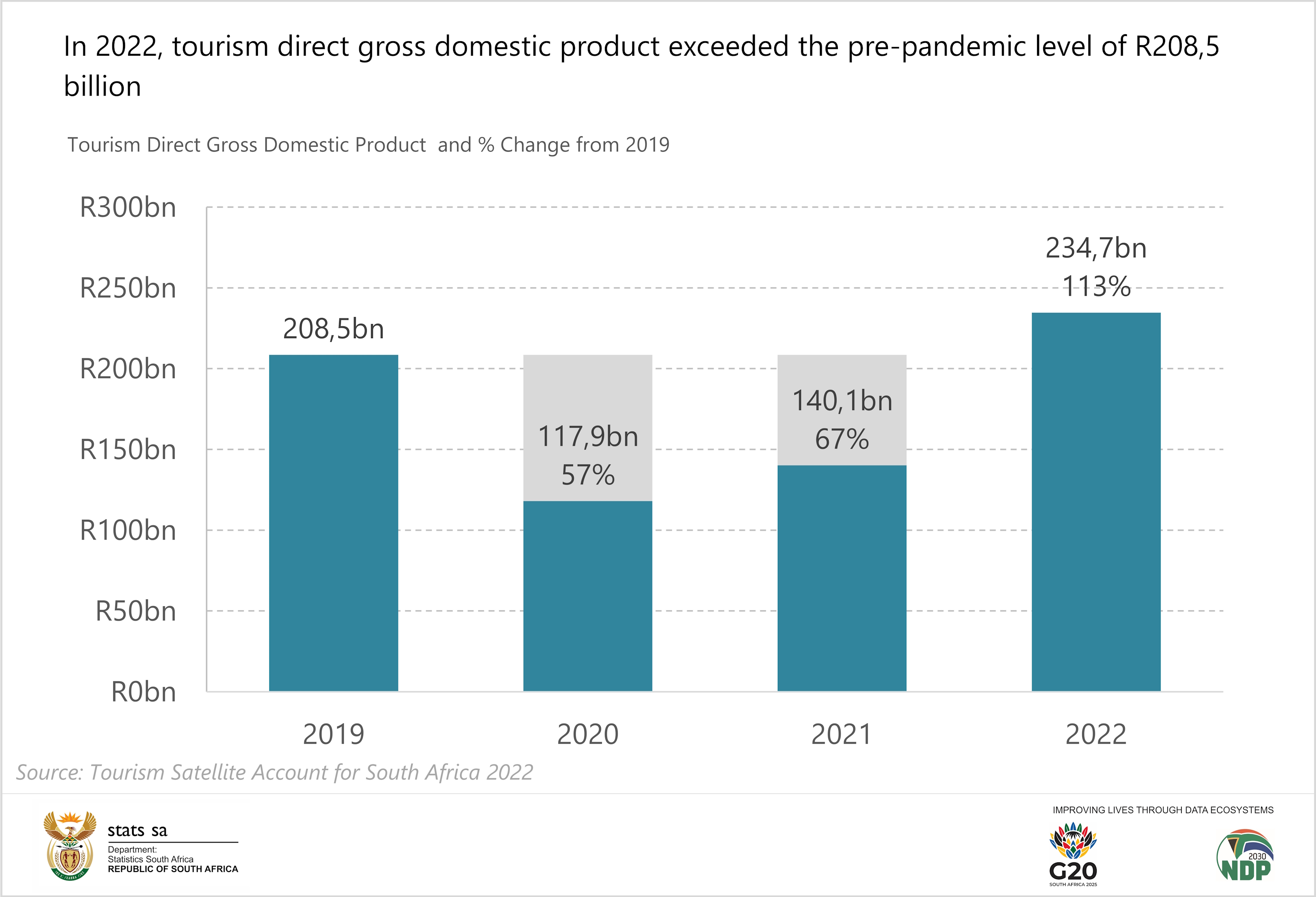
Statistics South Africa’s Tourism Satellite Account for 2022 shows that the Tourism Direct Gross Domestic Product (TDGDP) as a share of GDP was 3,5% (approximately R234 billion1).
Tourism in South Africa is measured as much in data as it is in experiences. Behind the pictures of beaches, wildlife and cultural festivals, Stats SA compiles various reports on tourism trends, visitor numbers and the industry’s economic impact. Tourism and Migration2 statistics record how many international visitors arrive and depart each month, and from where. The Domestic Tourism Survey (DTS3) captures how South Africans travel—whether for holidays, business, or to visit friends and relatives. The Tourism Satellite Account (TSA1) measures tourism’s direct contribution to Gross Domestic Product, employment, and other key indicators. The monthly Tourism Accommodation Survey4 provides insights into occupancy rates and income. The Accommodation Industry Survey5 provides detailed financial and employment statistics, while the monthly International Tourism6 release provides information on South African residents and foreign travellers who entered or left South Africa. The specific focus is on foreign tourists.
Together, these sources create a comprehensive statistical picture of tourism’s footprint in the South African economy and society. As September marks Tourism Month, it is a reminder that behind every trip is a number, and behind every number is a contribution to South Africa’s economy.
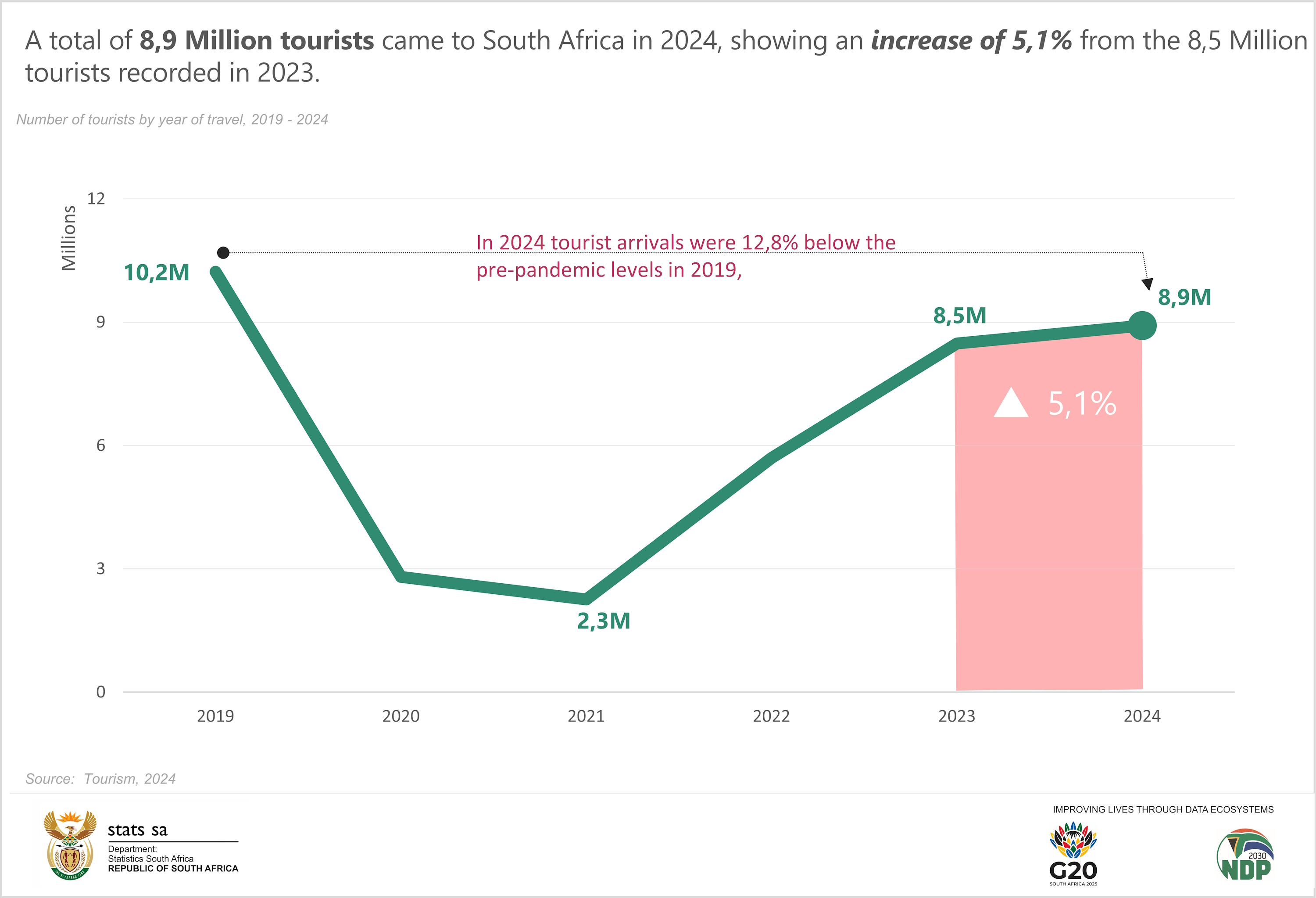
According to the latest data from Stats SA, South Africa’s tourism industry is showing positive signs of recovery and growth. In 2024, international arrivals reached 8,9 million—a 5,1% increase from 2023—highlighting the country’s growing appeal as a global travel destination.
By July 2025, about 3,1 million travellers passed through the country, including 2,1 million foreign nationals and nearly 880 000 South Africans.
Domestic tourism is also improving. The 2023 Domestic Tourism Survey reported 32,2 million day trips and 25,8 million overnight trips, with total expenditure reaching approximately R57,9 billion. Overnight trips accounted for R37,6 billion, while day trips contributed R20,2 billion. Cars and taxis were the preferred transport modes, especially for leisure travel.
The accommodation sector, long a cornerstone of the tourism industry, is showing some recovery. Between 2020 and 2024, income from accommodation nearly tripled from R14,0 billion to R37,4 billion, surpassing the pre-pandemic high of R36,6 billion in 2019. Despite the rise in income, hotel occupancy rates continue to lag. South African hotels recorded an occupancy rate of 57,4% in February 2025, the highest since the start of the pandemic. However, this is still lower than the 2019 peak of 64,4% recorded in November that year.
The 2022 Accommodation Industry report showed a decline in stay units (a hotel room-regardless of how many beds it has-, a self-catering apartment, a caravan or camping site, a chalet, lodge, or cottage, or any other unit in which a visitor can stay overnight) from 141 000 in 2018 to 128 000 in 2022, a 2,4% annual decrease. Over the same period, income fell from R54,2 billion to R46,2 billion, while employment dropped from 104 105 to 83 869 workers. Hotels remained dominant, accounting for 60% of stay units, nearly 72% of income, and 69% of employment.
In July 2025, growth in income from accommodation continued, rising by 10,4% year-on-year. Hotels grew by 18,3% (contributing 9,7 percentage points) and ‘other’ accommodation rose by 2,7% (contributing 1,1 percentage points).
The food and beverages sector, another key pillar of tourism, proved resilient during the COVID-19 pandemic. According to the 2022 report, income grew by 8,2% per year from R72,3 billion in 2018 to R99,0 billion in 2022, while employment rose by over 22 000 jobs to 236 527. Restaurants dominated the sector, contributing 51,8% of total income and 53,9% of employment.
The combined trends across international arrivals, domestic travel, accommodation, and food services reflect a tourism industry that is recovering. Tourism’s continued recovery highlights its importance as a driver of economic activity, community development, and cultural exchange.
From bustling urban centers to rural gems, every corner of South Africa holds stories worth sharing and experiences worth preserving. With every journey taken, the footprint of tourism grows—reflected in visitor statistics, spending patterns, and livelihoods sustained across provinces.
For more information on tourism statistics, check out the links below for all the Tourism Surveys produced by Stats SA.
References:
1Tourism Satellite Account (TSA)- https://www.statssa.gov.za/?page_id=1866&PPN=Report-04-05-07&SCH=7683\
2 Tourism and Migration – https://www.statssa.gov.za/?page_id=1854&PPN=P0351
3 Domestic tourism survey (DTS) – https://www.statssa.gov.za/?page_id=1854&PPN=P0352.1
4 Monthly Tourist Accommodation –https://www.statssa.gov.za/?page_id=1866&PPN=P6410&SCH=7417
5Accommodation industry (large sample survey): http://www.statssa.gov.za/?page_id=1866&PPN=Report-64-11-01&SCH=7082
6International Tourism – https://www.statssa.gov.za/?page_id=1854&PPN=P0350