


South Africa’s commercial agricultural industry is notable for its wide variety of crops, horticultural products and livestock. A recent release breaks it all down, providing data on the industry’s most popular products.
The Agricultural industry, 2023 statistical report summarises data from thousands of farms across the country, revealing interesting nuggets of information. Maize and sugarcane are leading products, for example. The commercial agricultural industry produced an estimated 13,4 million tons of maize and 9,6 million tons of sugarcane in 2023 (Figure 1).
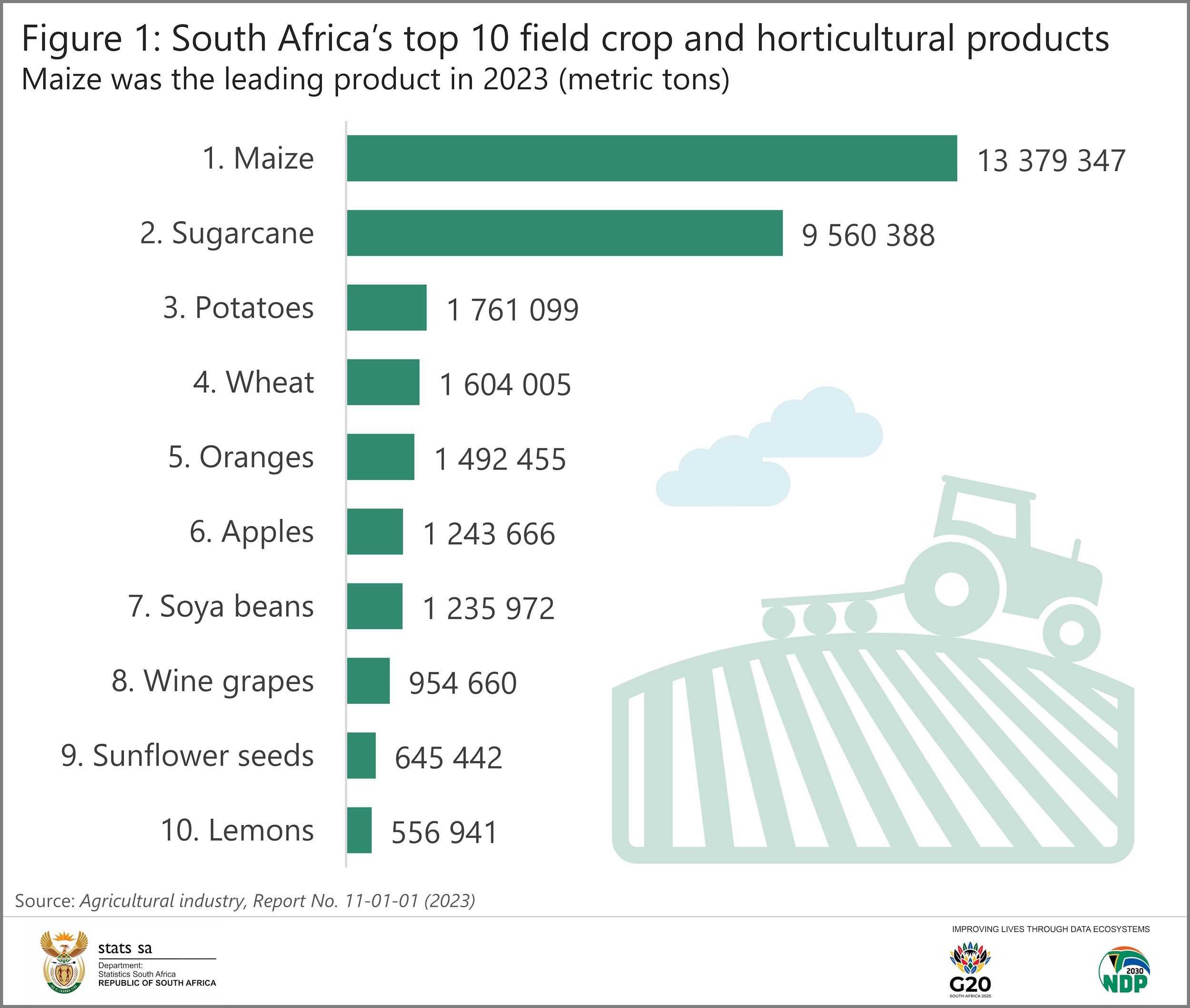
Potatoes were the third largest, following relatively far behind at 1,8 million tons. Wheat was fourth, followed by oranges, apples and soya beans.
Slicing into the data reveals a provincial breakdown, shown in Figure 2. Agricultural production is not uniform across the country – several products grow only in specific regions. For example, sugarcane is mainly grown in two provinces. KwaZulu-Natal dominates, with some production occurring in Mpumalanga. If a large-scale catastrophic event were to strike KwaZulu-Natal, the country would lose 80% of its sugarcane crop.
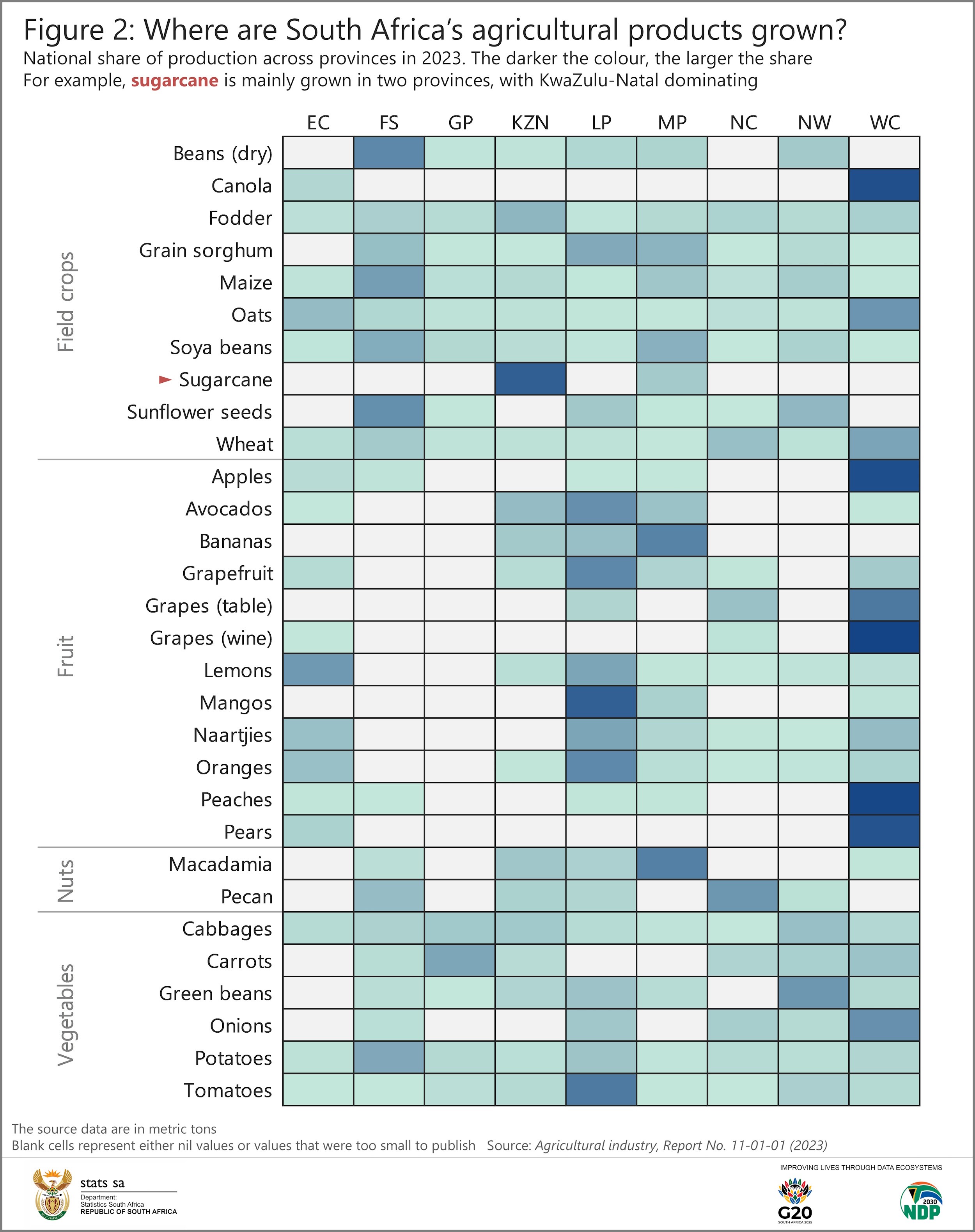
Wine grapes, peaches, apples, canola, pears and table grapes are mainly produced in Western Cape. The province also made notable contributions to the country’s basket of onions, oats and wheat.
US tariffs are expected to affect several South African industries, including the citrus sector. Most of the nation’s citrus crop – which includes lemons, naartjies, oranges and grapefruit – is grown in Limpopo and Eastern Cape, with smaller contributions from Western Cape, Mpumalanga and several other provinces.
In terms of vegetables, Limpopo was also responsible for almost two-thirds of the country’s tomato crop. Western Cape produced half of the nation’s onions. Potatoes were mainly grown in Free State and Limpopo.
A recent example of international investment directed at macadamia farming in Mpumalanga is not surprising.1 The province was the leading producer of macadamia nuts in 2023.
Not only did the survey ask farmers about field crops and horticultural products, but it also gathered data on livestock. Three types of animals are shown in Figure 3. There were an estimated 4,7 million head of cattle on commercial farms in 2023, mainly located in Free State, Eastern Cape and KwaZulu-Natal.
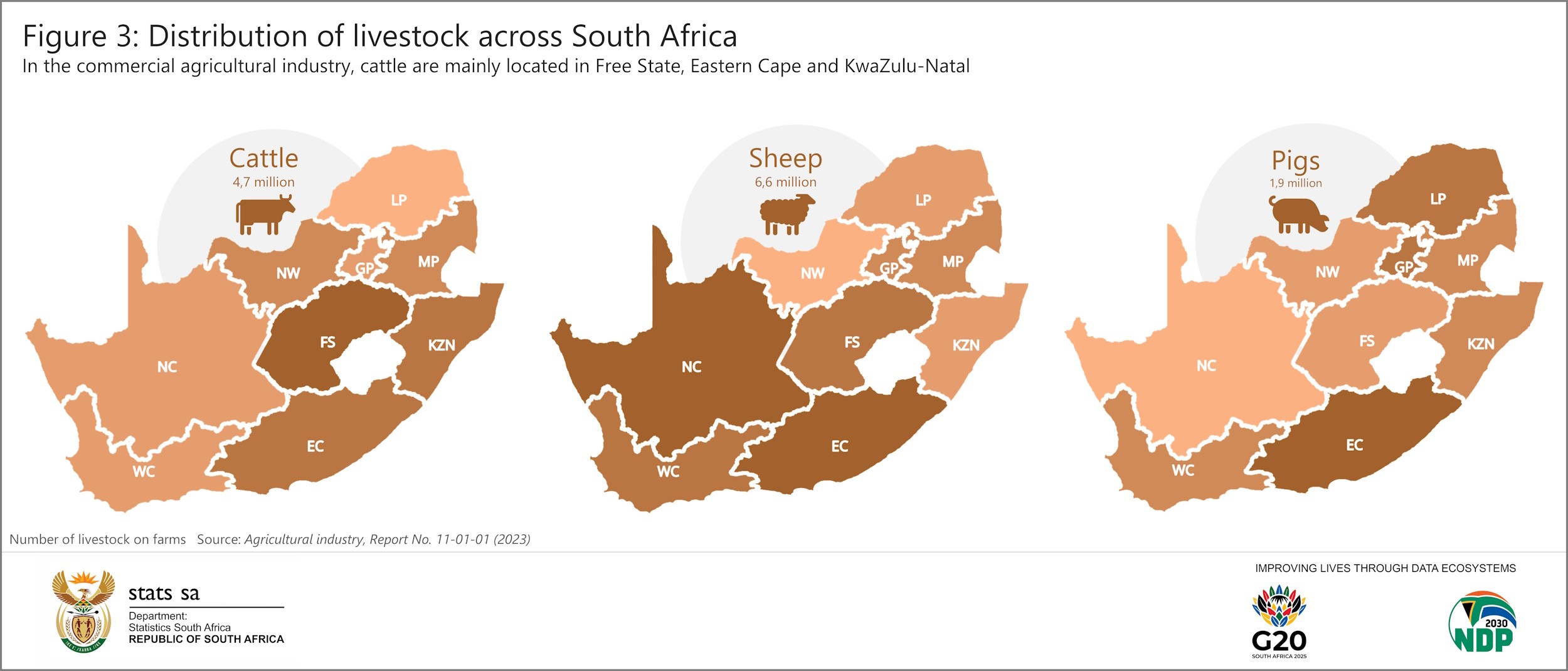
Sheep were predominantly found in the Eastern Cape, Northern Cape and Free State. Pigs were more evenly distributed across the country, with Eastern Cape and Gauteng hogging almost 40% of the national tally. Northern Cape was a notable exception with an extremely low number; less than two thousand commercially owned pigs were found in the province.
For more information on these figures, as well as on employment and income, download the Agricultural industry, 2023 statistical report, associated Excel data and media presentation here. The statistical report is based on a large survey of farms registered for value-added tax (VAT). For an overview of smallholder and subsistence agriculture, take a look at the Census 2022: Agricultural households statistical report, available here for download.
1 SABC, AgriStar macadamia farming creates more than 400 jobs in Mpumalanga [27 July 2025] (read here).
Similar articles are available on the Stats SA website and can be accessed here.
For a monthly overview of economic indicators and infographics, catch the latest edition of the Stats Biz newsletter here.