Access to safe, sufficient, and reliable drinking water and sanitation is a fundamental human right essential for health and everyday life. However, access to this right remains inequitable, both globally and in South Africa.
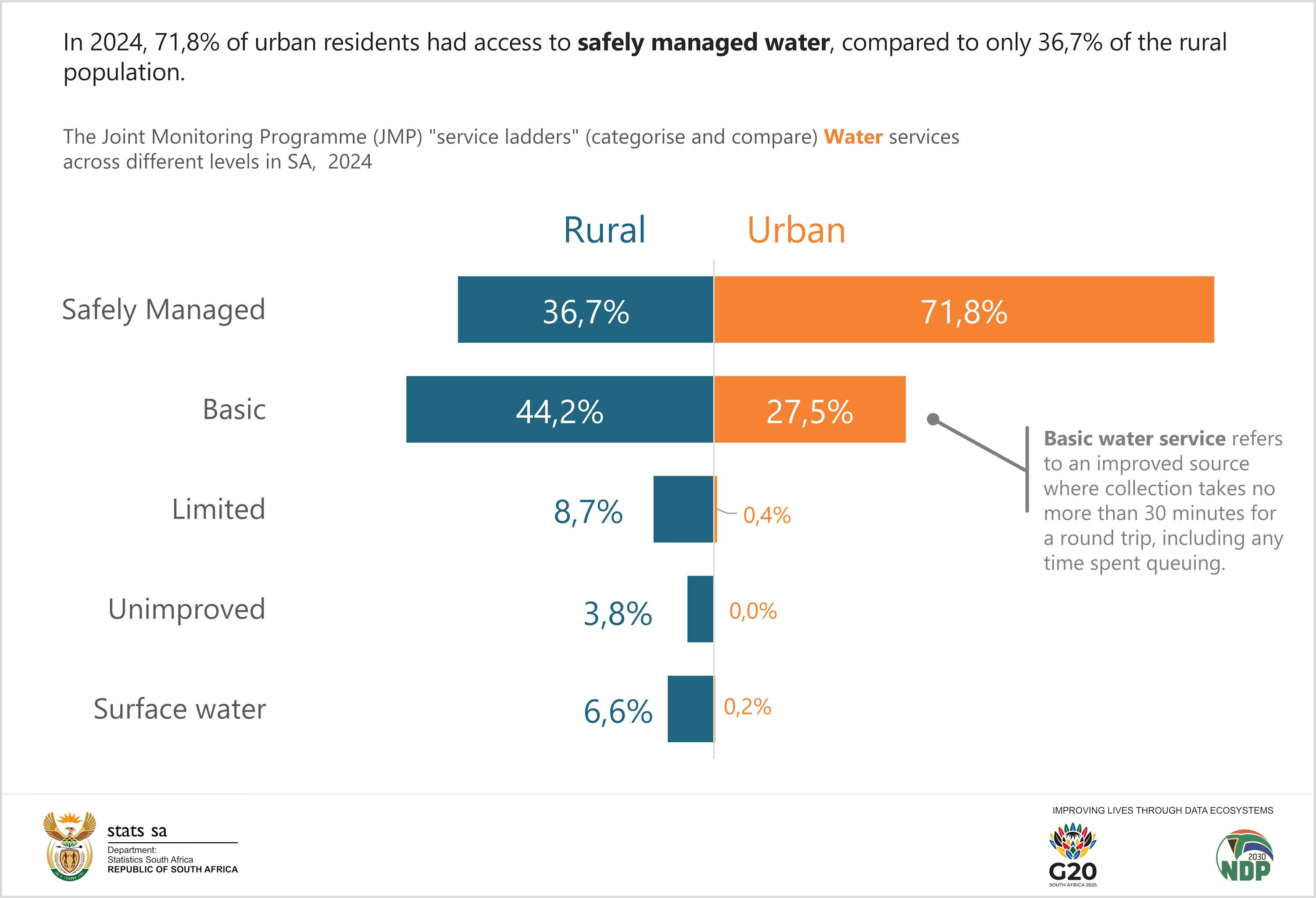
According to the General Household Survey (GHS), 2024, released by Statistics South Africa (Stats SA), while 71,8% of urban residents have access to safely managed water, only 36,7% of rural populations do—and nearly all those relying on limited, unimproved, or even surface water live in rural areas. In contrast, access to basic water is higher in rural areas (44,2%) than in urban ones (27,5%), highlighting the uneven quality of supply.
Goal 6 of the 2030 Agenda for Sustainable Development aims to ensure availability and sustainable management of water and sanitation for all. It outlines specific goals, including universal access to safe drinking water (Target 6.1) and adequate sanitation and hygiene (Target 6.2).
Tracking progress on these goals falls to the World Health Organization/United Nations Children’s Fund (WHO/UNICEF) Joint Monitoring Programme (JMP), which oversees global data on Water, Sanitation, and Hygiene (WASH). Using its service ladders, the JMP enables comparisons of water and sanitation access across provinces and between rural and urban communities. These service ladders help us to understand not just who has services, but what kind of access to services they have. By using the ladders, governments and organisations can see where the biggest gaps are and focus efforts on helping people move up the steps toward safe, reliable water and sanitation.
Water
Access to drinking water is classified using the “water ladder,” which ranks service levels based on proximity, safety, and reliability of the water source.
At the top of the ladder is safely managed water—a source located on the premises, available when needed, and free from faecal and harmful chemical contamination. Basic water service refers to an improved source where collection takes no more than 30 minutes for a round trip, including any time spent queueing. If collection takes longer than 30 minutes, even from an improved source, it falls under limited access.
Improved sources include piped water, boreholes, protected wells and springs, rainwater, and packaged or delivered water. In contrast, unimproved water comes from sources like unprotected wells and springs, while surface water—the lowest rung on the ladder—is drawn directly from rivers, streams, dams, or ponds.
According to the latest data, more than two-thirds (67,8%) of households that fetch their water do so in under 30 minutes, while 5% spend over an hour on the task. More than one-third (35,8%) of households in KwaZulu-Natal without piped water in their dwellings or on site took more than 30 minutes to fetch water.
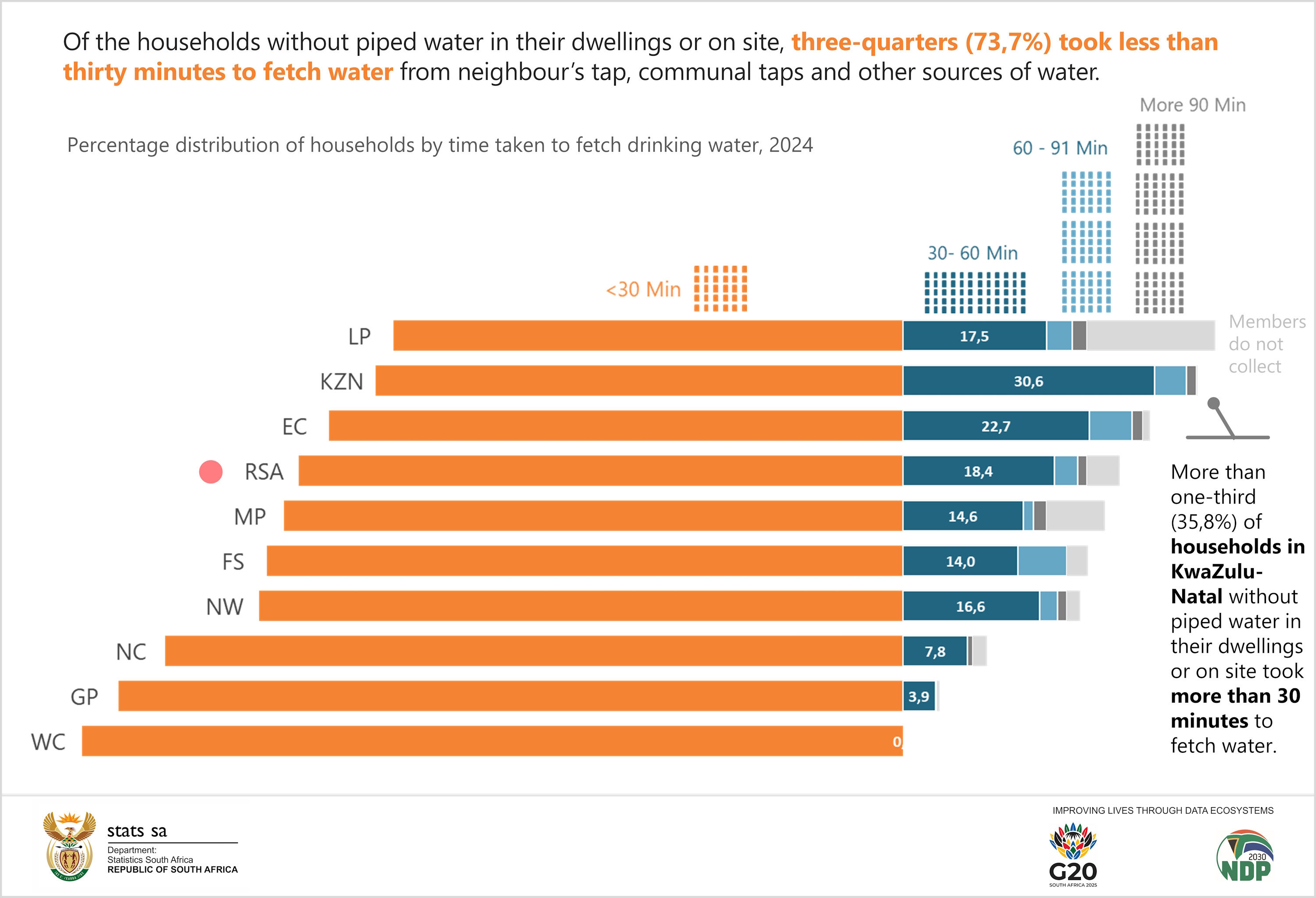
Almost four out of five households in South Africa—77,1 percent—had access to at least a basic level of drinking water in 2024, according to the national water ladder assessment.
The Western Cape reported the highest level of access, with 99,8 percent of households meeting at least the basic standard, followed by Gauteng at 99,6 percent. In contrast, access was significantly lower in provinces such as KwaZulu-Natal, where 83,3 percent of households had basic water services, with Limpopo at 86,4 percent, and the Eastern Cape at 87,8 percent.
These three provinces also recorded the highest reliance on surface water—an indicator of limited or unsafe water access.
Sanitation
Improved sanitation facilities are those designed to safely separate human waste from contact, helping to protect health and hygiene. These include flush or pour-flush toilets connected to sewer systems, septic tanks, or pit latrines; pit latrines with slabs (including ventilated ones); and composting toilets.
Under Sustainable Development Goal 6.2, a sanitation service is considered safely managed if it meets three key conditions: the facilities must be improved, not shared with other households, and the waste must be properly treated. This can happen in one of three ways:
The waste is treated and disposed of on site; it is stored temporarily and then emptied and treated elsewhere, or it is transported through a sewer system and treated off-site.
If the waste from improved facilities isn’t safely handled, the service is classified as basic. When improved facilities are shared between households, they fall under the limited service category.
In South Africa, access to proper sanitation varies depending on where people live, the condition of the services available, and their overall living environment.
In 2024, just under half—46,2 percent—of households reported having sanitation facilities located inside their homes, while only 3,1 percent relied on facilities situated outside their yards.
Nationally, 76,3 percent of South Africans had access to safely managed sanitation services, which meet hygiene standards and ensure proper waste treatment. The highest rates were recorded in the Eastern Cape (85,3 percent), Mpumalanga (84,7 percent), and the Northern Cape (84,4 percent). In contrast, only 66,1 percent of the population in Gauteng had access to safely managed sanitation.
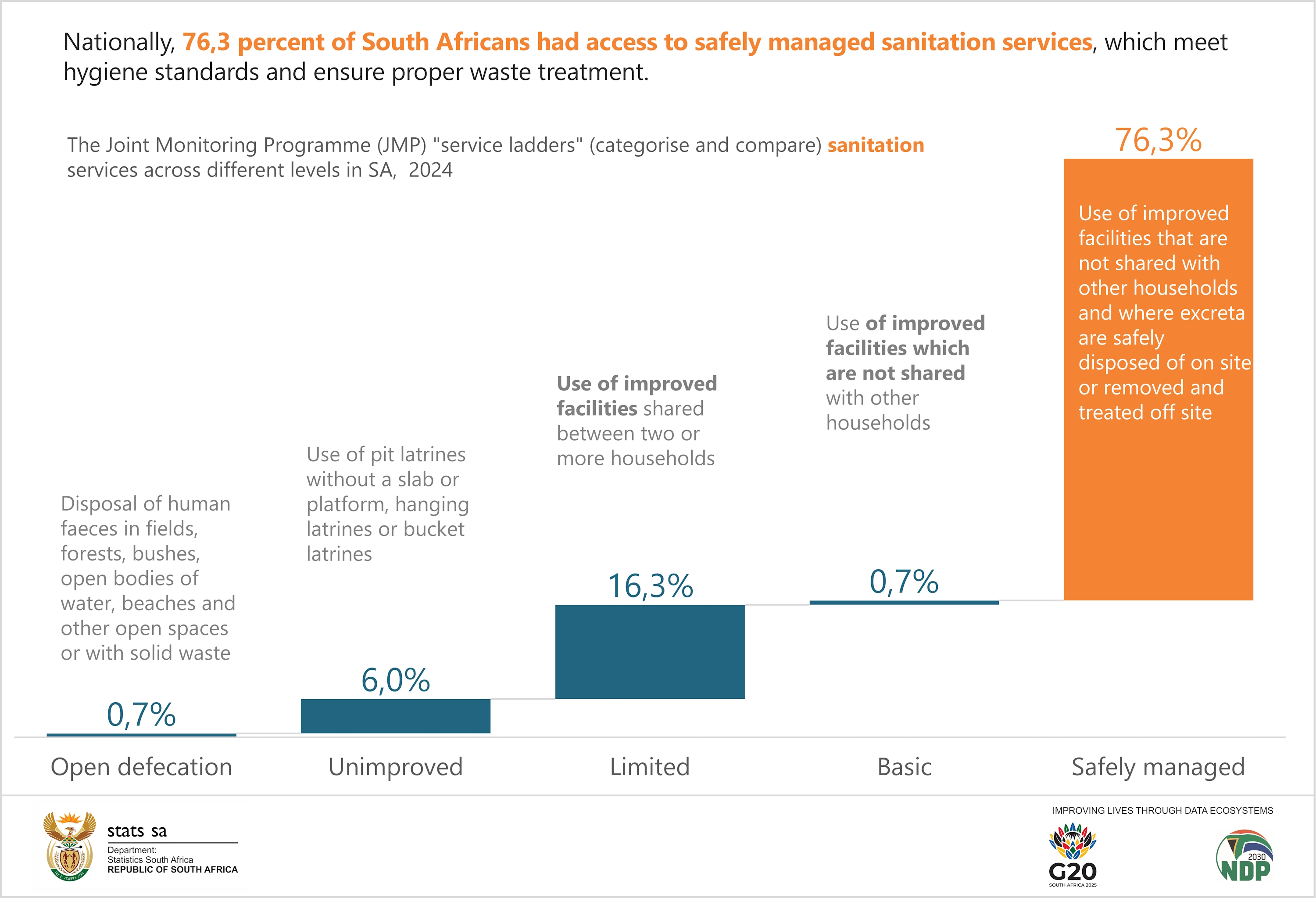
In Gauteng, 30,1 percent of residents used limited sanitation services—improved facilities shared between households—while in the Western Cape, the figure was 18,9 percent.
Nationally, one-fifth (19,9%) shared sanitation facilities, although the figure was much higher in urban (31,9%) than in rural areas (13,2%).
This disparity may be due to high population density, housing shortages, or limited space in cities. In many urban informal settlements, multiple households often live in cramped conditions without enough land or infrastructure to support private toilets. As a result, shared facilities become the only option. Meanwhile, rural areas, though often less developed, typically have more space per household, allowing for private or household-level sanitation, even if at a basic level.
Access to safely managed sanitation services in rural areas surpasses that of urban areas, with 79,6 percent compared to 74,6 percent. This is mainly due to the widespread use of improved facilities shared with other households, accounting for 21,4 percent. In rural areas, individuals relying on unimproved facilities or practicing open defecation are more commonly found.
The 2024 General Household Survey (GHS) provides information on the progress of development across a wide variety of fields and identifies persistent service delivery gaps in themes ranging from social welfare, health and education, to housing, basic services and access to food.
For more information, download the full report here.