
One of the many functions of government is to provide households with a safety net against social risks, such as unemployment, occupational injury, road accidents, loss of income and other forms of hardship.
Supporting the vulnerable
Many institutions across the public sector drive the social protection mandate. Several of these are classified as extra-budgetary accounts and funds (EBAs), which are institutions that deliver a wide range of services on behalf of the government. There are 254 EBAs in total, and well-known examples include the South African Revenue Service (SARS) and the National Student Financial Aid Scheme (NSFAS).
As a group, EBAs spent R411,5 billion in the 2024/2025 fiscal year, according to Stats SA’s latest Financial statistics of extra-budgetary accounts and funds statistical release.1 Figure 1 breaks this amount down by function. While economic affairs remained the largest area of expenditure, accounting for R132,9 billion or 32,3%, social protection was the second-largest, accounting for R90,2 billion or 21,9% of total EBA spending.
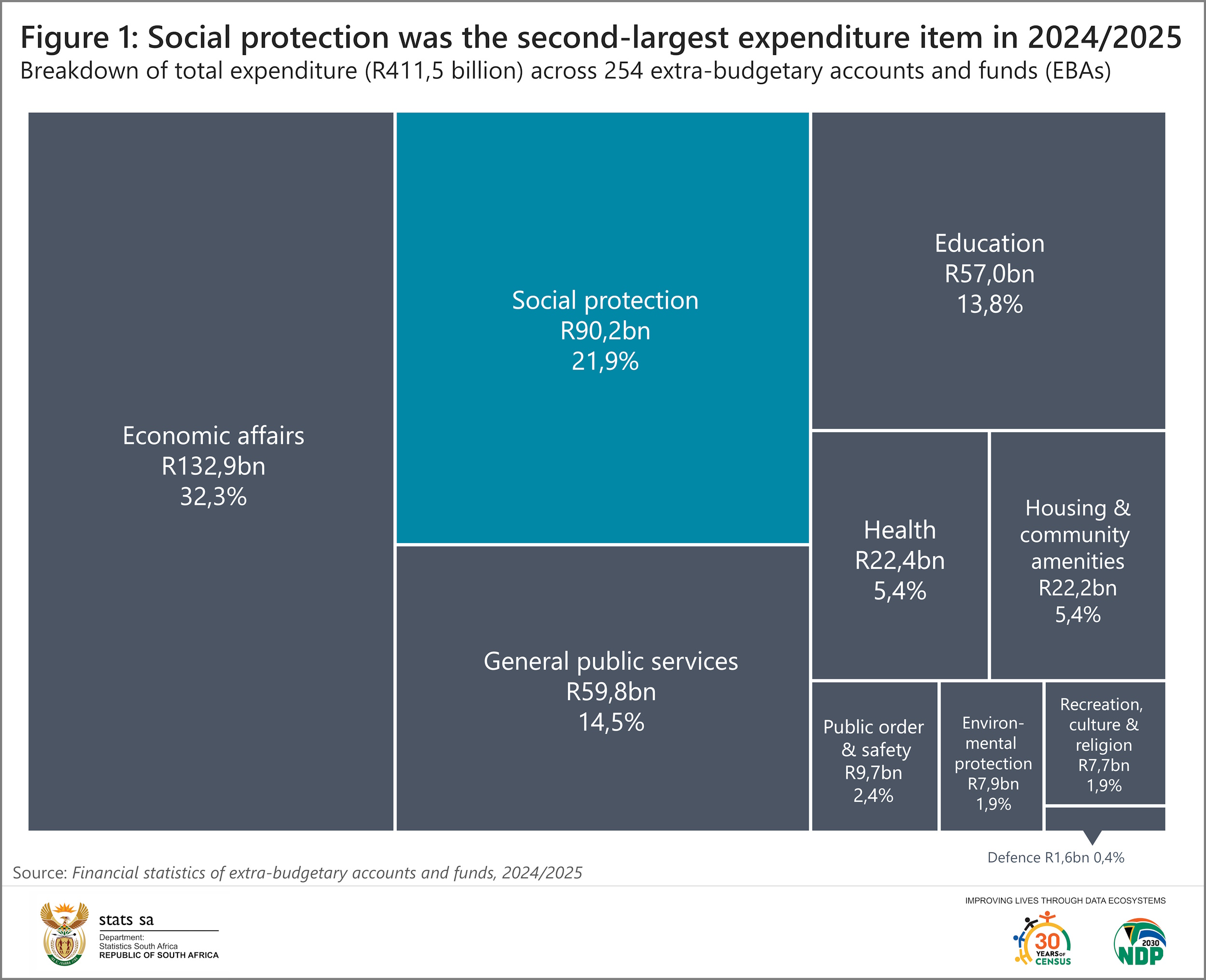
Twelve EBAs occupy the social protection block in Figure 1, with the Road Accident Fund (RAF), the Unemployment Insurance Fund (UIF), the Compensation Fund (CF) and the South African Social Security Agency (SASSA) being the largest spenders.
Exploring the rise in social protection expenditure
Total EBA spending on social protection rose by R4,8 billion in 2024/2025 compared with 2023/2024. The rise was driven mainly by the UIF, the CF and the Government Pensions Administration Agency (GPAA). The RAF registered the largest decrease (see Figure 2 below).
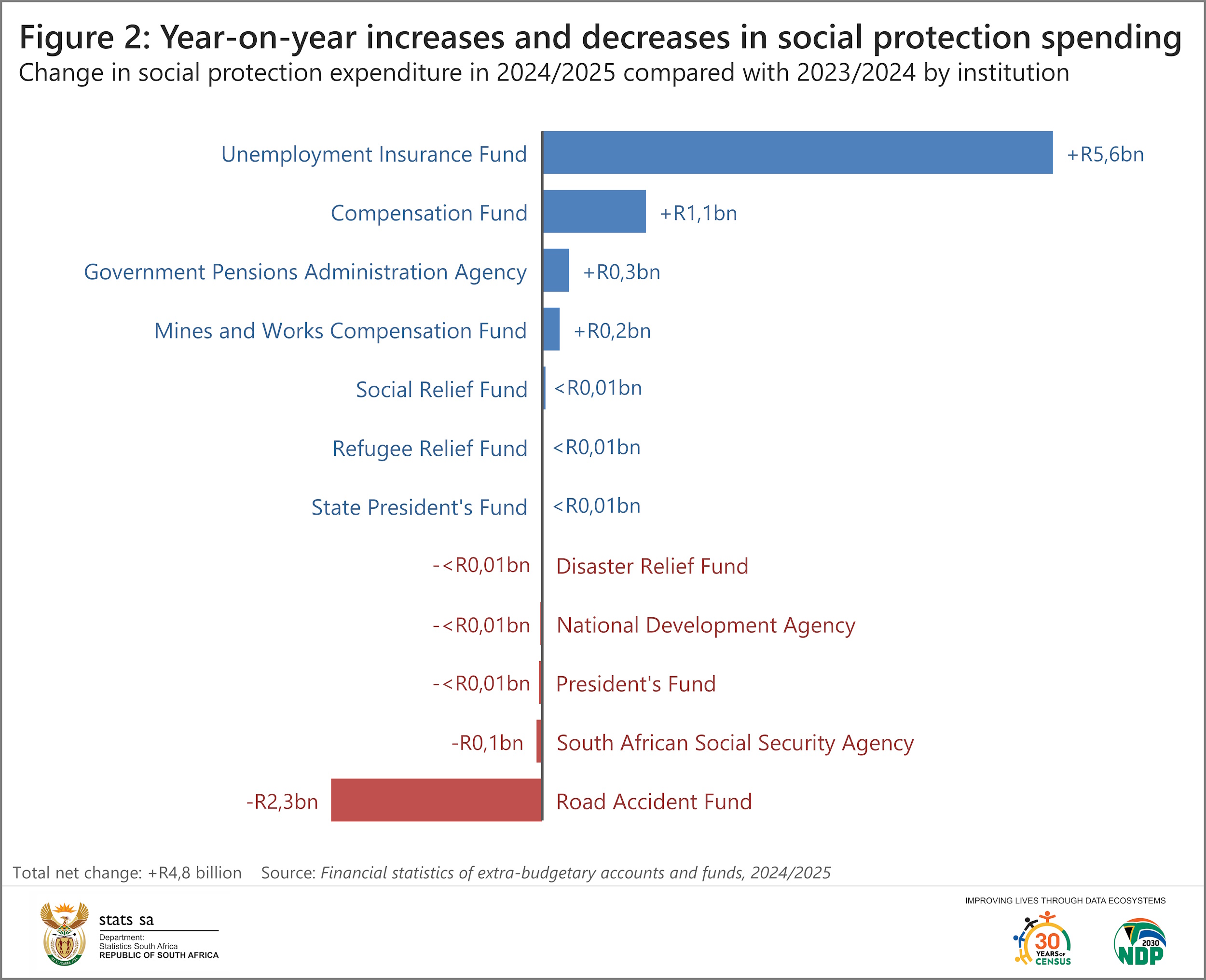
The UIF drove much of the upward momentum, rising by R5,6 billion (+28,9%). The increase was largely attributable to higher cash unemployment-benefit payments.2
The CF was the second-largest positive contributor. The R1,1 billion (+15,1%) rise was driven by an increase in claims paid to injured workers and their dependents, and the processing of a backlog of older claims.3
The RAF recorded the largest decrease, declining by R2,3 billion (-4,7%). This was primarily due to lower claims payments.4 This was in line with National Treasury’s 2024 expectation that the total value of claims paid out would decrease.5
Government pensions in the spotlight
The GPAA was the third-largest positive contributor to the overall rise in EBA social protection expenditure, expanding by R295 million (+24,2%). The GPAA is the administrator of government employee pensions on behalf of the Government Employees Pension Fund (GEPF). The agency also administers non-contributory civil benefits on behalf of the National Treasury and the Department of Military Veterans.
The GPAA’s expenditure is primarily recovered through administrative fees received from the GEPF. The Financial statistics of extra-budgetary accounts and funds dataset allows us to explore how this source of revenue has shifted over time.
Revenue from administrative fees jumped by 27,1% in 2024/2025 compared with 2023/2024, from R1,2 billion to R1,6 billion. This is a notable rise compared with growth of 11,4% in 2023/2024 and 13,7% in 2022/2023 (see Figure 3 below).
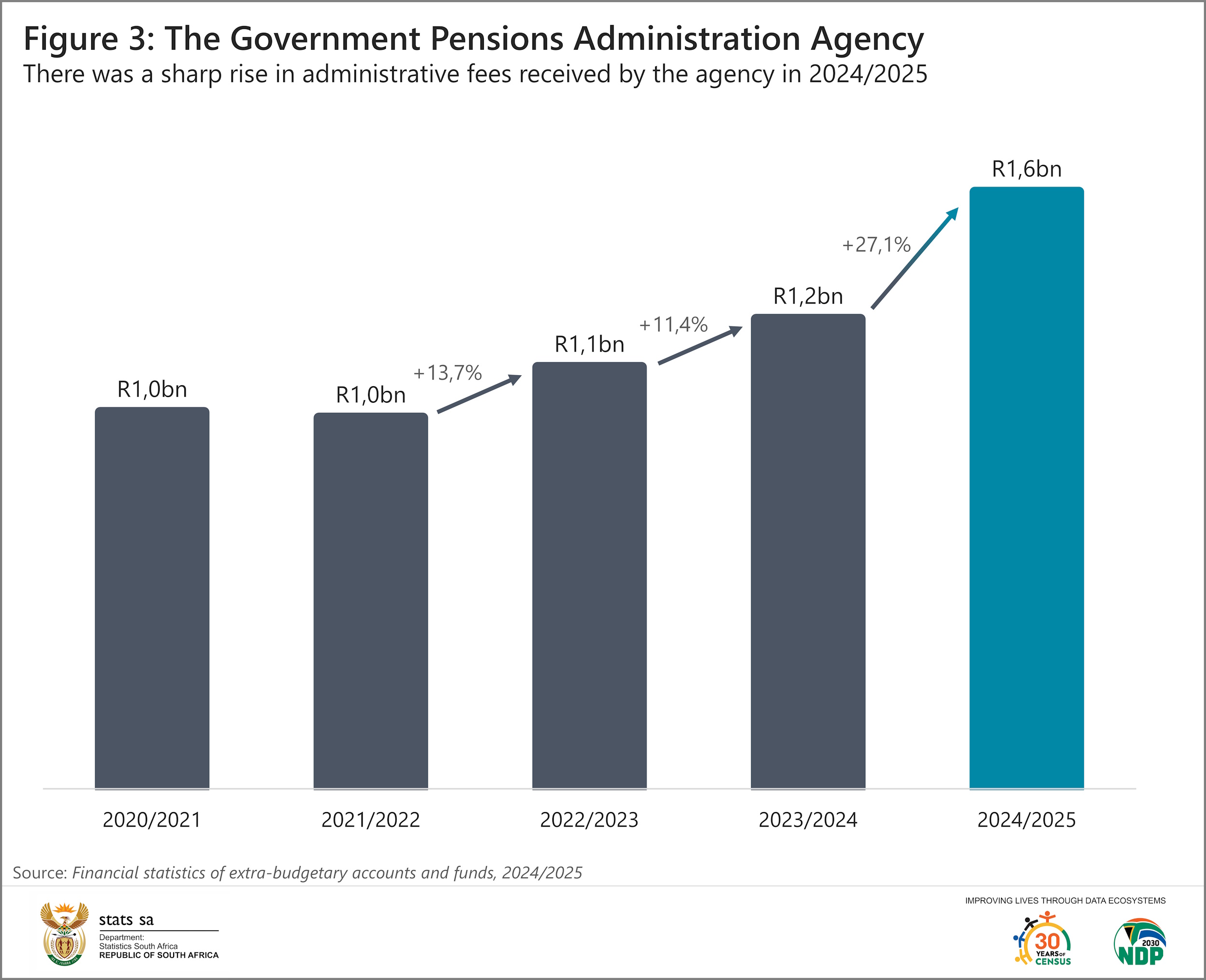
Because the GPAA operates on a cost-recovery basis, increases in spending generally result in higher administrative fee revenue. The R295 million rise in 2024/2025 was driven by an increase in operating cash payments and purchases of non-financial assets. Higher wages and salaries were the largest operating contributor, while capital expenditure was driven higher mainly by purchases of computer equipment, software and other machinery and equipment.
The effect of the two-pot retirement system
The sharp increase in 2024/2025 is also consistent with the introduction of the two-pot retirement system. Parliament amended the Pension Funds Amendment Act No. 31 of 2024, bringing the two-pot retirement system into effect in September 2024. The system allows pension fund members to access a portion of their retirement savings through a savings component without resigning or retiring. This was designed to improve preservation while providing limited pre-retirement access.6
Although the system was implemented halfway through the fiscal year, the GPAA processed 564 547 claims between September 2024 and March 2025, valued at approximately R15 billion. In its annual report, the GPAA states that the introduction of the system resulted in additional operational pressure, including staff training, increased call-centre activity, and a rise in walk-in-centre traffic.7
Exploring data from SARS
Personal income tax data mirror the rise in GPAA administrative fees and expenditures. SARS collected R733,2 billion in net personal income tax during 2024/2025, which represents a 12,6% increase compared with the previous year. SARS notes that this increase occurred despite a relatively weak economic environment, and that two-pot withdrawals provided an important boost to PAYE collections.
Finalised tax directives recorded year-on-year net growth of R15,3 billion, or 36,9%, compared with R4,2 billion, or 11,1%, in 2023/24.8 This was mainly driven by an increase of R12,6 billion in two-pot withdrawals from the finance, community, and mining & quarrying sectors.9
More withdrawals meant more tax directives, more verifications and more processing, all of which feed into the GPAA’s administrative fee income.
For more information, download the Financial statistics of extra-budgetary accounts and funds 2024/2025 statistical release and associated Excel files here.
1 The EBA statistical release is one of several annual government financial statistical releases published by Stats SA. Recent releases include financial data for national government and local government. Data for provincial government and higher education institutions will be published later in the year. A consolidated release, which incorporates data from all these releases, will be available in November.
2 Unemployment Insurance Fund. 2025. Annual report 2024/2025 (download here).
3 Compensation Fund. 2025. Annual report 2024/2025 (download here).
4 Road Accident Fund. 2025. Annual report 2024/2025 (download here).
5 National Treasury. 2024. Estimates of National Expenditure, pp. 977 (download here).
6 National Treasury. 2023. Publication of draft legislation for the “Two Pot” retirement system for public comment (read here).
7 Government Pensions Administration Agency. 2025. Annual report 2024/2025 (download here).
8 South African Revenue Service. 2024. Annual report 2023/24, pp. 60 (download here).
9 South African Revenue Service. 2025. Annual report 2024/25, pp. 30 (download here).
Similar articles are available on the Stats SA website and can be accessed here.
For a monthly overview of economic indicators and infographics, catch the latest edition of the Stats Biz newsletter here.